Tropicalities
pp. 19-21 · Read in the full issue

Gold Stars
Over Cooks
A green ensign with 15 gold stars in a circle on the fly is to be the new Cook Islands flag. Selected from 120 entries in a government-organised competition, it was chosen at a meet ing convened by Premier Albert Henry and attended by all members of the cabinet, the flag design com mittee and the competition judging panel.
The green background represents the “nation, the vitality of the land and the people and the evergreen and lasting growth of the Cook Islands.” The gold represents the “friendliness of Cook Islanders and their hope, faith, dedication, love and happiness.” The stars are “symbols of heaven, faith in God and the power that has guided Cook Islanders throughout their history.”
The circle symbolises “unity and strength of purpose and the mould ing of 15 islands into one united people.”
Australians are expected to be able to see the flag flown officially in Australia at the opening of the
Sydney Opera House next month when the Cook Islands National Arts Theatre Company will be per forming.
This time there’s no one to stop the Cooks designing their own flag— as there was just after the turn of the century when the New Zealand Governor rejected a flag designed nine years previously.
In 1892 a Federal Flag Bill was tabled in the Cook Islands Parliament but not assented to. The idea behind the bill was to have the flag—three horizontal strips of equal width (red, white and red), the Union Jack “quartered in the hoist and occupying a quarter of the flag” and a white oval shield in the centre of the Union flag containing a black coconut palm—flown at sea by ships owned by the Cook Islands.
The Union flag was to have still been flown in public places in the Cooks. However, after annexation by New Zealand in 1901—when the Union flag was replaced by the New Zealand flag—the governor rejected the “Federation flag for marine use.”
Another flag of three horizontal stripes—scarlet, white and scarlet, said to represent Te Au O Tonga.
Puaikura and Takitumu, the three main land divisions of Rarotonga—is still to be seen in the Cook Island Library and Museum in Avarua, Rarotonga.
Finding a
In*l flyer
Jim Hazelton, veteran ferry pilot of more than 30 trans-Pacific light aircraft crossings was lost—at 9,000 feet. The radio compass in his Piper was malfunctioning, heavy cloud lay below him, possibly concealing the peaks of the New Hebrides, and light was failing fast.
On the Tarawa-Vila leg of his San Francisco-Sydney journey, Hazel ton radioed Vila to tell of his pre dicament. With little more than the strength of Hazelton’s radio signal to guide them, Captain McKern and Chief Engineer Warren Stewart took off from Vila in an Air Melanesiae Norman Islander. Noting the moon’s position in relation to each aircraft and describing cloud formations, the two pilots worked steadily toward each other. At last, 70 miles out to sea from Vila they spotted each other—and Jim Hazelton was able to follow the Norman Islander home for an after-dark but safe landing.
... ami iamvellinsj
another
English pilot Douglas Pearson holds a unique distinction in the history of the French nuclear testing pro gramme at Mururoa atoll. He was the first foreign pilot to visit the eventual testing grounds in the late 19505, flying French military personnel and supplies to the atoll.
In 1966, the year France began testing, French President Charles de Gaulle visited Tahiti and Pearson flew the escort plane for De Gaulle’s trip to Mururoa. The genial, bearded Englishman who recently retired after 15 years of flying in French Poly nesia, came to Tahiti in 1958 solely because his World War II and post war flying experience filled an urgent need in French Polynesia for a “flying boat” pilot.
He became chief pilot (1962) for the local RAI (Reseau Aerien Inter insulaire) airline, which today is Air Polynesie.
Even after the flying boats were retired in 1970, Pearson continued flying for RAI and Air Polynesie. By the time he made his last flight for
Retiring pilot Doug Pear son with his farewell present, the joystick from a Bermuda flying boat.
Air Polynesie last September, he had logged 9,000 flying hours in French Polynesia.
From the time that he began his 30-year career with the Royal Air Force during the war to that last flight in French Polynesia, Pearson had logged 19,600 hours of flying time—l3,ooo hours in flying boats.
Now, aged 51, he has been forced to give up flying. He was unable to get his pilot’s licence renewed earlier this year because of health reasons, and has returned home to Whitley Bay in Northumberland.
Before he left Tahiti, Governor Pierre Angeli pinned a medal on him for his services in the territory and his friends gave him the steering mechanism from a Bermuda flying boat.
Ecumenism!
WliaCs that?
Is it to be peace or prerogative on Kusiae Island, the only major popu lation area in Micronesia where liquor is not available?
A religious leader (Congrega tional), Paul Sigrah, told the Joint Committee on Future Status that “for more than 100 years there has been but one religion in Kusiae. Please help us to keep other religions out.”
The Reverend Harrison George said: “. . . Why allow other churches when Kusiae has been peaceful for more than 100 years under one church? The introduction of any other new religion will bring con flict.”
It seems that already there has been some conflict in recent times on Kusiae with the coming (and in one case, rapid going) of Jehovah’s Witnesses and Seventh-day Advent ists. The conversion of one member of a prominent family on Kusiae to Kingdom Hall beliefs has split the family into two factions. And the Seventh-day Adventists have been told that a medical and dental clinic they wanted to set up was not re quired.
But it’s not all going the Con gregationalist way. Ekpap Silk, chair man of the Future Status committee, pointing out that legally “freedom of religion is protected under both Micronesian and US law,” said: “We are in no position to violate this fundamental human right.”
Congressman Ekpap’s remarks were not what the Congregationalists wanted to hear. And with the arrival on the same ship as the committee members of another Seventh-day Adventist it seemed that unless both
sides remembered that “God is love,” the century-long peace on Kusiae could soon be well and truly shattered.
Plumage is
for the birds
The pomp and circumstance of colonial government is fading with the colonies. The latest Governor of the GEIC, Mr John Smith (ex-BSIP Financial Secretary), reflected this when he arrived at Bonriki airport on July 23 to take up a three-year ap pointment. For the swearing-in ceremony the plumed helmet was re placed by a red-banded service cap, but the white uniform remained.
Referring to the absence of the plumage when replying to an address of welcome in the Legislative Council chamber, Mr Smith said: “Some of you may have noticed that I am not boasting the plumage under which a governor customarily puts into port.
Happily there is little demand for such splendour these days and those once responsible for its manufacture have passed with empire”.
Mr Smith said there was something both unreal and out of time in being appointed a colonial governor in 1973.
“The unreality will, of course, quickly be dispelled as you help me to understand the very real problems which beset small peoples living on remote islands with few resources in a century in which there are so many examples of what can be done to ease man’s lot if technology can be com bined with affluence,” he said.
“As for being out of time, I want to assure you that, whatever may be the current image of colonies and governors, I personally have no in tention of becoming an anachronism.”
Mr Smith, who had paid a pre vious visit to the GEIC, soon set about getting to know the colony and the people.
One of his first functions was to go to Eita village with Mrs Smith, where they were presented with gar lands and coconut milk to drink in a ceremonial ritual which, according to tradition, brings the protection of the god, Auriaria, and luck and blessing to the governor and his family. Auriaria, a powerful god of the Tungaru people (Gilbertese), “resides” in Eita at a place known as Tabuarerae, where the present Auriaria Kokoi School stands. Travel lers stop to drink from his well as a courtesy to receive his blessing and protection.
It's over io
i lie Miiiervans
It looks as if the only way, short of doing battle, in which the Miner vans of the Republic of Minerva can recover their country from the Tongans is by an appeal to the UN’s Committee on Colonialism. The King of Tonga and Minerva King Taufa’ahau Tupou IV, has rebuffed any approach from them with a statement on the ownership of the few square yards forming the republic.
In his speech from the Throne at the opening of the Legislative As sembly His Majesty rescued to <he “satisfactory state of affairs regarding the annexation of the two Minerva reefs as part of Tongan territory.”
The reefs, he said, should have been part of Tongan territory years ago as they were part of the Tu’i Lau’s estate, the first Tu’i Lau being Henele Ma’afu, who “acquired” dominion in that part of Fiji.
Because the reefs were submerged, Ma’afu couldn’t include them when he ceded the Lau Group to Britain, and the British Government wasn’t in a position to return them to independent Fiji.
“Now that Tonga has built an island on each of these reefs, it is possible to return these parts of the dominions of the Tu’i Lau, Henele Ma’afu, to Tonga, his country of origin,” said the king.
Maybe it was an association of ideas engendered by the veiled threat by “President” Morris C. Davis to invade Tonga if the republic wasn’t handed back to the Minervans, which prompted the king to mention, in the next royal breath, that the new patrol boat had commenced opera tions and that a bigger boat was in
prospect so that the kingdom “will be assured of sufficient protection from foreign fishing vessels that poach in our territorial waters.” No doubt other types of poaching were in the royal mind.
Ilriclging a
gap in Truk
The Truk District of Micronesia has progressed a long way since the United States took it over as part of its Trust Territory after the Pacific War. To such an extent that it now has that indispensible in gredient of western-style living—a generation gap.
A Federal grant to the tune of $25,187, plus a local contribution of SUSS,396, has now been allocated to try to bridge it.
According to a government hand out the programme will “involve el derly citizens and the youth in learn ing the various aspects of the local culture such as history of Truk and its people, proper language among families and clans, language between men, women and among elders, and the proper language between local leaders and government officials.
“The programme is also geared to revive the teaching of local trades such as boat and canoe building, navigation, weaving thatch roofs, making handicraft, ropes, short lines and fishing traps.”
The news release doesn’t say any thing about Trukese in the middle age groups. Presumably, as in other societies, they are just going on do ing the work and paying the taxes.
Ponape district had a similar gener ation-gap project last year which has been pronounced a success.
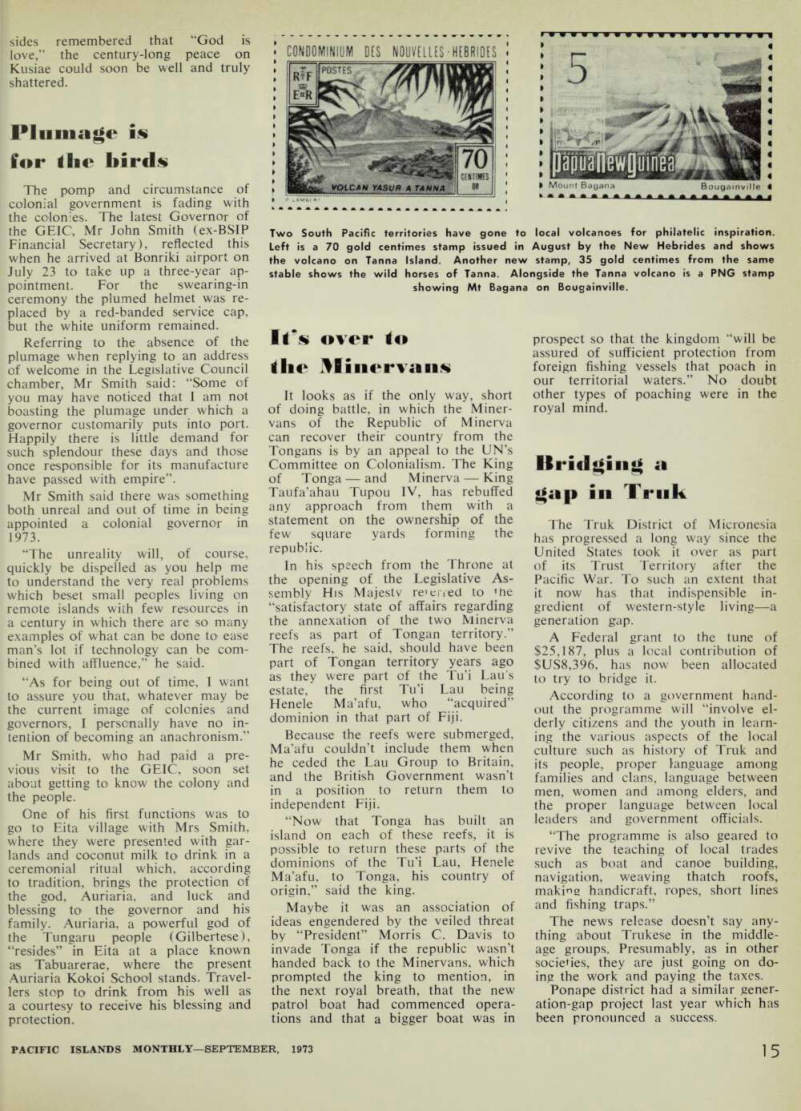
Two South Pacific territories have gone to local volcanoes for philatelic inspiration.
Left is a 70 gold centimes stamp issued in August by the New Hebrides and shows the volcano on Tanna Island. Another new stamp, 35 gold centimes from the same stable shows the wild horses of Tanna. Alongside the Tanna volcano is a PNG stamp showing Mt Bagana on Bougainville.