New Guineans Plan Dramatic
pp. 16-17 · Read in the full issue
Changes In Land Ownership
From a Port Moresby correspondent
In Port Moresby in August a Commission of Inquiry into PNG Land Matters issued an interim report "to draw attention now to the urgent need for new policies on alienated land".
The commission will complete its main report in September, but its interim recommendations are far-reaching. It proposes among other things that all rural freehold should be converted to government leasehold; that undeveloped rural freehold and leasehold land should be taken from present holders and
redistributed to people in need; that all new leases should be for a maximum of 60 years for citizens and 40 years for non-citizens; that in areas where the return of undeveloped alienated land is not sufficient to relieve local land shortages, developed land nearby should be acquired, with compensation to landholders limited to unexhausted improvements only.
Following is the introduction to the interim report, in which the commissioners explain why they made these proposals:
The interim report is concerned with the 1.4 million hectares that have been alienated from the custo mary rightholders by government purchase, compulsory acquisition, confiscation, and “waste and vacant” or “ownerless” declaration. It is not concerned with customary land that has been the subject of land tenure conversion orders; nor is it concerned with forestry leases. The introduction to the report says: Approximately 160,000 hectares of the alienated land has passed in free hold, and approximately 340,000 hectares in leasehold to private in terests—mostly missions, individual planters and plantation companies.
The remaining 0.9 million hectares are still held by the Administration, most of it undeveloped.
In all districts we have visited we have received a great many requests that alienated land be restored to the descendants of the clans who origin ally held rights in them. The reasons given are: (a) Clans are short of land for subsistence or commercial agri culture; (b) The “waste and vacant” or “ownerless” declarations were im proper; (c) The clan leaders were tricked into selling the land for small amounts of trade goods or money at a value far below the economic value of the land; (d) In many cases the land has never been developed.
We did not accept these claims automatically, since the demand for return of land is clearly a popular outcry at the moment, which many are taking the opportunity of joining.
Nevertheless, we believe that real and sometimes long-standing grievances exist.
As a general problem the question of shortage of land due to alienation should not be exaggerated. Alienated lands comprise only 2.8 per cent of the total land area of Papua New Guinea, and some of it is used by government and missions for roads, schools, hospitals and other public facilities. But in some districts land alienation has been particularly serious.
In the Gazelle Peninsula, one of the most heavily populated areas of the country, 43 per cent of the land north of a line from the mouth of Warongoi River to the Warongoi Re settlement Area and then round the northern boundary of UAL 82 to the western boundary of Vunapaladig on Ataliklikun Bay has been alienated.
On the Duke of York Islands approxi mately 2,642 hectares out of 6,452 have been alienated.
In these examples the land includes much more good arable land than the unalienated does; and although some clans in such areas are not short of land, others have lost nearly all their land, and now hold only limited land rights from neighbouring islands. For example, on Enuk Island off Kavieng, all 800 hectares of the Enuk villagers’ traditional land has been alienated with only 18 hectares set aside as reserves.
In all districts we have visited, Papua New Guineans have expressed a keen interest in commercial agri culture, and in some areas, though not generally, they have been frustrated by land shortage. Whether alienation really has caused land shortage de pends upon many factors. We could not examine every case, but we are satisfied from several cases we did examine that in a number of places people are short of land even for sub sistence purposes.
The rapid increase in population is worsening the situation. Many wit nesses who are not land-short now are afraid their communities will be land short in 10 or 20 years time. We believe these fears are often justified.
With regard to “waste and vacant” or “ownerless” declarations, the original investigations were often very limited. In some cases there were villages on the land. In other cases it was hunting and gathering land or contained “pies masalai”. Areas such as the Bulolo and Ycdda Valleys were fought over and, although none of the fighting clans were able to keep permanent settlements on the land, all of them make overlapping claims
to it. We consider that it was im proper of the colonial powers to have taken these lands without compen sating someone for the loss of rights there.
The question of early purchases for trade goods or small payment is more complicated. In some cases consider able amounts of trade goods were paid, which may have had as much real value as the three cents an acre paid in the 1930’s or one dollar an acre paid in the 1950’5. Owing to inflation and the rising price of land all of these payments now seem small and we do not consider this a suf ficient reason by itself for making additional payments now or returning the land. 5 Nor is an error in boundary mark ing, or the fact that one section of the traditional rightholders missed out on the payment, a sufficient reason for upsetting the title, paying huge compensation or engaging in expen sive legal actions.
The real need is for a simple mach inery to find where land selling has really made people short of land and assist them.
Particularly where it has not been developed, alienated land is causing considerable ill-feeling. Although complaints are in many cases exaggerated they are also in many cases very real. There are poor villages on the edge of prosperous towns that have grown up on the villagers’ traditional land; there are densely populated islands of sub sistence villagers amid vast planta tions holding very few people; stock or bulldozers suddenly appear on villagers’ hunting and gathering land which had been purchased up to 60 years ago but never before developed.
Past attempts by officials such as Governor Hahl or Judge Phillips to create reserves for land-short people have been completely overtaken by the population explosion and the in terest in commercial agriculture.
Furthermore, laws like the New Guinea Land Titles Restoration
Ordinance have prevented the people from recovering more land.
We feel that law and administra tion must be made more flexible so that complaints can be promptly dealt with and, where necessary, land re stored to land-short people. This is our first main aim.
We believe that the return of some land is urgently needed in order to create the conditions for good rela tions between races, between sections of the Papua New Guinea people and between the people and their govern ment. Frustration from the lack of response to repeated requests by local people for the return of land has in some areas produced an ugly situ ation of tension and distrust and led to direct action in the form of squat ting movements on land claimed, occasional harrassment of plantation management and quarrelling between groups of local claimants.
Furthermore, in the absence of a clear-cut policy, expatriates are un certain of their future. In this situ ation, with its potential for violence, continued delay would be irrespon sible.
Most complainants hold the colonial powers responsible for the situation but some criticise the Papua New Guinea Government for slow ness in finding a remedy and greater concern for overseas investors than for land-short Papua New Guineans.
We do not believe that it is neces-
sary to recover all alienated land from expatriate hands. But we do believe that Papua New Guinean land needs must be promptly met, and an end put to the system that has allowed a small number of expat riates to acquire title to large areas of the best land and leave much of it undeveloped.
We have recommended policies to achieve this and provide for a system which will permit people of any race to take land rights while preserving good relations between them and the local people. This is our second main purpose.
We also believe, however, that policy towards alienated land must do more than remedy grievances caused by European colonisation. The needs of the new nation and problems about relations between sections and classes of Papua New Guinean people are already much more important than the problem of tidying up relations with Europeans. For this reason we believe government should not lose sight of the value of the alienated lands as a national asset.
Alienated lands can be used to in crease production and national in come. Some districts are short of land and need to find room for their growing population. We need to
permit mobility among our enterpris
ing people who can find outlets for their creative energies on alienated lands if these are made available to them. Inter-clan mixing and a sense of belonging to the wider national community can be fostered if people from various districts are also able to take up rights in empty areas of alienated land.
For these reasons we believe that the concept of using land must there fore be stressed—that the holders of title to alienated land must make good use of it or give way to those with greater need and ability to use it.
These reasons of public interest modify a simple policy of returning alienated land to the descendants of traditional rightholders.
We also wish to limit in Papua New Guinea the western concept of land as a marketable commodity to be bought and sold or speculated like manufactured goods. In and near urban areas of Australia the practice of speculating in land has greatly inflated the value of land and enabled people to profit not from productive industry, but by trading on public need for land.
We prefer to maintain the tra ditional concept of land as a com munity heritage, available for use by those of the community (by which we mean the wider national com munity) who need it. It should not be taken into absolute possession by individuals. Rents charged for the use of alienated land should also go to the government, on behalf of the community, not to private individuals.
In summary the four main aims which underlie our recommendations on alienated lands are: • To return land to land-short Papua New Guineans. • To provide a system of land holding which will promote good race relations. • To treat land as a national re source and emphasise the need to use it properly. • To discourage speculation in land.
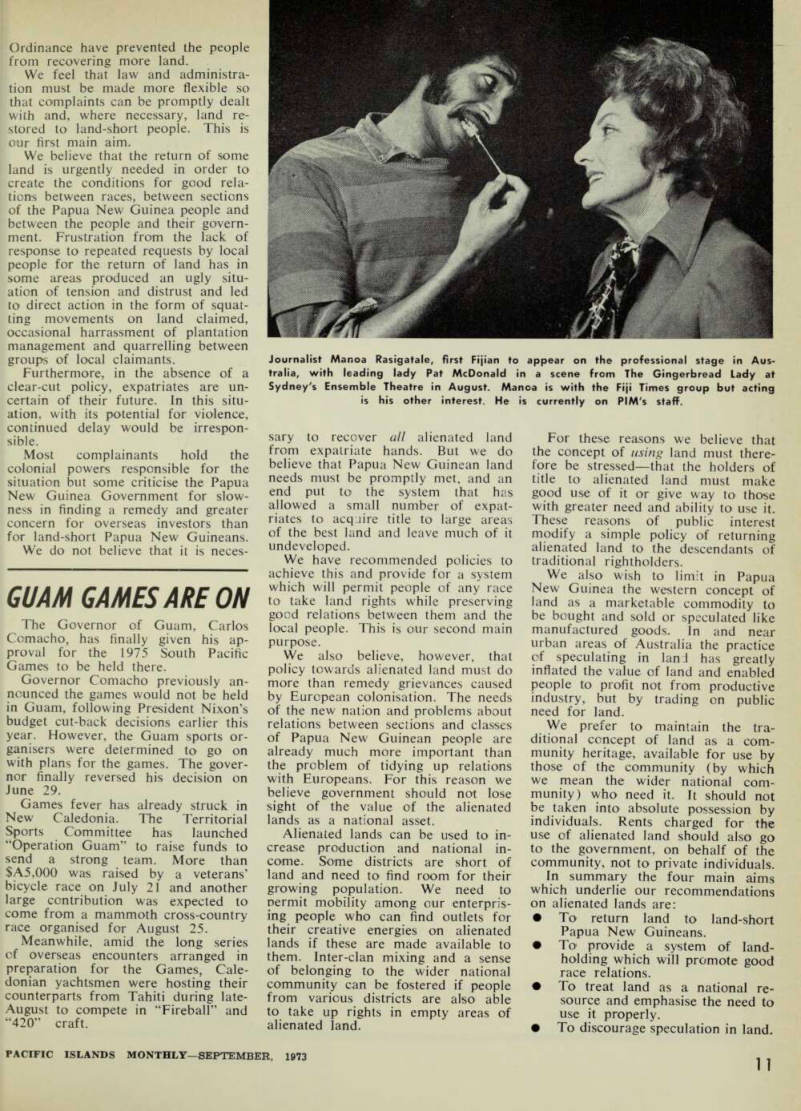
Journalist Manoa Rasigatale, first Fijian to appear on the professional stage in Aus tralia, with leading lady Pat McDonald in a scene from The Gingerbread Lady at Sydney's Ensemble Theatre in August. Manoa is with the Fiji Times group but acting is his other interest. He is currently on PIM'S staff.