Flexible Idealists In The Solomons
pp. 14-15 · Read in the full issue
From a Honiara correspondent
The Solomons has an important new political party, formed out of many of the successful candidates elected to the new Governing Council.
It’s the United Solomon Islands Party (distinct from the now apparently de funct Solomons United National Party), and it could bring to power next year under the new constitution a young, idealistic group.
The basic aims of the new party have survived the first meeting of the Governing Council in July, and it looks like being a flexible party which is seeking a way to govern virtually by consensus, yet working within the framework of a cabinet system.
That’s the theory, anyway.
The big question now, following the latest council meeting, is the name of the dominant leader who will emerge from the enlarged legislature of 24 elected members. This is the man who next year is likely to be Chief Minister in the new Solomons.
There is a real choice. He may not even come from the USIP.
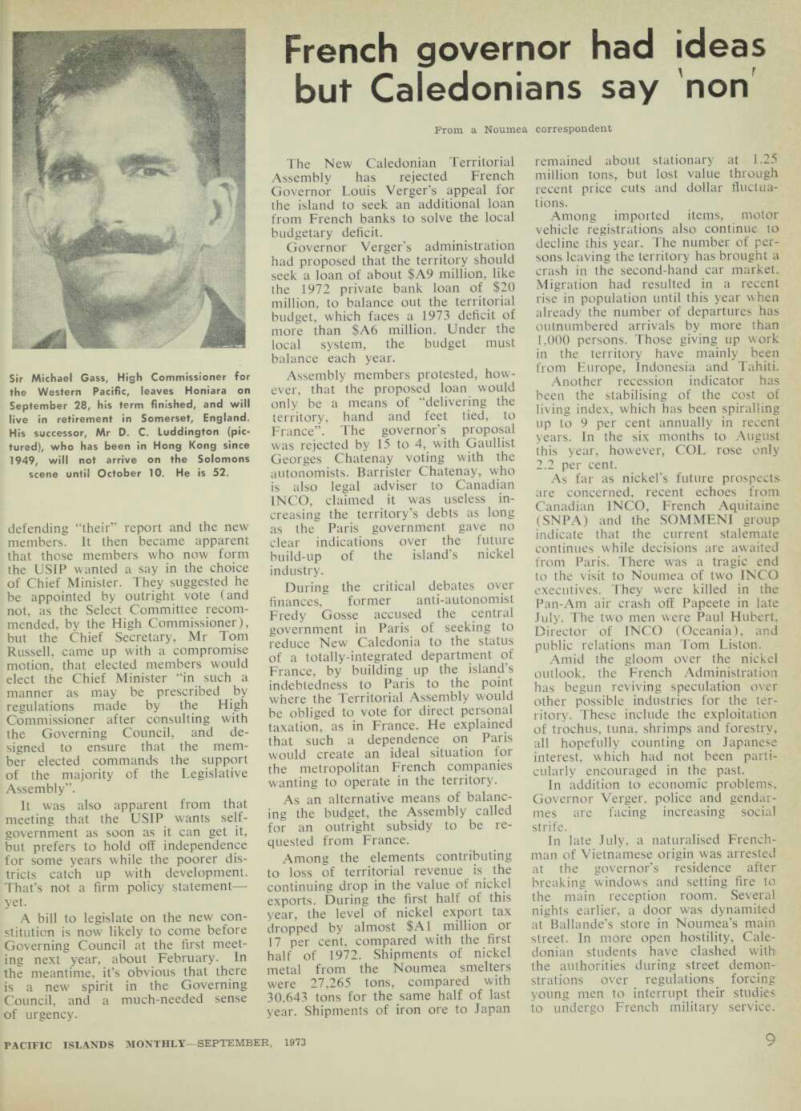
Chairman of the new party is a “late joiner”, deep thinker and eloquent speaker Benedict Kinika, 35, member for East Makira, formerly warden and a lecturer at the Honiara Technical Institute. Deputy leader is Dr Gideon Zoleveke, 51, a Fiji graduate medical officer who was nearing retirement age in his job as the senior Public Health Education officer when he was elected. He represents Choiseul Island and is a controversial choice.
USIP secretary is the youngest member of the legislature, former Government Information Officer, Ashley Wickham,. 25, member for Honiara, which is the largest electo
rate and the only truly urban one in the BSIP.
Party membership includes five Malaita members—Philip Solodia, former labour inspector for the government; former Marching Rule leader Jonathan Fifi’i, from Kwaio, who is the oldest member; Emilio Li’i Ouou, from Small Malaita, who opted out of the Catholic priesthood like Solodia; Jerial Ausuta, of Northwest Malaita, who left the police force as a senior inspector; and Father Leslie Fugui, from east Malaita, an Anglican priest and educationist.
Others are former Central District medical officer, Dr Francis Kikolo from East Ysabel and Savo; Andrew
Kukuti, from Vella la Vella and Shortlands, who is rather inadequately described as a carpenter; one of the only two Solomon Islander dental officers in the protectorate, George Ngumi of Gizo; the Fiji-Indian builder Moses Razak, from Gela; Waita Ben, second youngest member at 26 and former Forestry Depart ment officer, from East Guadalcanal; and Australian, Bill Page, of Roviana and Rendova, an almost mystical, gentle refugee from Western society.
Among those in the running for Chief Minister (nobody is openly seeking power) are Philip Solodia and Solomon Mamaloni, the 31-year-old firebrand of the last council, who is both humble and vain, penetrating and yet blind. But Mamaloni is a quick learner and an engaging per sonality, and popular for his vigorous tackling of local government issues.
Kinika’s election as leader by open vote at a caucus meeting of USIP on July 30 is seen as a compromise, but a good one. Solodia may have stepped aside to avert any resentment against his quick rise, but he’s not out of the running. Nor can one discount the chance of Chairman of Social Services, Willie Betu, from West Ysabel. Thus it’s possibly a four-horse race among Solodia, Mamaloni, Betu and Kinika.
Only two days before the party was formed, the council members had voted on the report of the Special Select Committee on Constitutional Development (which was in fact all the 17 elected and three ex-officio members of the last Governing Council).
In the long debate, the house often divided between the six old members
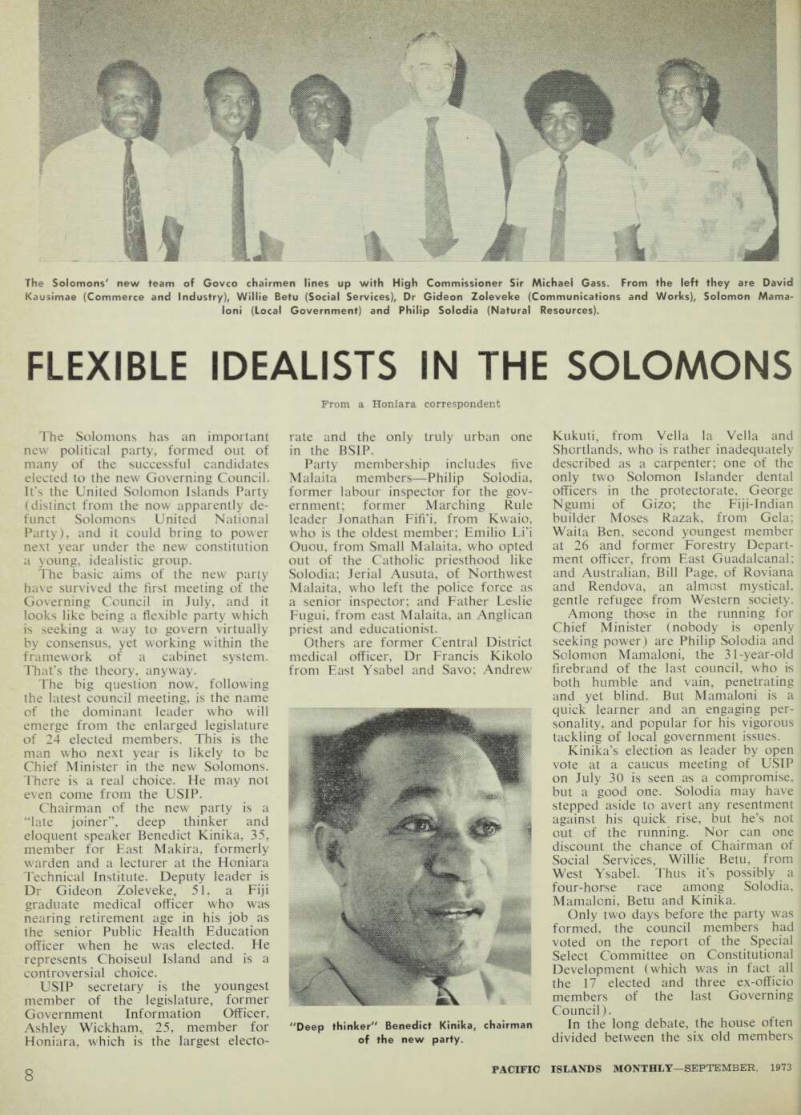
The Solomons' new team of Govco chairmen lines up with High Commissioner Sir Michael Gass. From the left they are David Kausimae (Commerce and Industry), Willie Betu (Social Services), Dr Gideon Zoleveke (Communications and Works), Solomon Mama loni (Local Government) and Philip Solodia (Natural Resources).
"Deep thinker" Benedict Kinika, chairman of the new party.
defending “their” report and the new members. It then became apparent that those members who now form the USIP wanted a say in the choice of Chief Minister. They suggested he be appointed by outright vote (and not, as the Select Committee recom mended, by the High Commissioner), but the Chief Secretary, Mr Tom Russell, came up with a compromise motion, that elected members would elect the Chief Minister “in such a manner as may be prescribed by regulations made by the High Commissioner after consulting with the Governing Council, and de signed to ensure that the mem ber elected commands the support of the majority of the Legislative Assembly”.
It was also apparent from that meeting that the USIP wants self government as soon as it can get it, but prefers to hold off independence for some years while the poorer dis tricts catch up with development.
That’s not a firm policy statement — yet.
A bill to legislate on the new con stitution is now likely to come before Governing Council at the first meet ing next year, about February. In the meantime, it’s obvious that there is a new spirit in the Governing Council, and a much-needed sense of urgency.
Sir Michael Gass, High Commissioner for the Western Pacific, leaves Honiara on September 28, his term finished, and will live in retirement in Somerset, England.
His successor, Mr D. C. Luddington (pic tured), who has been in Hong Kong since 1949, will not arrive on the Solomons scene until October 10. He is 52.