‘They’re Just trying
p. 10 · Read in the full issue
to dump us!'
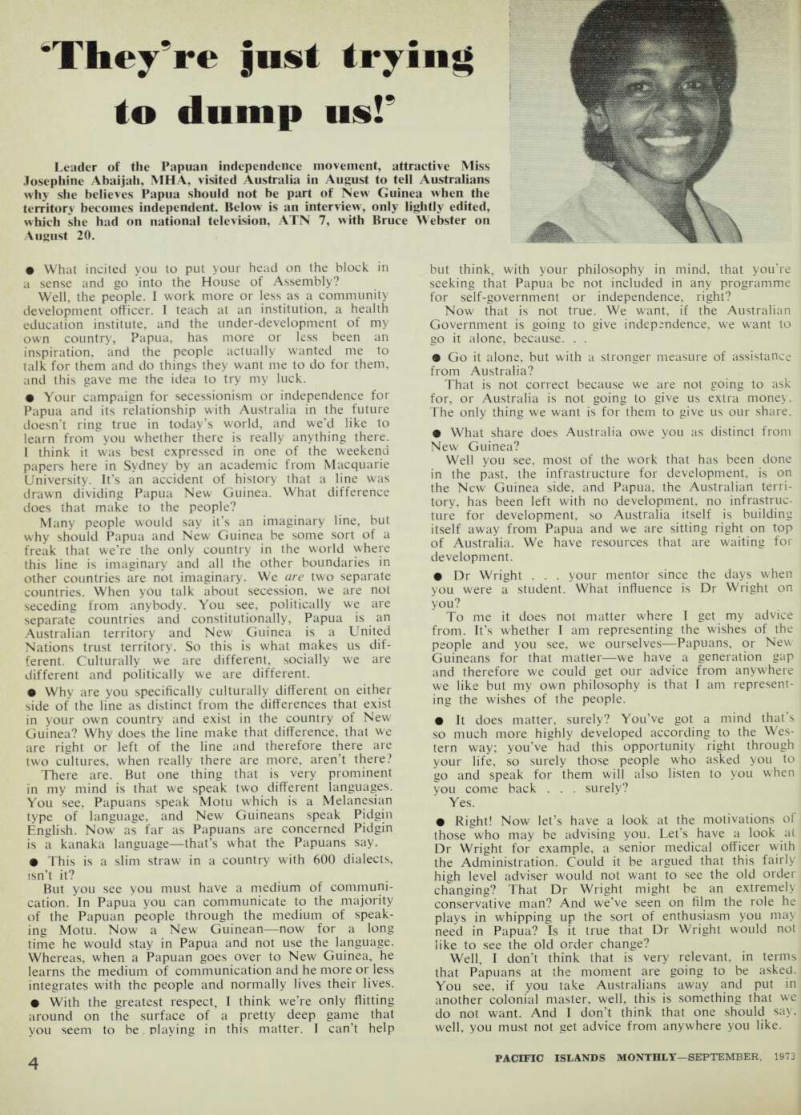
Leader of the Papuan independence movement, attractive Miss Josephine Abaijah, MHA, visited Australia in August to tell Australians why she believes Papua should not be part of New Guinea when the territory becomes independent. Below is an interview, only lightly edited, which she had on national television, ATN 7, with Bruce Webster on August 20.
• What incited you to put your head on the block in a sense and go into the House of Assembly?
Well, the people. I work more or less as a community development officer. I teach at an institution, a health education institute, and the under-development of my own country, Papua, has more or less been an inspiration, and the people actually wanted me to talk for them and do things they want me to do for them, and this gave me the idea to try my luck. • Your campaign for secessionism or independence for Papua and its relationship with Australia in the future doesn’t ring true in today’s world, and we’d like to learn from you whether there is really anything there.
I think it was best expressed in one of the weekend papers here in Sydney by an academic from Macquarie University. It’s an accident of history that a line was drawn dividing Papua New Guinea. What difference does that make to the people?
Many people would say it’s an imaginary line, but why should Papua and New Guinea be some sort of a freak that we’re the only country in the world where this line is imaginary and all the other boundaries in other countries are not imaginary. We are two separate countries. When you talk about secession, we are not seceding from anybody. You see, politically we are separate countries and constitutionally, Papua is an Australian territory and New Guinea is a United Nations trust territory. So this is what makes us dif ferent. Culturally we are different, socially we are different and politically we are different. • Why are you specifically culturally different on either side of the line as distinct from the differences that exist in your own country and exist in the country of New Guinea? Why does the line make that difference, that we are right or left of the line and therefore there are two cultures, when really there are more, aren’t there?
There are. But one thing that is very prominent in my mind is that we speak two different languages.
You see, Papuans speak Motu which is a Melanesian type of language, and New Guineans speak Pidgin English. Now as far as Papuans are concerned Pidgin is a kanaka language—that’s what the Papuans say. • This is a slim straw in a country with 600 dialects, isn’t it?
But you see you must have a medium of communi cation. In Papua you can communicate to the majority of the Papuan people through the medium of speak ing Motu. Now a New Guinean—now for a long time he would stay in Papua and not use the language.
Whereas, when a Papuan goes over to New Guinea, he learns the medium of communication and he more or less integrates with the people and normally lives their lives. • With the greatest respect, I think we’re only flitting around on the surface of a pretty deep game that you seem to be, playing in this matter. I can’t help
but think, with your philosophy in mind, that you’re seeking that Papua be not included in any programme for self-government or independence, right?
Now that is not true. We want, if the Australian Government is going to give independence, we want to go it alone, because. , . 9 Go it alone, but with a stronger measure of assistance from Australia?
That is not correct because we are not going to ask for, or Australia is not going to give us extra money.
The only thing we want is for them to give us our share. • What share does Australia owe you as distinct from New Guinea?
Well you see, most of the work that has been done in the past, the infrastructure for development, is on the New Guinea side, and Papua, the Australian terri tory, has been left with no development, no infrastruc ture for development, so Australia itself is building itself away from Papua and we are sitting right on top of Australia. We have resources that are waiting for development. • Dr Wright . . . your mentor since the days when you were a student. What influence is Dr Wright on you?
To me it does not matter where I get my advice from. It’s whether I am representing the wishes of the people and you see, we ourselves —Papuans, or New Guineans for that matter —we have a generation gap and therefore we could get our advice from anywhere we like but my own philosophy is that I am represent ing the wishes of the people. • It does matter, surely? You’ve got a mind that’s so much more highly developed according to the Wes tern way; you’ve had this opportunity right through your life, so surely those people who asked you to go and speak for them will also listen to you when you come back . . . surely?
Yes. • Right! Now let’s have a look at the motivations of those who may be advising you. Let’s have a look at Dr Wright for example, a senior medical officer with the Administration. Could it be argued that this fairly high level adviser would not want to see the old order changing? That Dr Wright might be an extremely conservative man? And we’ve seen on film the role he plays in whipping up the sort of enthusiasm you may need in Papua? Is it true that Dr Wright would not like to see the old order change?
Well, I don’t think that is very relevant, in terms that Papuans at the moment are going to be asked.
You see, if you take Australians away and put in another colonial master, well, this is something that we do not want. And I don’t think that one should say. well, you must not get advice from anywhere you like.