Pacific Shipping
pp. 91-94 · Read in the full issue
Island Ports Get Their First
Glimpse Of The Containers
The Union Steam Ship Co’s con tainer service to the Pacific Islands got under way, after some initial problems, when the Tarros-class Union South Pacific sailed from Auckland on June 20. The USS Co Auckland manager, Mr R. C.
Stevens, just before sailing, explained the mechanics of the new service to exporters.
The Tarros-class concept of con tainer service differs from other con tainer handling methods in one im portant aspect—the ability of the ship to work at any existing wharf structure which provides sufficient berthage to accommodate the vessel’s stern and ramp.
It would be most difficult for governments in the Islands to raise development capital to build sophisti cated unit-handling operations. Most Island ports have modern wharf structures, but they are unsuitable to take the high axle loadings involved with conventional unit-handling methods. To upgrade facilities would send port charges to an unacceptable level.
Mr Stevens said that while the USS 2o was not certain the Tarros-type ship was the answer, the cargo hand ing methods used could be readily adapted, possibly improved cargo carrying units could be used later in he light of experience.
During the trial period, which will ast about six months, Island shippers vill not be faced with any change n documentation procedures. The train concern is to get the service aunched and to solve operational iroblems as they arise.
In the trial period, the Union louth Pacific will carry 77 20 ft x \ ft x 8 ft ISO type containers, which /ill be lifted by a shipboard gantry, 'he gantry can only be worked /ithin the beam of the ship (not ver the side). Containers are carried shore by a prime mover and trailer perating over a ship-mounted stem amp.
The service requires three sets
of the containers—one distributed through the Islands, one in the ship, and one in Auckland. The first two voyages are container-positioning voyages.
The new system entails training schools so that port operators could familiarise themselves with the system. After the third voyage it is expected there would be full service to Suva, Pago Pago, Apia and Nukua lofa every 14 days.
Initially, the containers operate only from wharf to wharf. Till all operational problems have been solved, the only exceptions to that rule are outward freezer cargo and
inward copra. Three types of con tainers are used —the Coldwrap 787 GF for freezer cargo, box units 1100 CF, for general cargo, and open-side units, for produce, etc. No dangerous or hazardous cargo is carried in the containers.
The other USS Co services to the Pacific Islands will continue.
New Shipping
Company Formed
Some businessmen is the Pacific Islands have formed a new shipping company to operate services covering the Far East, several Pacific Islands and Australia. The company, United
Last Of The Teraka
The Teraka, used by the GEIC as a training ship for cadets, sank to the bottom of the Pacific on June 17, just 65 minutes after the valves were opened.
The ship was doomed after holes and extensive rust were found during a survey.
The Tautunu and two tugs pulled her out of the Betio Harbour to six and a half miles from Betio light. Just before she was finally abandoned, engine valves were unscrewed to let water into the engine-room. The only trace after she disappeared was a few pieces of wood.
The Teraka was delivered to the GEIC in April, 1967. Up to April, 1973, more than 750 cadets were trained in the Teraka and had been given work as seamen in overseas ships.
—Photos by courtesy of the GEIC Infor mation Department.
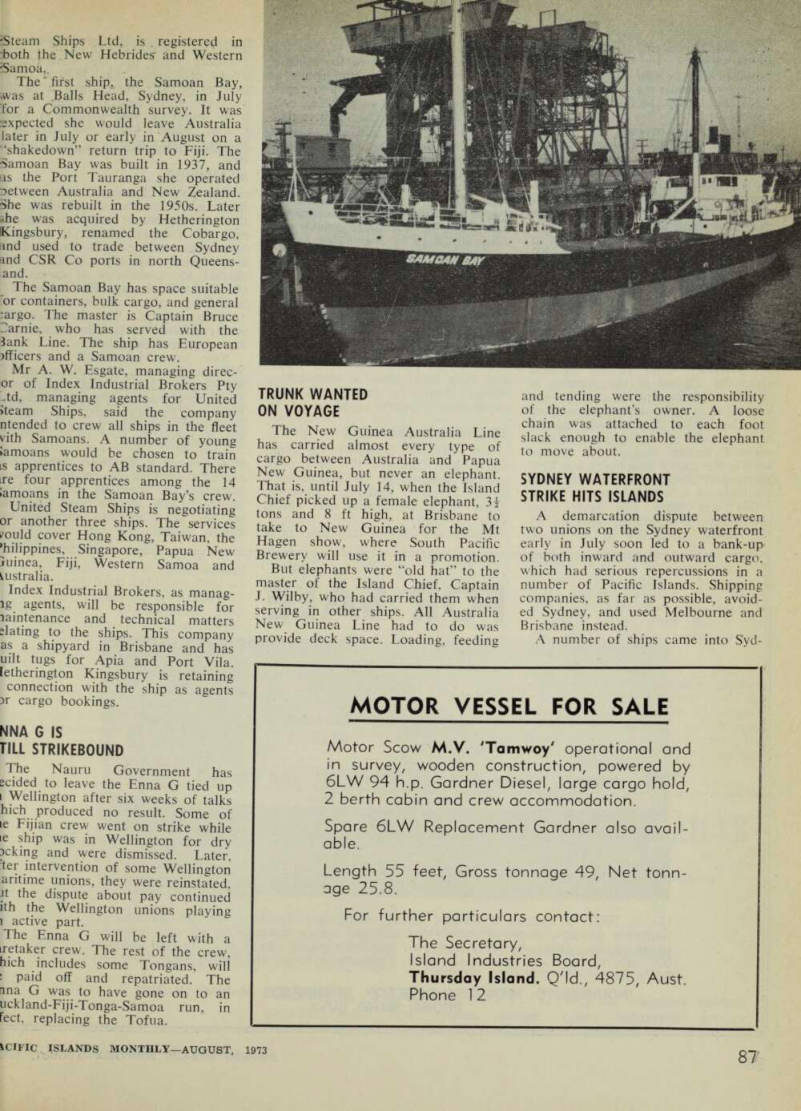
'Steam Ships Ltd, is . registered in :both the New Hebrides and Western Samoa,, The " first ship, the Samoan Bay, was at Balls Head, Sydney, in July :for a Commonwealth survey. It was expected she would leave Australia later in July or early in August on a ‘shakedown” return trip to Fiji. The Samoan Bay was built in 1937, and sas the Port Tauranga she operated between Australia and New Zealand.
She was rebuilt in the 19505. Later ;>he was acquired by Hetherington Kingsbury, renamed the Cobargo, and used to trade between Sydney and CSR Co ports in north Queens and.
The Samoan Bay has space suitable 'or containers, bulk cargo, and general :argo. The master is Captain Bruce Sarnie, who has served with the 3ank Line. The ship has European >fficers and a Samoan crew.
Mr A. W. Esgate, managing direc or of Index Industrial Brokers Pty Ad, managing agents for United >team Ships, said the company ntended to crew all ships in the fleet vith Samoans. A number of young ►amoans would be chosen to train is apprentices to AB standard. There ire four apprentices among the 14 ►amoans in the Samoan Bay’s crew.
United Steam Ships is negotiating or another three ships. The services /ould cover Hong Kong, Taiwan, the 'hilippines, Singapore, Papua New Juinea, Fiji, Western Samoa and Australia.
Index Industrial Brokers, as manag ig agents, will be responsible for laintenance and technical matters slating to the ships. This company as a shipyard in Brisbane and has uilt tugs for Apia and Port Vila, [etherington Kingsbury is retaining connection with the ship as agents )r cargo bookings.
Nna G Is
Till Strikebound
The Nauru Government has ecided to leave the Enna G tied up i Wellington after six weeks of talks hich produced no result. Some of le Fijian crew went on strike while ic ship was in Wellington for dry >ckmg and were dismissed. Later, ter intervention of some Wellington aritime unions, they were reinstated, it the dispute about pay continued ith the Wellington unions playing i active part.
The Enna G will be left with a iretaker crew. The rest of the crew, hich includes some Tongans, will s paid off and repatriated. The nna G was to have gone on to an uckland-Fiji-Tonga-Samoa run, in Feet, replacing the Tofua.
Trunk Wanted
On Voyage
The New Guinea Australia Line has carried almost every type of cargo between Australia and Papua New Guinea, but never an elephant.
That is, until July 14, when the Island Chief picked up a female elephant, 3i tons and 8 ft high, at Brisbane to take to New Guinea for the Mt Hagen show, where South Pacific Brewery will use it in a promotion.
But elephants were “old hat” to the master of the Island Chief, Captain J. Wilby, who had carried them when serving in other ships. All Australia New Guinea Line had to do was provide deck space. Loading, feeding
and tending were the responsibility of the elephant’s owner. A loose chain was attached to each foot slack enough to enable the elephant t 0 move a f out .
Sydney Waterfront
u.tc .c. amhc
Strike Hits Islands
A demarcation dispute between two unions on the Sydney waterfront early in July soon led to a bank-up of both inward and outward cargo. which had serious repercussions in a number of Pacific Islands. Shipping companies, as far as possible, avoid ed Sydney, and used Melbourne and Brisbane instead, A number of ships came into Syd
ney, and left again almost immedi ately when it was apparent they would neither be able to load nor un load. Some ships, the Tauloto among them, got away before the trouble erupted.
The dispute, between the Sydney branch of the NSW Transport Work ers’ Union and the Waterside Workers’ Federation, is over who should move containers from a ter minal to a nearby depot. It was ‘shakily’ settled when the unions agreed to share the work.
Within a few days of settlement of that dispute, there was another, be cause each union claimed the right to cut wire bands around ship’s cargo.
Royal Support
For Containers
King Taufa’ahau Tupou IV of Tonga has come down on the side of container ships. In his Address from the Throne at the opening of the 73rd Parliament he said he was convinced in spite of some opposition, containerisation had definite merits, and it should not be lightly dismissed without further thought. It seemed certain the use of containers was both faster and cheaper than conventional methods of handling cargo.
He said there had been some opposition to container cargoes by SE Asian countries at a recent
ECAFE shipping conference, and Fiji watersiders had criticised the scheme.
The marine-minded king spoke of the need for a slipway and a repair and ship-building yard. He con sidered there should be an investiga tion into the possibility of a joint marine venture with a large overseas company, possibly European, to con struct and operate a slipway, and to train shipwrights and technicians to take charge. In that way Tonga would be able to set up a slipway, and other services more quickly and efficiently than by continuing to rely on her own limited resources.
King Taufa’ahau said he was pleased Tonga had acquired a modern patrol boat, which operated in the southern part of the group. The country should now look at getting a second and bigger patrol boat to serve Vavau and the Niua Islands. These boats would patrol territorial waters and keep them clear of encroaching fishing ships. In emergencies they could carry essential supplies.
Tt Shipping Grumbles
The Majuro Chamber of Com merce has criticised the lack of a positive programme to improve the Trust Territory shipping situation.
There were complaints that tariffs were too high.
Under the present Transpac tariff
unspecified cargo coming to the Trust Territory from the US west coast would cost more than $l3B a ton, said to be $3O higher than a tariff available from Seatrain Lines. Sea train would be able to ship at $95 a ton, which would not include charges importers had to pay Trans pac.
Meanwhile . . .
Transpacific Lines, of Micronesia, has made a number of additions to the top executive staff to coincide with the company’s shift to a con tainer-type service with Pacific Far East Lines. The first PFEL ship carried 151 containers of cargo for the Trust Territory, which were off loaded into the Lotte Reith for the various districts. The Lotte Reith was converted to container handling in a Japanese shipyard.
New men appointed are: Mr William Penrose, general manager; Mr George Collins, traffic manager; Mr John Marumoto, finance manager; Mr F. F. Payment, accounting manager; and Mr Morgan Hind, personnel manager. e Captain R. S. (Bob) Allen, who retired last year as marine super intendent for Australia and the SW Pacific Islands for the Shell Co, has set up as a marine consultant in Corio, Victoria.