Book Reviews
pp. 81-83 · Read in the full issue

A Close Look At Bougainville,
New Guinea’S Awakening Giant
The people of Bougainville are lucky to have had the interest of such a man as Professor Oliver. Professor Douglas Oliver has been for 35 years studying the people of Bougainville and their problems, and has made this valuable study available to whoever is interested, particularly the Bougainville people themselves in his Bougainville published by Melbourne University Press in a glossy two-colour paperback of 231 pages with 41 plates, a good collection of maps and illustrations of artefacts.
It is refreshing to read a book about New Guinea where the author is continually aware that it is populated by people who have a different viewpoint from the Europeans and who makes his assessments from both points of view. And let us hope that some Bougainvillian takes up his challenge when he writes, “future appraisal should be written by Bougainvillians themselves”, that is, assessments of the future brought about by the discovery in 1964 “of an immense deposit of copper and the
establishment of the largest industrial enterprise in the Pacific, and in fact one of the largest mining adventures in the world, this sudden and massive intrusion of advanced industrialism into an archaic Melanesian peasantry.”
Professor Oliver covers many aspects of the island’s history, and I read with great interest his chapter called Discovery and Early History wondering why, with the treatment some of the Bougainvillians received from traders and more especially from blackbirders, they ever had any time for white people at all.
He traces the history of Bougain ville from its pre-history right to the present time, all of it making easy reading of material many Bougain villians will be glad has been re corded. Some may be surprised to learn that their ancestors were no less ferocious among themselves than the blackbirders among them.
It is interesting to read that H. B.
Guppy, the naval surgeon attached to a British expedition to the Solo mon Islands in 1882 made the pro-
phetic statement: “A sample of stream tin from the south-east part of Bougainville was given to me by the Shortland Chief. Copper will not im probably be found in association with the serpentine rocks of these islands”.
One of the best known German visitors to Bougainville last century was Richard Parkinson. He sums up the early history of Bougainville: “The recruiters concentrated their efforts on the filling of their ships.
From place to place they went, searching the coasts up and down with their boats, and whether or not, came into conflict with the natives who could make themselves under stood, and who knew from experience and hearsay the methods of recruiting labourers which they regarded as pure kidnapping.”
As Parkinson recorded: “Murders of white men were recorded every year, murders that were brought about by the victims’ own fault, or, as was unfortunately often the case, done to avenge the misdeeds of other recruiters. Every white person was regarded as an enemy, recruiter, trader, or missionary; the crime of another has ofien caused the death of a perfectly harmless and peaceful man.” It was not until 1902 that the Roman Catholic Society of Mary set up a station at Kieta and not until 1905 that the German Colonial Administration at Rabaul established a post at Kieta.
I was delighted to find in the chapter The Indigenes in Pre-Euro pean Times, mention that Professor Oliver is dealing with the complex language situation: “For a person’s language serves not only to express his thoughts, but acts in some very fundamental ways to help shape those thoughts. And when languages differ as much as those of Europe and Bougainville-Buka in both word meanings and grammar, it is quite certain that the thoughts of their respective native speakers will also differ in many profound ways.”
Professor Oliver realises that to
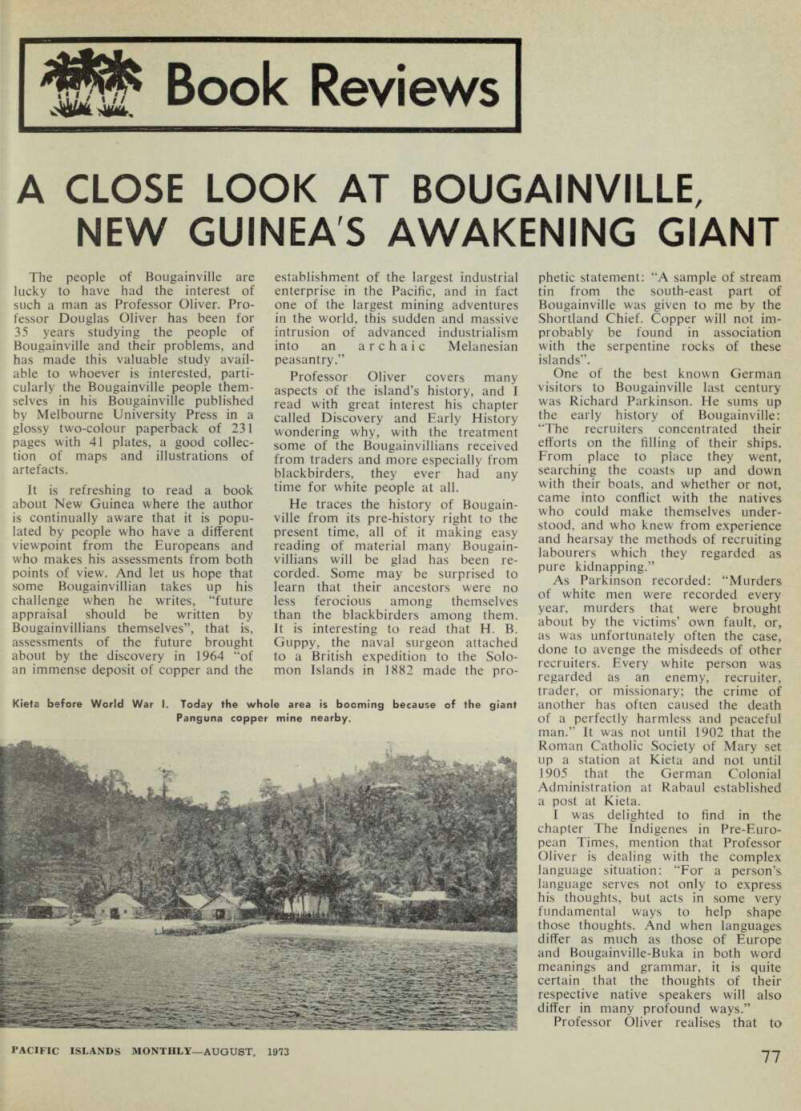
Kieta before World War I. Today the whole area is booming because of the giant Panguna copper mine nearby.
understand a man you must be able to speak to him. A revolutionary thought in the administering of New Guinea! In the same chapter the des criptions of the important functions of gardening and hunting are exact and detailed. Bougainvillians may find this chapter particularly interest ing. Professor Oliver’s description of life in those pre-European times gives a vivid impression of Bougainvillians as they were.
I have written enough to indicate that Professor Oliver covers all aspects of the affairs of Bougainville, and his book is one of great im portance, and should not be missed by anyone with the slightest interest
in Bougainville.
Peter Livingston.
(BOUGAINVILLE, a personal history.
By Douglas Oliver, Melbourne University Press. Recommended price $2.40).
Fascinating
readings in
history
“Readings in New Guinea History” sounds dull enough as a title, but the contents of this 454-page book aren’t.
There are nine chapters and 231 sub sections in this readable volume, dealing with such subjects as D’Albertis’ famed rocket attack on the natives of the interior, the dis covery of Port Moresby, the effects of blackbirding, the Port Breton fiasco, the influence of the mis sionaries, the development of the Papuan administration and its search for policy, German rule, military rule, the use of goldmining and plant ing, World War II and its aftermath, right up to self-determination.
The book is a varied selection of readings across the whole Papua New Guinea landscape, from every source, some no longer than a couple of paragraphs, others several pages.
The editors, Brian Jinks, Peter Biskup and Hank Nelson, (who also produced the earlier Short History of New Guinea) have welded it all together in chronological order, in clear departments, with concise commentaries introducing each ex
tract, and with a general index, a topic index and an index of authors to make the book more practical for the students for whom it is intended.
There is no separate bibliography, references being given with each extract in the body of the book, but unfortunately while the city of publication is given, the name of the publisher is not —which makes it tougher on those readers attempting to send to their bookseller for con temporary books.
The fact is that students—if in
fact the publishers mean university students—will not be the only people interested in this wide collection of New Guineana. It’s sufficiently varied, and selected from sources not so easily accessible, as to make it a volume that will be valued by any body wanting to keep in touch with the history and development of Papua New Guinea, and it certainly comes at the right time in New
Guinea’s political succession.-
SI.
(Readings In New Guinea History.
Edited by B. Jinks, P. Biskup, H. Nelson.
Angus & Robertson, Sydney. $6.95).