The Ass In Lion’S Skin
pp. 71-72 · Read in the full issue
Short Story
By Raymond C. Pillai
THERE was no point in trying to hide it. She was bound to find out sooner or later, because she had a special talent for catching him out whenever he was at fault. Besides, as he well knew from experience, she was less vicious if he made a clean breast of things. Any attempt at concealment, on the other hand, was regarded as an act of betrayal unworthy of an equal partnership between wife and husband, and she would flay him mercilessly. Accord ingly, having debated the pros and cons of the matter, he resolved to tell her as soon as he entered the house.
But even the firmest of resolves, formulated rationally and dispas sionately, have a way of reversing themselves when confronted with realities. Our hero’s instincts of self preservation were developed to a keen degree after years of domestic strife. This fact, coupled with the circumstance that his wife was in an unconscionably tractable frame of mind because of a new sari she had purchased that day, emboldened him to believe that it was safe not to mention the matter. As it happened, his prognostication proved wide of the mark.
It was evening. He had established himself in his favourite armchair, cup of tea at his elbow, feet propped up on the coffee table (despite his wife’s severest strictures on this practice), and record player exuding the sombre opening notes of a majestic raga. There could hardly be a better sequel to a satisfying dinner. But the pleasure of the moment was decisively extinguished when his wife strode into the room.
“How did it happen?” she demanded, holding up the evidence malignantly. In her right hand she brandished the stock of an umbrella; the curved handle dangled sheepishly from her left hand.
Damnation! How had she found out so soon? “The umbrella was stuck. It wouldn’t open, I pushed harder, and the handle just fell off.”
He knew he sounded unconvincing.
“How can it just fall off. Who knows, it was probably broken before you bought it,” she said.
“Oh, come now, don’t be ridicu lous. No one would be that dishonest.
The handle is not broken. It’s just a little loose. Here, let me show you.”
He took the handle from her and pushed it on to the shaft of the umbrella. “See, it’s all right again.
A little bit of araldite should fix it permanently. You musn’t take these small things too seriously. You can’t expect these cheap things to be very strong.” With that, he turned up the volume of the music and returned to his chair.
She promptly turned off the record player and returned to the fray.
“Will you stop listening to that sitar of Ravi Shankar’s and that raga Bhairavi or whatever it is.”
“Actually, it’s Ali Akbar Khan playing on the sarod. And it’s raga Malkauns, not Bhairavi. Raga Mal kauns has a pentatonic structure, with the 2nd and sth notes omitted, whereas Bhairavi . . .”
“Stop changing the subject. You paid $8.79 for that umbrella. It’s not even three days and the handle’s broken. Now you go right back to the store tomorrow and ask for a new one. You know what’s your trouble? You are a fool, Gopendra.
You have the face of a fool and that’s why everyone takes advantage of you. You’re completely hopeless.”
Gopendra did not try to argue with her. For one thing, it would be a tactical blunder. Besides, she was quite right about his face. His un remarkable physiognomy possessed no features of interest; it was a bland visage that plainly invited disaster.
Gopendra did not resent having a weak looking face, but he objected to the inference that he had a weak
mind as well. It was a total non sequitur which ignored the fact that he was an M.A., Dip. Ed., and prin cipal of a secondary school which produced a goodly number of examination passes every year. How ever, that was neither here nor there.
What really disturbed him was the thought of having to return to the store to complain about an umbrella with a loose-fitting handle.
Gopendra hated making a fuss about anything. It drew attention to oneself, and it embarrassed by standers (or amused them, which was worse). Any way one looked at it, it was unedifying. For a sensitive person like Gopendra, it bordered on calamity. Already his head was throbbing with the beginnings of a migraine attack, and he went to bed dejectedly, dreading the ordeal of the morrow.
THE next afternoon he sidled up to the menswear counter in his usual self-effacing fashion. He had still not settled upon the precise strategy to adopt; his main concern was to avoid making an egregious ass of himself. Fortunately he was spared the agony of a public disputation. A passenger liner was in port that day and the usual motley contingent of tourists had descended upon the shops like a plague of locusts. So intent were the sales assistants on fleecing the tourists that the local citizenry were ignored completely.
Gopendra did not mind the lack of service. On the contrary he was rather glad of it. Having waited a full minute without being served, he felt he could withdraw with a safe conscience. At least she wouldn’t be able to say now that he hadn’t tried.
His spirits lifted visibly. On a sudden impulse he reached for a complaint form which read, “I could not get —” and he wrote SERVICE in the blank space. He folded the form neatly, pushed it into the suggestion box, gave the box a mollifying pat
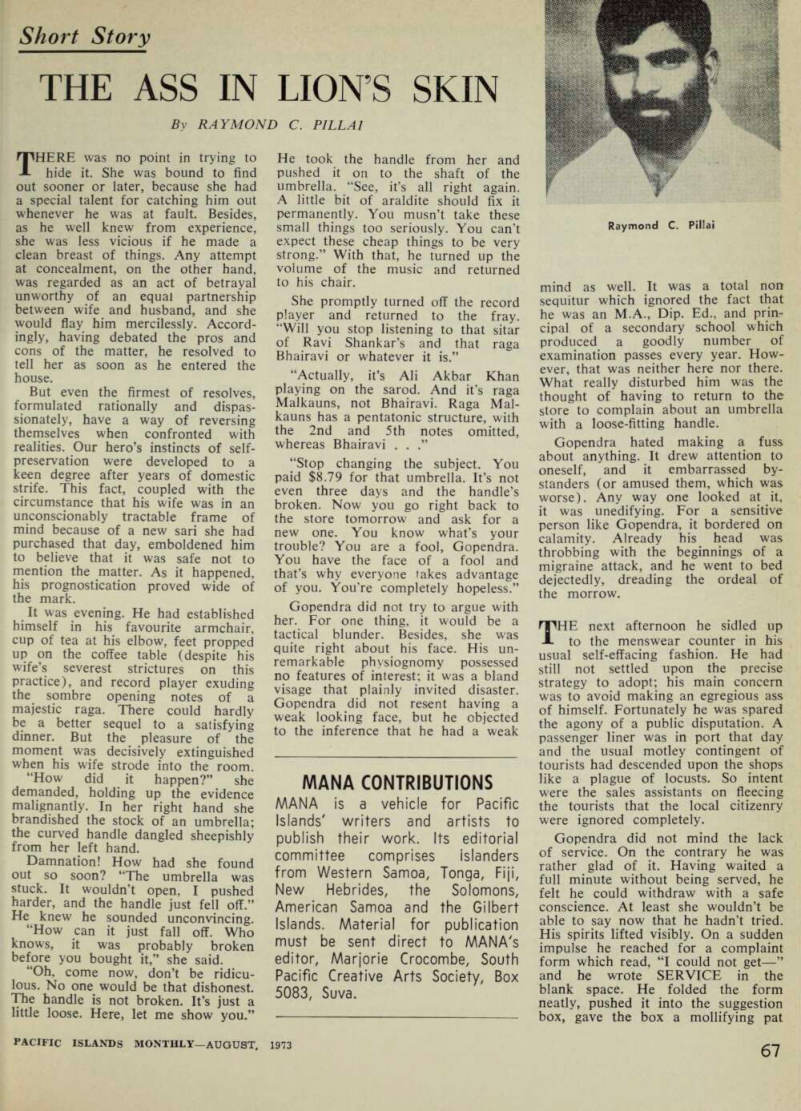
Raymond C. Pillai
The Ass in Lion’s Skin . . .
(Continued from previous page)
to indicate that he bore no personal ill-will, then fled in a rush of relief.
His wife was not particularly im pressed by his defence. “Gopendra, you’re an ass. If you just stand in front of a counter, you’ll end up standing all day. You have to demand to be served nowadays. You should have showed them the broken handle and complained loudly for all the tourists in the shop to hear. If you did that, they would have given you a new umbrella and pushed you out of the place within 10 seconds.”
“If I did that, I would have ended up in The Fiji Times’ with their usual corny headlines—Broken Brolly Brouhaha’ or something like that. I hate making a fuss.”
“You know,” said Gopendra’s wife, her eyes narrowing questioningly.
“I don’t think you really tried. You go back right now and tell them to give you a new one.”
“But they’ll be closed by the time I go back,” bleated Gopendra feebly.
“Well, then, you pick up the phone and complain to the manager right now,”
“Yes, daddy,” his children chorused gleefully. “Tell the manager off properly!”
THIS was appalling. But there was no escape. His whole family were waiting for him to make a move.
Waiting expectantly, almost mali ciously, because they all knew he was incapable of verbal violence.
Fate, however, had a surprise in store for them. It was a strange Gopendra they heard expostulating on the phone, a Gopendra who spoke with alien authority. “Look, Mr Haddock, I know there’s a ship in port but . . . What’s that? . . . Yes, I know it’s busy on such occasions, but that’s no reason for discriminat ing against locals. It’s about time you expatriates go off your high horses and . . . What? . . . No, I’m not a racist, I’m . . . No, I’m not being irrational either. I’m just asking for fair play, which isn’t too much to ask, surely . . .” And so it went. At the end of the conversation Gopendra announced that the merchandise manager would personally hand him a new umbrella. It was an incredible performance which left his family stupefied. How could such a timid man accomplish such marvels?. A
hubbub of disbelief broke about his ears.
Gopendra, savouring the attention he was now getting, explained that he was a peaceable man, but when roused he could be a veritable terror.
Perhaps it did not pay to be too easygoing. He had realised now the value of asserting himself and he was going to develop a more force ful personality, he declared. Mrs Gopendra was not sure she liked the implications of that last remark. But a new era had indisputably begun.
The next afternoon it was a trans mogrified Gopendra who swaggered home from school, jauntily twirling a new umbrella.
THE episode of the umbrella was a turning point in Gopendra’s life. He now ruled over his house in a manner befitting his position. His children gave him respect and his wife submitted to his will. Even at school a new regimen prevailed. The students no longer ignored school regulations. His staff now found him to be a tough administrator. Pre viously his teachers used to exploit him shamelessly, knowing him to be
a hen-pecked husband—jokes about
“petticoat government” and “panti socracy” used to be common in the
teachers’ common room. Now the jokes were about “benevolent auto cracy”. It was, to say the least, a startling transformation. And all at the cost of a humble umbrella. Or should I say two umbrellas?
The fact of the matter is that our hero’s new posture rested on a slight deception. For, you see, he had faked the telephone call to the merchandise manager and had purchased a new umbrella the next day, having thrown away the defective one into some neighbour’s garden. Returning home and finding himself lionised by his family, he was forced to live up to his new role, and he played the part so convincingly that he had fooled himself as well. But in view of the results, who is to say that he acted
unwisely?
Gopendra, it should be admitted, was troubled at first because he had compromised his integrity. But his conscience is troubled no more. Being the pedant that he is, he had con sulted his books to mitigate his actions and was granted an absolute discharge by Plato himself. Plato’s counsel was that a ruler may be permitted to lie for the good of the State. So, if a man might lie for the good of the State, might he not lie for the good of his soul?