Magazine Section
pp. 57-60 · Read in the full issue
Diminutive American Missionary Who
Pioneered New Guinea Highlands
From a Port Moresby correspondent
The opening of the rich and closely populated Highlands of New Guinea was the most important single development of the pre-World War II administration of New Guinea. The adventure began in 1933 with a joint government-private enterprise ex ploratory patrol into the interior by a party led by government officer J. L. Taylor and including gold pro spectors Mick and Dan Leahy.
And it was quickly followed up by a Catholic Mission party led by Father W. A. Ross, which was faced with the task of long-term consolida tion after the Highlanders had got over their surprise of seeing their first white man.
Taylor and the pioneer Leahy brothers still live in New Guinea.
And Father Ross has just died there (PIM, July), at the age of 77, a Highlands missionary to the last.
Fortunately Father Ross has left personal records of his experiences after 47 years as a New Guinea missionary, and in one account he tells of how he came to enter the Highlands, and the problems he had to overcome.
He recalled how, as a young mis sionary at Alexishafen, he received a message from his friend Mick Leahy, whom he had met on the Wau gold fields, and who was now establishing the gold prospecting camp at Mt Hagen.
“This is a fabulous country,” Mick wrote. “A vast population, a beauti ful climate, in fact this is the real New Guinea. Come in here by all means.”
Father Ross showed this letter to his superior, Bishop Francis Wolf, the first bishop of the Divine Word mission.
“Go to Salamaua, arrange a flight to Mt Hagen, and spend some time up there arranging for a future mis sion,” said the bishop.
Bishop Wolf had gone to New Guinea in 1923, and had been
anxious to enter the Highlands since 1930. The government had told him it was “inadvisable”.
When Father Ross got to Salamaua he learned that Mick Leahy and his party were returning to the coast for a rest, and it was not until February, 1934, that Father Ross, with Brother Eugene Frank and Father William Tropper left Begadjim, down the coast from Madang, for the 38-day trek to Mt Hagen.
They had with them 70 carriers and supplies to last for six months, besides essential building materials, nails,
locks, hinges, bolts, household sup plies and church goods, Crossing the Ramu River in two dugouts, one passenger at a time and a limited amount of cargo, took up an entire day, but they made it with out mishap.
Father Ross recalled: “From the bank of the Ramu, the road followed a dried river bed; there was hardly any shade and the heat was like a drawn sword; we were all badly sun burned, especially on the legs after wearing shorts. When we reached Bundi, the natives gave us a warm
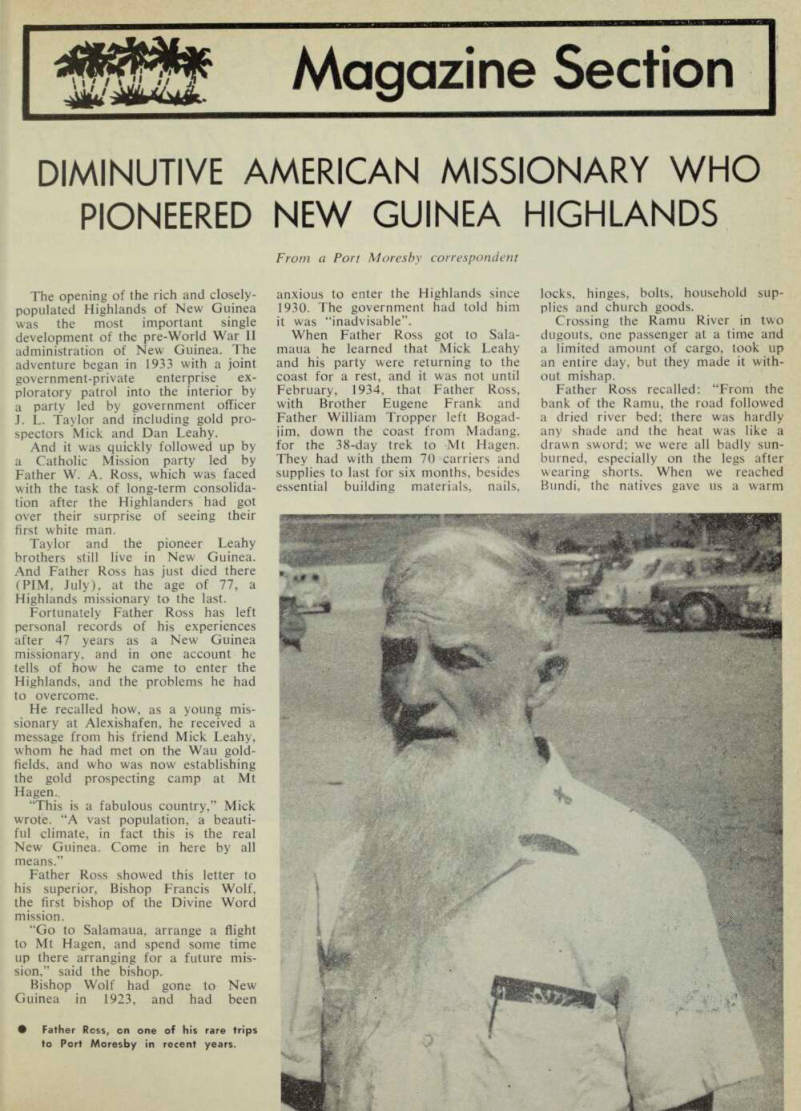
• Father Ross, on one of his rare trips to Port Moresby in recent years.
welcome, but as they carried us in triumph the sunburned legs became a real torture.”
At Bundi, Fathers Schaefer and Aufenanger joined the party to ac company it as far as Mt Hagen, as Father Schaefer had many contacts in the initial section of the trek, through the Chimbu area.
“At various hamlets along the route, we made inquiries as to who might be interested in having us work in their areas,” wrote Father Ross. “One volunteer would be ap pointed as our future representative.
We would return and talk with him again.
“Likely sites for mission stations were marked on our rough map.
Along the route we marked sites and native friends at Denglagu, head of the Chimbu gorge, at middle Chimbu, at Mirani near the present Kundiawa, at Mingende which would be our centre; at Kerowagi, Nondugl, Banz, Kelua, Wilya. . . .”
Mingende was in what is today the Chimbu District, near Kerowagi.
The missionaries arrived at Wilya, Mount Hagen, on March 28, 1934, and met Mick and Dan Leahy, who had completed a small airstrip, and were expecting the first plane to land at the new Mogei airstrip on Easter Sunday, April 1, 1934.
The plane touched down about 9 am on Easter Sunday. Bob Gurney, the pilot of Gqinea Airways, was amazed to have seven Europeans greet him in this unexplored centre of New Guinea, The plane brought food supplies, and mail for Mick and Dan. Early Monday morning, Gurney took off, and shortly after wards Father Ross and his party were heading back to Mingende to set up their Highlands’ mission station.
Mick Leahy wrote later: “They all seemed genuinely delighted at having received permission to found a mission in this remote place, to spend the rest of their lives at hard work without pay in the society of savages.”
The missionaries (and the miners) had no government protection; a government official was not in fact appointed to the Wahgi until 1938, and in the meantime the Europeans supplied their own law and order.
The diminutive (sft 2 in), Ameri can-born Father Ross carried a revolver and there were times later when he had to use it.
But meanwhile, the big, and sunny tempered Brother Eugene started the building of the Mingende station, and rapidly the buildings took shape.
Living house, kitchen, laundry, workers’ quarters, tool shed, and a small church. Literally thousands of
natives helped with the work; for payment they asked for a few cowrie shells a day.
The missionaries could buy a pig for a bush knife, or a small axe. The natives were still using stone. Other articles for trade included tambu shells and beads. For a green-snail shell a large pig could be bought.
By the end of May, the station buildings at Mingende were completed, and the missionaries had the confidence of the natives. Many of the headmen asked the missionaries to go with them to Mt Hagen to buy new wives, so the missionaries arranged for another visit to Mick Leahy.
Mick asked the missionaries to take over Wilya. Father Tropper agreed to return to Mingende and live there, while Father Ross and Brother Eugene would remain at Wilya, and open the first Catholic Mission station in the present Western Highlands. the official approval for the first foundation of the Catholic Mission in the Western Highlands was embodied in a letter from Bishop Wolf, dated June 15, 1934, autnorising Brother Eugene and Father Ross to reside at Mt Hagen, and be responsible for the establishment and development of the Catholic Mission in the Mt Hagen area.
Brother Eugene, with 15 coastal boys, and hundreds of local volunteers, now quickly built the main station at Wilya, where Mick and Dan Leahy had built their Mogei airstrip.
House, church, kitchen, workers’
quarters, fowl house, piggery, were completed, built of native materials, bamboo walls and kunai grass roofs.
Brother Eugene was a tireless worker. From June till September, 1934, besides the main station, nine out-stations were built. To the west, 12 miles; south 15 miles, east 24 miles, and north 20 miles.
Recalled Father Ross: “It would seem almost unbelievable, but one out-station at Anggil in the Ulga valley was completed in one day of 13 working hours; some 2,000 natives, men and women and children, like an ant colony, kept busy bringing in kunai grass, ropes from the bark of trees, wild sugar cane for walls, saplings. For each bundle brought in, a few small cowrie shells were con sidered adequate payment by the Ulga natives. From 6 am till 7 pm, residence and kitchen, house for workers, and workers’ kitchen and a number of latrines; in this one day 11 houses were completed and ready for use.”
At Wilya they planted gardens.
The soil was poor, light and volcanic and was crying for fertiliser. But the staple crop, sweet potatoes, flourished.
The Mt Hagen natives had a higher set of values than the Chimbu. They bought pigs for the mother-of-pearl shells and for bailer shells. A large bailer shell costing in those days about 25 cents would buy a 2001 b pig.
Meantime, they were busy dressing wounds, cuts and sores; giving aspirin for fever. They visited the hamlet areas to get acquainted with the natives and estimate the population.
Daily they bought the food brought
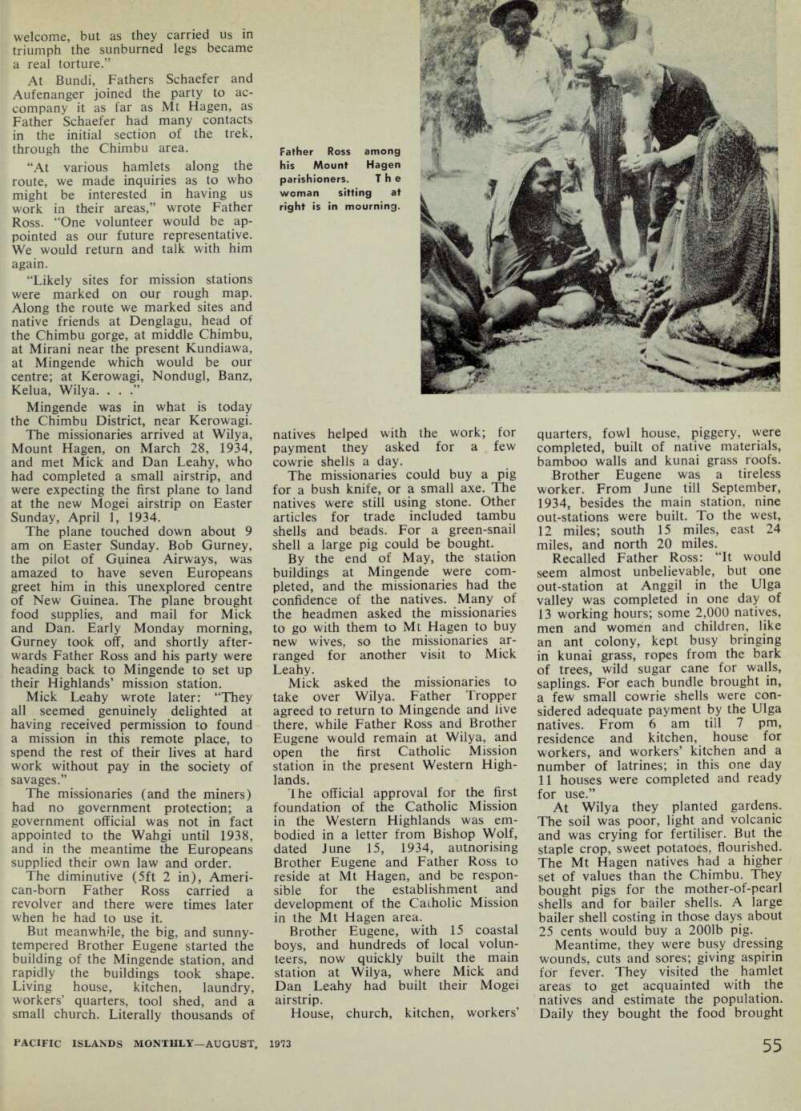
Father Ross among his Mount Hagen
parishioners. The
woman sitting at right is in mourning.
in by the natives, for everyone had more than enough for his own use.
They had a small church at Wilya where, every Sunday, mass was celebrated, but very few of the local natives attended services, not know ing what it was all about. Finally the turning point came.
Father Ross tells it: “In December, 1934, the local paramount chief of the Mogei Nampoga clan came to me and asked what might seem a very blunt question, but a question for which I had been waiting patiently all these months. Six months had passed since we took up residence at Wilya.
“Nindi, the chief, asked me: ‘What do you want from us; when is the pay-off? You have been here six months now, buying our food and pigs, paying us well; you have looked after our sick, attended to our sores, wounds and bruises, now we want to know when you are going to give us the bill, for in our way of life, nothing is given for nothing, and we presume you are the same.’
“I replied to Nindi, ‘That is the question I have been waiting for and here is my answer. We do not want your land, your women or your pigs.
We wish to open a boarding school where your boys from the ages of 10 to 16 will be taught to read and write. You have seen us looking at books, writing on paper. This art we shall teach your boys; they will live at our mission station and go to school each day,’
“Nindi then asked, ‘Will we have to find food for the boys?’ I told him we would take care of the food. ‘We can take 50 boys.’ Nindi said, T can send you 100 boys if you want them.’
“No,' I said, ‘for the beginning 50 is the limit. We shall open the school right after the New Year’.”
By January, 1935, the site for the boarding school and boys’ quarters had been cleared and Brother Eugene decided to go to Bundi for a few weeks for a rest.
Before he left with 10 coastal boys he said to Father Ross, “Please don’t build the school before I get back.
I really want to have that privilege, the first Catholic school in the Western Highlands.”
Brother Eugene did not come back.
Six days later, at Mingende, he learned that Father Carl Morsch heuser had been killed by the natives, and despite warnings by friendly natives not to go through the Chimbu river area, where the clans were at war, he started up the Chimbu gorge.
Soon after, fully-armed natives swarmed down on the party and Brother Eugene was struck eight
times by bone-tipped arrows and most of the carriers fled in panic.
The missionary was stripped and left for dead.
Remarkably, soon after, Brother Eugene, weak and exhausted, was helped to a small mountain hut by a friendly group of natives, where several days later he was found by District Officer Bob Melrose, of Salamaua, who had flown in to Kun diawa to investigate the killing of Father Morschheuser.
Father Morschheuser had died on December 16 from arrow wounds.
Brother Eugene died a week after he was flown to Salamaua.
“Only a man of his magnificent physique and strength could have survived so long,” Father Ross wrote.
Following these murders, the New Guinea Administration came under fire from Australian newspapers, which demanded to know why mis sionaries should be permitted to endanger their lives by entering areas where there was no government pro tection. As a result, the government announced strict restrictions—no more missionaries would be permitted
to enter the Highlands, and those already there would not be permitted to leave their main stations, Father Ross found the station re striction a help, because full time could be given to learning the native language and composing books for the new school, The first classes opened in March, 1935. The boys were taught reading and writing, Pidgin-English and English, arithmetic. There were 50 boys in two classes. The training of these boys continued through 1937 and 1938, for meanwhile, the re strictions on the missionaries were eased to allow missionaries to enter the Highlands after four years coastal experience, and equipped with four rifles to each party.
On Christmas Day, 1938, 28 schoolboys were baptised. This was the first group in the Western High lands to become members of the Catholic Mission—Father Ross had succeeded in bringing the Word, When he died in May he was still in the Highlands, where he had spent almost all of his 47 years in New Guinea, still bringing the Word.