inevitable
pp. 45-53 · Read in the full issue

Papua New Guinea on the eve of the inevitable
By Judy Tudor
Papua New Guinea at present seems not so much a country as something cooked up by novelist Nicholas Monsarrat. Overtones of The Tribe that Lost its Head still linger while affairs move swiftly into a Richer than all his Tribe situation.
Both novels—which were about an imaginary island off the west coast of Africa, one before and one after independence—have been widely read in PNG, at least by the non-indigenous population which, although it is now 4,000 down on the peak year of 1971, still numbers about 46,000 persons.
As usual in PNG, where rugged individualism has always prevailed, it is impossible to get a clear-cut blanket opinion from these 46,000 about anything, including novels, or the shifting sands of the present PNG situation. A few express enthusiasm; they are fascinated, they say, and can scarely wait to see how it will turn out, although they feel sure that it will be for the best in the best of free, democratic worlds.
These people are usually academics who, while long in advice and theory are very short on practical investment.
In due course they will go on to other academic jobs, in other countries and will not lose a cent in New Guinea.
There is another minority group which is extending its activities in the
belief—and this could well be right —that, after the whirlwind of self government and independence, will come a period of calm and op portunity in which large benefits will accrue.
But the great majority of non indigenous residents of Papua New Guinea are in various stages of con fusion, uncertainty and, occasionally, fear, of what is likely to happen after December 1, 1973, when Papua New
Guinea officially becomes self-govern ing.
For all practical purposes, PNG is self-governing now and the official date could—and probably should— be the non-event of the year, as it marks only a stage on the way to independence. But already the mere fixing of it has given it some mystique in the minds of New Guineans as the day when they will inherit the earth.
It is also the day when many present residents of the wrong colour intend to be absent. It was freely being said in Rabaul in June that not one Chinese woman or child would still be there on that date.
Since 1962 I have witnessed three handovers in Pacific territories from one form of government to another.
The first was in what was Dutch New Guinea, when the Dutch were given about six weeks to get out in favour of the Indonesians although there was a six months period when the United Nations were supposed to manage the transition and see fair play. The wishes of the indigenous Papuans were entirely ignored and have remained that way ever since.
The second hand-over occasion was in 1970 when Fiji became an indepen dent dominion. In retrospect it was a calm, painless transition with the minimum of disruption, the actual
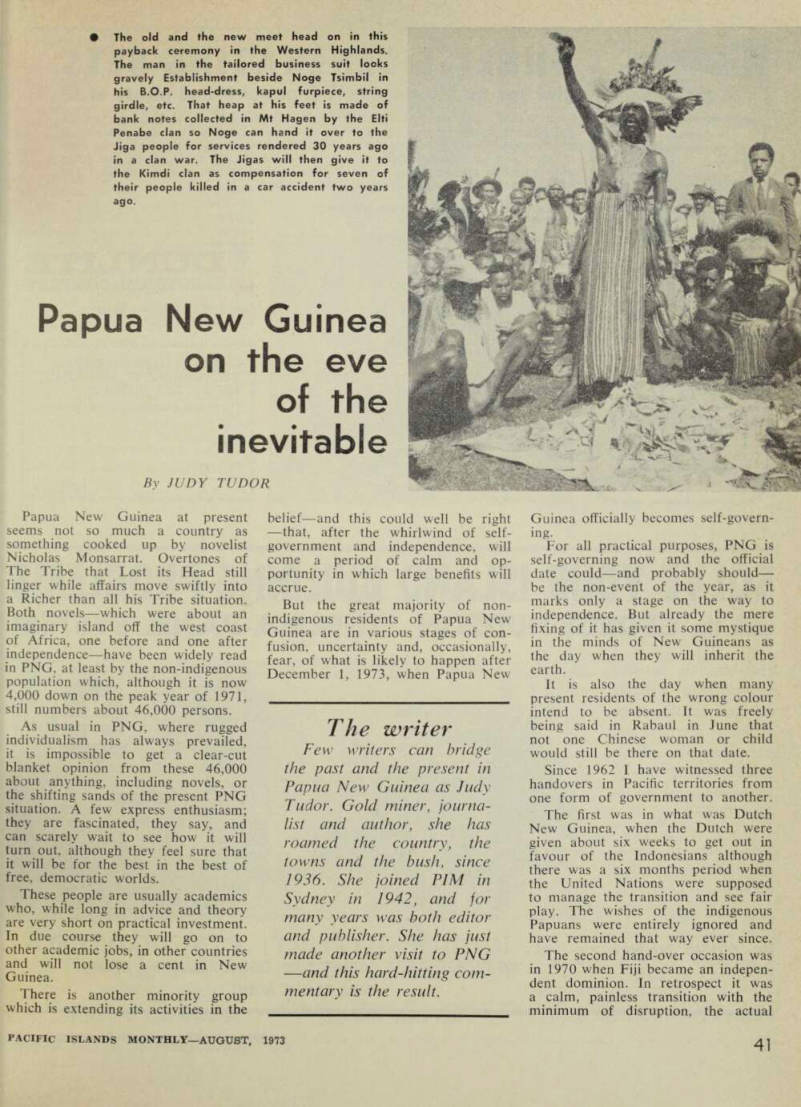
• The old and the new meet head on in this payback ceremony in the Western Highlands.
The man in the tailored business suit looks gravely Establishment beside Noge Tsimbil in his B.O.P. head-dress, kapul furpiece, string girdle, etc. That heap at his feet is made of bank notes collected in Mt Hagen by the Elti Penabe clan so Noge can hand it over to the Jiga people for services rendered 30 years ago in a clan war. The Jigas will then give it to the Kimdi clan as compensation for seven of their people killed in a car accident two years ago.
handover marked by happy festivities of a truly multi-racial nature, with everyone on their best behaviour, and no incidents.
Now we have Papua New Guinea.
In this case the New Guineans are getting everything they want, but the atmosphere is anything but calm, and it is entirely likely that the transition is going to be as painful as possible due largely to an un holy desire on the part of everyone to tear apart the existing fabric of administration and erect something new in its place, and to do it before the end of this year if possible, but if not, shortly after.
New government departments are being formed, old departments pulled apart, the Public Service is being reorganised, the judicial system changed, new taxation laws are in the making, a new banking structure has been announced, there are new guide lines for industry and invest ment, Papua New Guinea is to have its own airline. And so it goes on.
Never a day passes but there is something new to digest; some other ministerial profundity to savour.
Small wonder that people who once thought they knew everything can’t say more than, “I just don’t know what’s going to happen” in italics, and just sit and wait for it like mesmerised chickens.
In June the Constitutional Plan ning Committee was touring PNG getting the views of the people on what shape political affairs should take in the future. Each day the local newspaper faithfully reported the more newsworthy statements, usually about citizenship for non indigenes who might like to stay in the country.
These ranged from the view that every white, Asian and mixed-race person should pack up and leave the country immediately; to a system under which each aspirant would be put through a loyalty test in the community in which he or she lived, loyalty in this case meaning a desire to work for the good of the indigenous people.
In between, there were other ideas—such as that new citizens should “follow Papua New Guinea customs and way of life,” whatever that might mean. It could scarcely mean grass skirts for the ladies and penis gourds for the gents, these articles being long discarded in favour of the übiquitous shorts and shirts and dresses by all but real bushies.
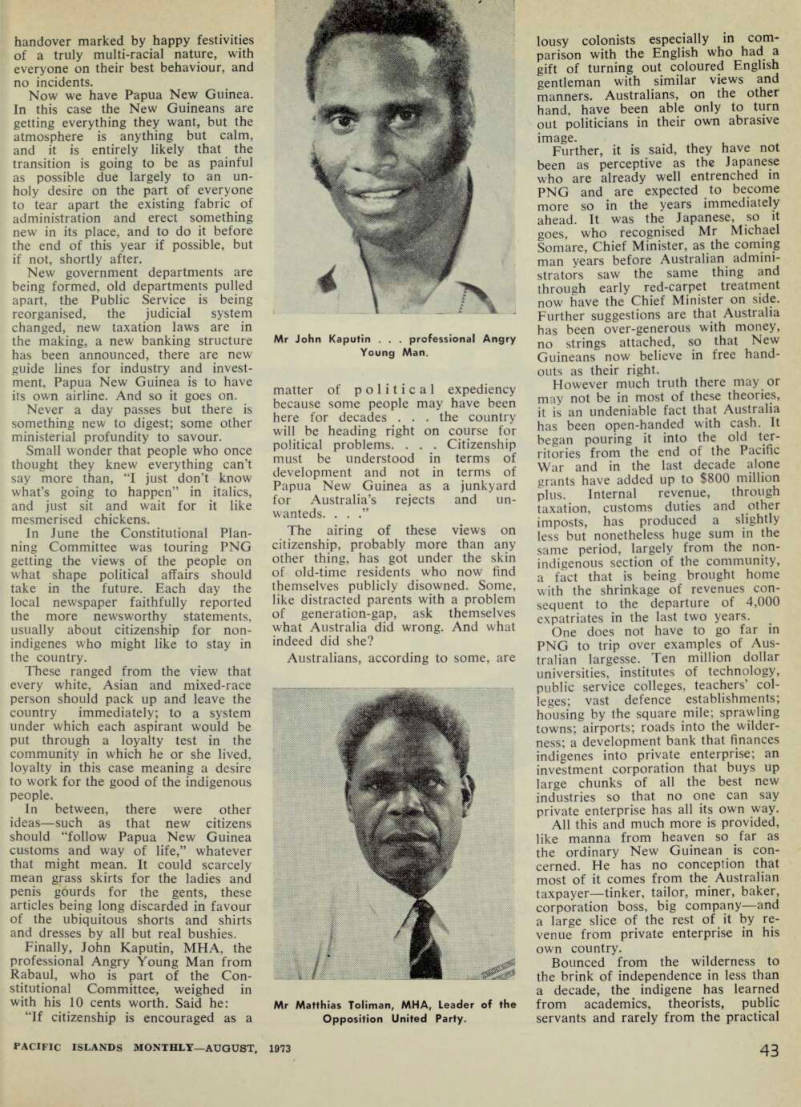
Finally, John Kaputin, MHA, the professional Angry Young Man from Rabaul, who is part of the Con stitutional Committee, weighed in with his 10 cents worth. Said he: “If citizenship is encouraged as a
matter of political expediency because some people may have been here for decades . . . the country will be heading right on course for
political problems. . . . Citizenship
must be understood in terms of development and not in terms of Papua New Guinea as a junkyard for Australia’s rejects and un wanteds. . . .”
The airing of these views on citizenship, probably more than any other thing, has got under the skin of old-time residents who now find themselves publicly disowned. Some, like distracted parents with a problem of generation-gap, ask themselves what Australia did wrong. And what indeed did she?
Australians, according to some, are
lousy colonists especially in com parison with the English who had a gift of turning out coloured English gentleman with similar views and manners. Australians, on the other hand, have been able only to turn out politicians in their own abrasive image.
Further, it is said, they have not been as perceptive as the Japanese who are already well entrenched in PNG and are expected to become more so in the years immediately ahead. It was the Japanese, so it goes, who recognised Mr Michael Somare, Chief Minister, as the coming man years before Australian admini strators saw the same thing and through early red-carpet treatment now have the Chief Minister on side.
Further suggestions are that Australia has been over-generous with money, no strings attached, so that New Guineans now believe in free hand outs as their right.
However much truth there may or may not be in most of these theories, it is an undeniable fact that Australia has been open-handed with cash. It began pouring it into the old ter ritories from the end of the Pacific War and in the last decade alone grants have added up to $BOO million plus. Internal revenue, through taxation, customs duties and other imposts, has produced a slightly less but nonetheless huge sum in the same period, largely from the non indigenous section of the community, a fact that is being brought home with the shrinkage of revenues con sequent to the departure of 4,000 expatriates in the last two years.
One does not have to go far in PNG to trip over examples of Aus tralian largesse. Ten million dollar universities, institutes of technology, public service colleges, teachers’ col leges; vast defence establishments; housing by the square mile; sprawling towns; airports; roads into the wilder ness; a development bank that finances indigenes into private enterprise; an investment corporation that buys up large chunks of all the best new industries so that no one can say private enterprise has all its own way.
All this and much more is provided, like manna from heaven so far as the ordinary New Guinean is con cerned. He has no conception that most of it comes from the Australian taxpayer—tinker, tailor, miner, baker, corporation boss, big company—and a large slice of the rest of it by re venue from private enterprise in his own country.
Bounced from the wilderness to the brink of independence in less than a decade, the indigene has learned from academics, theorists, public servants and rarely from the practical
Mr John Kaputin . . . professional Angry Young Man.
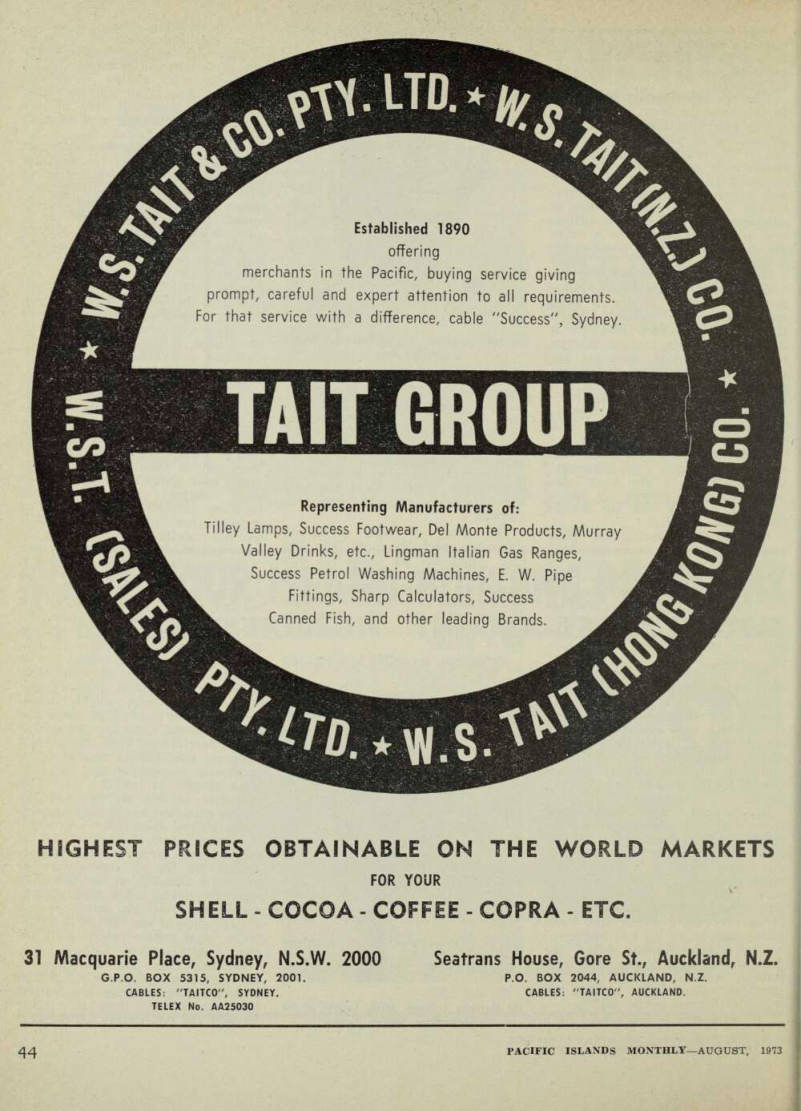
Mr Matthias Tollman, MHA, Leader of the Opposition United Party.
Hedge Against Utter Confusion
viewpoint of private industry which initially held aloof. Told so often that privately owned industry is another word for exploitation, a large section of New Guineans now believe that the only function the expatriate can legitimately have is to hand on his expertise quickly and then get out.
With hindsight, there are many ways in which Australia might have done better —including an attempt to start localisation earlier and letting the process go on longer into indepen dence and beyond. The last-minute rush into change, often it seems for the mere sake of change, is unnerv ing, and makes the transition into independence far more difficult than it need be.
Anyone who experienced the years leading up to independence in Fiji cannot help but be struck by the fact that, even at this late stage, there are still hundreds of young, unattached, expatriate males and females in PNG.
This wasn’t so in Fiji before indepen dence.
With about 350 jobs now legally reserved to indigenes or restricted to expatriates who are supposed to be teaching an indigene the job, it might be imagined that these would be first to go. However, localisation does not always work like that. It is often the top jobs that are localised, with the second and third stringers kept on as a hedge against utter con fusion. All the District Commis sioners, for example, will have been replaced by indigenes by June, 1974, but it is hoped that Deputy District Commissioners and other expatriate field staff will stay on.
This will work just so long as the second stringers will have it on, and at independence all permanent officers are entitled to take their golden handshake from the Australia Govern ment and go, whether they are re quired in PNG or not.
There are no clear-cut views amongst senior public servants about localisation. Some officers are im patient to be declared redundant; while others are unhappy at the prospect of being dispensed with, even bitter.
Meanwhile the Public Service Board is trying to work out how many ex patriates will be needed, and for how long.
When it all happens, the Austra lian taxpayer will again be doing his best, through his benevolent govern ment, to cushion the worst of the traumas attendant on a return to Australia. It is alleged that some public servants will be able to quit
with vast sums like $BO,OOO or even $120,000.
But the big sums are for the lucky minority and the average handshake will be much less. In any event, even $BO,OOO should be seen in its present Australian context for a man, possibly in his 40s, with a wife and a couple of teenage kids to support. If he has spent 20 years in field work in New Guinea he is not trained for anything else, and after providing himself with a house in Australia he is
obviously in for a thin time if he tries to live on what is left.
The smart ones of course bought Australian property years ago, for just this eventuality. Papua New Guinea has been, and still is, golden pasture for Queensland land developers and property realtors, On the other side of the business of expatriate jobs, are the masses of unemployed, unskilled New Guineans who drift in a never-ending stream from the villages to squatter encampments on the edges of towns.
These are the detritus of the transition period, caught mid-way between the primitive village life and the life of
No gat wok
the smart young indigene who has been educated, urbanised and western ised.
Only time in terms of generations will solve this problem, while in the present there is for these aimless ones only the universal Papua New Guinea message, tacked on the doors of offices, shops and dwellings, that says NO GAT WOK. In Lae there is a whole pile of these notices, in neat two-inch high type, for sale in the airport shop. Whether they are for the convenience of locals or sold as a tourist gimmick I had no time to find out.
But in spite of all the foregoing; in spite of the rapes, bashings, oc casional murders and tribal mayhem that make the daily news, it is still possible to travel right round the county and be completely unaware of any tension simmering below the surface; to be met with nothing but politeness, kindness and courtesy from the people, even in the two trouble spots of the Highlands and Gazelle Peninsula, East New Britain.
After the Highlands districts were thrown open for settlement in the early 1950 s there were 20 years in which Europeans and Highlanders developed coffee and tea plantations or raised stock in perfect harmony, but for the last 18 months murders and tribal brawls have been an almost daily occurrence in one part or other of this area.
Occasionally Europeans are in volved by being in the wrong spot at the wrong time but generally the trouble is inter-tribal, based on pay back, land disputes or occasionally as the outcome of drinking parties.
In June, incidents and full tribal warfare raged through Western High lands and the month ended with a pitched battle in the streets of Kundiawa, headquarters town of Chimbu District.
These often are old type battles with strange modern overtones. The Highlands districts have good road and radio microwave communications so fight leaders can call up their warriors by S.T.D. and have them arrive on cue at the chosen spot, in full battle dress, by belting down the road in hired taxis.
The reasons for the breakdown of law and order in the Highlands are many and complex, but the root cause is uncertainty and a deep-seated vil lage belief that with independence all Europeans will leave the country, making it a case of everyone in for his chop.
Rabaul and the Gazelle Peninsula are a different matter. The local Tolai
people are the most sophisticated in New Guinea and have been in con tact with Europeans for almost 100 years. The early Europeans, however, acquired about 40 per cent of the cultivable land of the Gazelle and this is at the root of and the excuse for most of the problems of the area today.
Since 1945 the population of the area has doubled and this has resulted in some land shortages and con sequent resentment of successful European plantation owners.
But for many years local govern ment institutions prevailed over most of the Gazelle in the framework of administration sanction and, within the Gazelle Local Government Council, existed the successful Tolai Cocoa Project which was held up as a model of successful indigenous enterprise.
All this came to an end when local government legislation was amended to provide for multi-racial councils and the Mataungan Association was founded in 1969 to oppose it. This group of Tolais has since consistently aimed at domination of the social, political and economic life of the Gazelle Peninsula and has as con sistently opposed any local govern ment council, has maintained a policy of non-co-operation with government in any form and has continuously exploited land issues. As a result of the intransigent Mataungans the Gazelle council was disbanded and no tax is collected outside the Rabaul urban area except on a voluntary basis.
It is estimated that 55 per cent of the Tolai population supports the M.A. but it could well be more.
Three of the area’s four members of the House of Assembly are Mataungan office holders and these are also members of the present coalition government led by Chief Minister Somare.
Mr John Kaputin runs the busi ness arm of the M.A., the New Guinea Development Corporation, which has been running for over two years and on the surface, anyhow, appears to be going from strength to strength. It has a nominal capital of $500,000, has acquired a store and cocoa drier at Vunavutung, has bought or is buying Vunapit Planta tion, goes in for cocoa processing, and is said to have the biggest outlet for South Pacific beer in PNG. There is a great deal of conjecture about the corporation in the Gazelle but not much hard fact although, as a com pany, it presumably must make annual reports to the Registrar General.
People are said to work for the corporation and be recompensed in
A major victory
kind rather than in wages and this is given point to by Mr Kaputin himself who said in June that he had “worked his guts out for the corpora tion” for two years and had demanded no salary. [ln late June suggestions that Kaputin would be offered a Cabinet post caused some dissention on Mataungan home ground].
The anti-Mataungan section of the Tolais is fragmented, although official sources give the Greater Toma Council Group, which was pro- Gazelle Council, about 20 per cent of local support. This groui is headed by Mr Matthias Toliman, MHA, Leader of the Opposition United Party in the House of As sembly.
There is also the Warbete Kivung that centres on the Raluana and Navuneram areas, which since 1951 has opposed participation in local government and refused to join the Gazelle LGC when it was formed in 1966. It therefore predates the Mataungans in civil disobedience but although now inclined to give the M.A. moral support, continues to administer its own affairs. The Warbete Kivung is officially believed to have about 5 per cent of local support.
The rest of the inhabitants of the Gazelle are either non-political or foreigners, mostly Highlanders, work ing in the area and concerned mainly with their pay packets.
The House of Assembly in recent times has passed the Gazelle Penin sula Affairs (Temporary Provisions) Bill which proposes the establishment of a loose federation of the three major factions on the Gazelle, each maintaining its right to govern its followers and collect taxes but com bining on major projects.
The Mataungans see this as a major victory; while the Toliman pro- Council group, which feels that it alone tried to uphold law and order in the 1969-73 period, has taken umbrage and wants the Greater Toma Council recognised as a political organisation.
Meantime, as a result of the tur moil of the last few years, plus 18 months of depressed copra and cocoa prices, all Papua New Guinea’s problems seem to come to a focus in Rabaul. Commodity prices were up in June to shed some joy, but half the Chinese stores were closed up, while those which still functioned were depleted in stocks; the local desiccated coconut factory, which employs about 600 people, had an
nounced its imminent closure; the old “Cosmo” Hotel had ceased dispensing beer and cheer; there were empty houses galore on a depressed market—all adding up to general gloom.
But Gazelle gloom and Highlands recalcitrance are only two of the current problems that PNG will carry forward into self-government. Others, not so publicised, are more frightening in their implications.
In mid-1973 no one really knows what independence is going to mean in Papua New Guinea although, judging by current history, it’s an even bet that somehow, in some form, it will manage to survive.
Other fledgling nations with less going for them have done that and come civil wars, economic bankruptcy, crazy dictators and dis illusioned citizens, have not tried to come back under the colonial cloak once the final ties have been cut.
But it is a thousand pities that Papua New Guinea, which has been given so much and has occupied Australian thought, in one form or another, for a century, could not have had a transition that was easy, peace ful and devoid of many of the man made problems that it now has. m • c • u/ ® Next page: Going finish is no
myth.