Custom's rebirth at chiefly funeral
pp. 12-13 · Read in the full issue
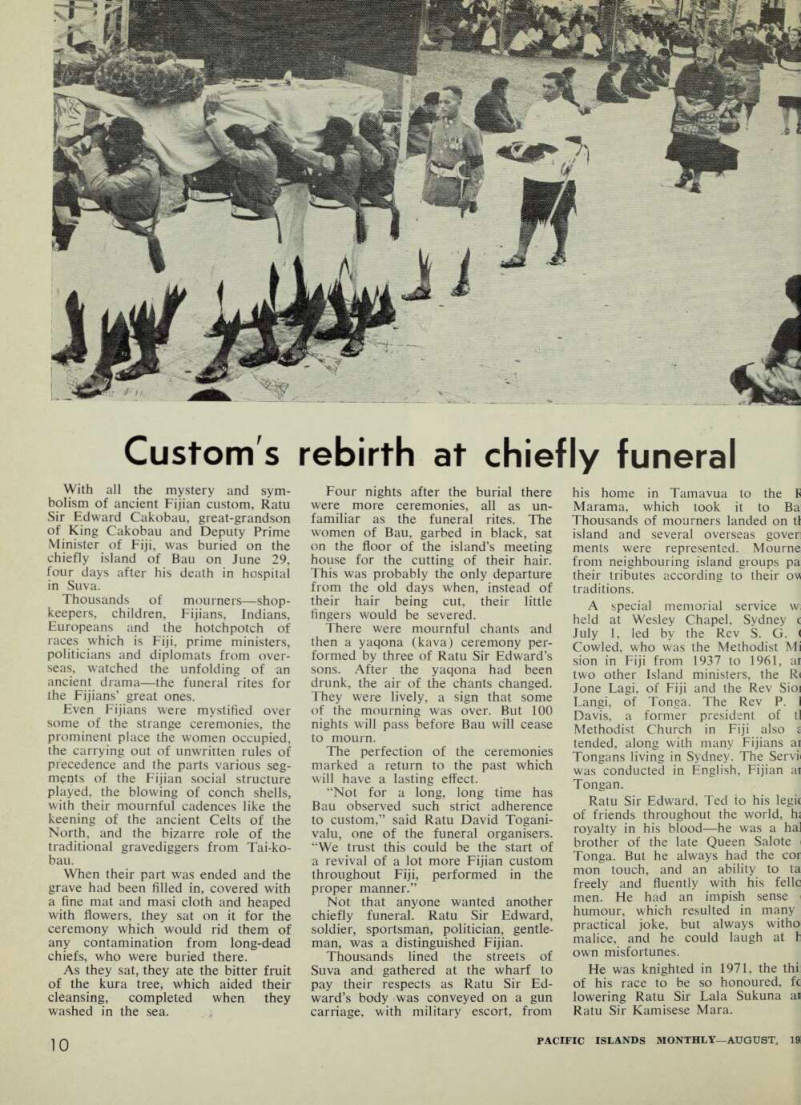
With all the mystery and sym bolism of ancient Fijian custom, Ratu Sir Edward Cakobau, great-grandson of King Cakobau and Deputy Prime Minister of Fiji, was buried on the chiefly island of Bau on June 29, four days after his death in hospital in Suva.
Thousands of mourners—shop keepers, children, Fijians, Indians, Europeans and the hotchpotch of races which is Fiji, prime ministers, politicians and diplomats from over seas, watched the unfolding of an ancient drama—the funeral rites for the Fijians’ great ones.
Even Fijians were mystified over some of the strange ceremonies, the prominent place the women occupied, the carrying out of unwritten rules of precedence and the parts various seg ments of the Fijian social structure played, the blowing of conch shells, with their mournful cadences like the keening of the ancient Celts of the North, and the bizarre role of the traditional gravediggers from Tai-ko bau.
When their part was ended and the grave had been filled in, covered with a fine mat and masi cloth and heaped with flowers, they sat on it for the ceremony which would rid them of any contamination from long-dead chiefs, who were buried there.
As they sat, they ate the bitter fruit of the kura tree, which aided their cleansing, completed when they washed in the sea.
Four nights after the burial there were more ceremonies, all as un familiar as the funeral rites. The women of Bau, garbed in black, sat on the floor of the island’s meeting house for the cutting of their hair.
This was probably the only departure from the old days when, instead of their hair being cut, their little fingers would be severed.
There were mournful chants and then a yaqona (kava) ceremony per formed by three of Ratu Sir Edward’s sons. After the yaqona had been drunk, the air of the chants changed.
They were lively, a sign that some of the mourning was over. But 100 nights will pass before Bau will cease to mourn.
The perfection of the ceremonies marked a return to the past which will have a lasting effect.
“Not for a long, long time has Bau observed such strict adherence to custom,” said Ratu David Togani valu, one of the funeral organisers.
“We trust this could be the start of a revival of a lot more Fijian custom throughout Fiji, performed in the proper manner.”
Not that anyone wanted another chiefly funeral. Ratu Sir Edward, soldier, sportsman, politician, gentle man, was a distinguished Fijian.
Thousands lined the streets of Suva and gathered at the wharf to pay their respects as Ratu Sir Ed ward’s body was conveyed on a gun carriage, with military escort, from
his home in Tamavua to the F Marama, which took it to Ba Thousands of mourners landed on tl island and several overseas gover ments were represented. Mourne from neighbouring island groups pa their tributes according to their ov traditions.
A special memorial service w; held at Wesley Chapel, Sydney c July 1, led by the Rev S. G. ( Cowled, who was the Methodist Mi sion in Fiji from 1937 to 1961, at two other Island ministers, the R< Jone Lagi, of Fiji and the Rev Sioi Langi, of Tonga. The Rev P. I Davis, a former president of tl Methodist Church in Fiji also £ tended, along with many Fijians ai Tongans living in Sydney. The Servi( was conducted in English, Fijian ai Tongan.
Ratu Sir Edward, Ted to his legk of friends throughout the world, h; royalty in his blood —he was a hal brother of the late Queen Salote < Tonga. But he always had the cor mon touch, and an ability to ta freely and fluently with his fellc men. He had an impish sense ■ humour, which resulted in many practical joke, but always witho malice, and he could laugh at h own misfortunes.
He was knighted in 1971, the thi of his race to be so honoured, fc lowering Ratu Sir Lala Sukuna an Ratu Sir Kamisese Mara.
In World War II he served in the Solomons, where he won the MC, and in 1953 and 1954 he was in Malaya, first as second in command, and then as commanding officer of the Fiji battalion fighting against the Com munist terrorists for which he was awarded the OBE. Malaya was an ex plosive place in those days, politi cally and militarily, but his charm and easy manner helped to overcome many difficult political situations.
Many tales are told of Ratu Sir Edward’s ready wit —like the time he was at a Melbourne Cup meeting wearing his battledress, with a sulu replacing the trousers. Asked if he belonged to a Highland regiment, he
replied, “Sure, I am a South Seas ‘highlander’.” Then, while travelling in a ship, a woman at a nearby table made nasty remarks about ‘former cannibals’. Ratu Sir Edward took it but when the steward appeared to take his order, he handed over the menu and demanded, “Bring me the passenger list”. And when he was president of the Fiji Cricket Associ ation he was re-elected, almost unanimously, at an annual meeting.
His was the only nomination, but that did not stop him from cal ling for the “ayes” and “noes” and then solemnly raising a hand as the only “no”.
Calls on his time were legion. After more than 20 years in the old Legis lative Council he became a Council of Chiefs’ nominated member in the new parliament. He went on to the hustings for the first time at the last general election and for the first time by popular vote took his seat in Parlia ment. He held several portfolios and at the time of his death was Deputy Prime Minister.
Ratu Sir Edward was born on the chiefly island of Bau and educated at Queen Victoria School, Wanganui Technical College (NZ), Auckland Technical College, and Wadham Col lege, Oxford, where he took a course in colonial administration. In his younger days he was a schoolteacher. He moved from teaching to the Fijian administration, in which he held a number of senior posts, including that of Deputy Secretary for Fijian Af fairs.
Ratu Sir Edward is survived by his wife, Adi Lady Vasemaca, and four sons.
• Funeral scenes—On op posite page Ratu Sir Edward's coffin is carried by staff ser geants of the Royal Fiji Military Forces towards Suva wharf.
Prince Tui'pelehake, Tonga's Prime Minister and Ratu Ed
ward's nephew, walks behind.
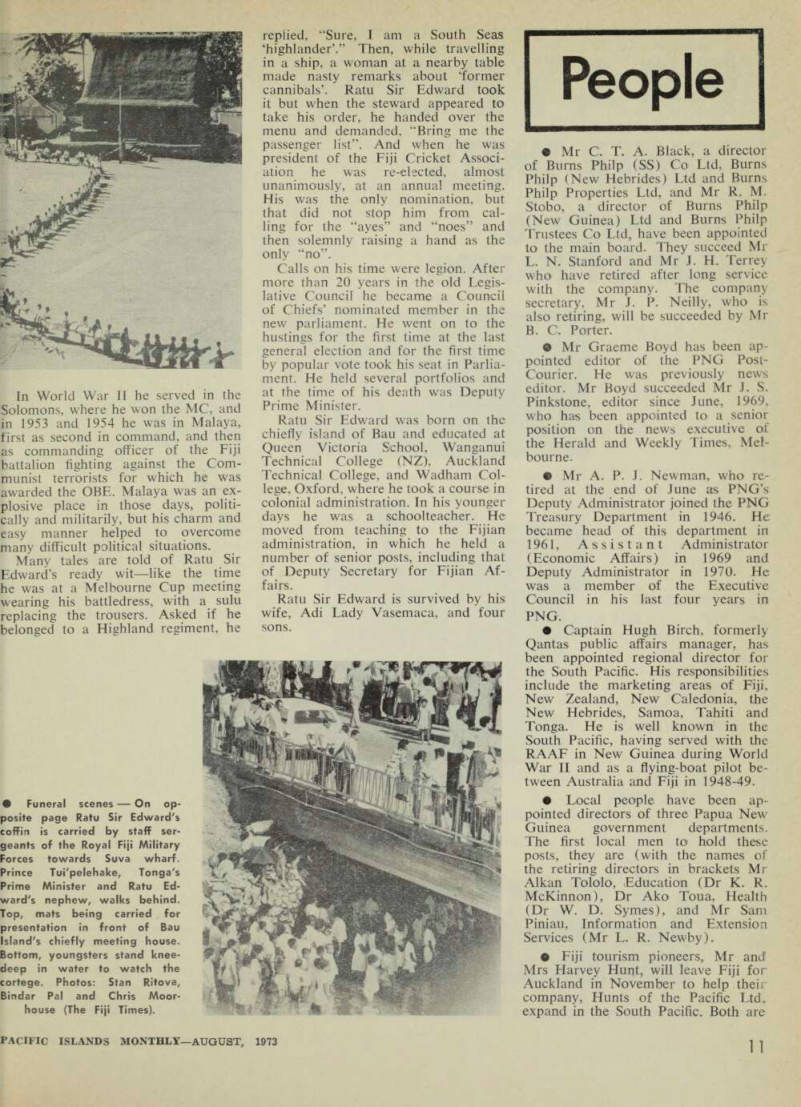
Top, mats being carried for presentation in front of Bau Island's chiefly meeting house.
Bottom, youngsters stand knee deep in water to watch the cortege. Photos; Stan Ritova, Bindar Pal and Chris Moor house (The Fiji Times).