Independence!
pp. 10-11 · Read in the full issue
Tahitian answer to the bomb
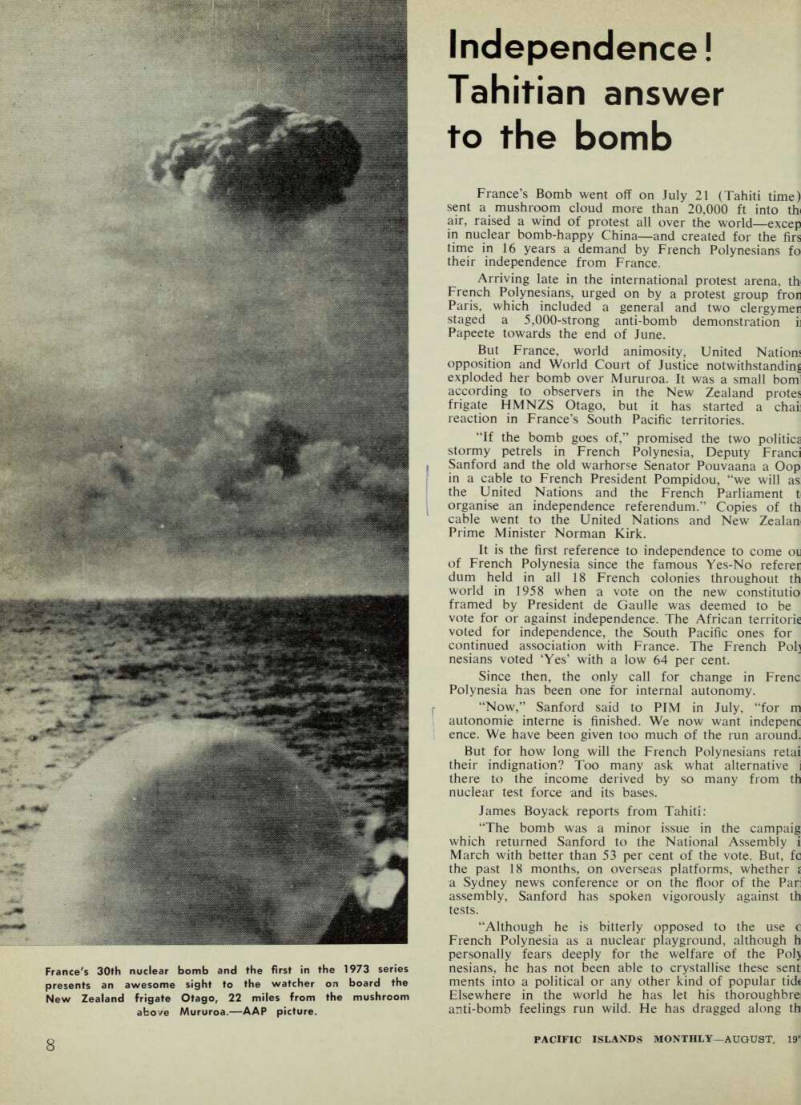
France’s Bomb went off on July 21 (Tahiti time) sent a mushroom cloud more than 20,000 ft into th air, raised a wind of protest all over the world—excep in nuclear bomb-happy China—and created for the firs time in 16 years a demand by French Polynesians fo their independence from France.
Arriving late in the international protest arena, th French Polynesians, urged on by a protest group fron Paris, which included a general and two clergymer staged a 5,000-strong anti-bomb demonstration i: Papeete towards the end of June.
But France, world animosity, United Nations opposition and World Court of Justice notwithstanding exploded her bomb over Mururoa. It was a small bom according to observers in the New Zealand protes frigate HMNZS Otago, but it has started a char reaction in France’s South Pacific territories.
“If the bomb goes of,” promised the two politics stormy petrels in French Polynesia, Deputy Franci Sanford and the old warhorse Senator Pouvaana a Oop in a cable to French President Pompidou, “we will as the United Nations and the French Parliament t organise an independence referendum.” Copies of th cable went to the United Nations and New Zealan Prime Minister Norman Kirk.
It is the first reference to independence to come or of French Polynesia since the famous Yes-No referer dum held in all 18 French colonies throughout th world in 1958 when a vote on the new constitutio framed by President de Gaulle was deemed to be vote for or against independence. The African territorie voted for independence, the South Pacific ones for continued association with France. The French Pob nesians voted ‘Yes’ with a low 64 per cent.
Since then, the only call for change in Frenc Polynesia has been one for internal autonomy.
“Now,” Sanford said to PIM in July, “for m autonomic interne is finished. We now want indepenc ence. We have been given too much of the run around.
But for how long will the French Polynesians retai their indignation? Too many ask what alternative i there to the income derived by so many from th nuclear test force and its bases.
James Boyack reports from Tahiti; “The bomb was a minor issue in the campaig which returned Sanford to the National Assembly i March with better than 53 per cent of the vote. But, fc the past 18 months, on overseas platforms, whether i a Sydney news conference or on the floor of the Par: assembly, Sanford has spoken vigorously against th tests.
“Although he is bitterly opposed to the use c French Polynesia as a nuclear playground, although h personally fears deeply for the welfare of the Polj nesians, he has not been able to crystallise these sent ments into a political or any other kind of popular tide Elsewhere in the world he has let his thoroughbre anti-bomb feelings run wild. He has dragged along th
France's 30th nuclear bomb and the first in the 1973 series presents an awesome sight to the watcher on board the New Zealand frigate Otago, 22 miles from the mushroom above Mururoa. —AAR picture.
Ihariot of autonomic interne for international attention.
“He is a political innocent yet he too has under- Jtood that so goes the bomb, so might go the political juture of French Polynesia. To date, the administration ias flatly denied this theorem. Governor Pierre Angeli :xplained in his farewell press conference—he is retiring -that France is part of the new Europe, and Europe mist remain in the Pacific to buffer the super-powers ■a China, Japan and the United States.
“The Polynesians instinctively know of test dangers; hey connect widespread fish poisoning with the blasts; he fact is, however, they, like most of us, can’t say for ore what the real dangers are. Add a few cases of Hinano beer, let the singing begin, the dancing, and the .ague dangers no longer exist, invisible as they are.”
Meanwhile, France is ignoring everything and 'veryone but the tests. The first, at 8 am on July 21, •rought no statement from the French and the news hat, after several postponements, the bomb had been xploded, came from HMNZS Otago, which sailed ight up to the 12-mile territorial limit, ignoring the Tench “prohibited” zone. It could see the bomb uspended under a balloon.
The only comment from a French official came rom Jean-Jacques Servan-Schreiber, head of France’s Ladical Socialist Party, who was in Tahiti as leader of ae eight-man Battalion of Peace which led the anti omb demonstration.
“I know as a fact,” he said, “that France plans six 3 eight tests. They have made it official policy to con uct their tests no matter what. Psychologically, they ave to show that they can do it no matter what the rotests.”
He added that there was strong feeling in France
against the tests. Paris reports bore this out—but every thing is relative, and the man-in-the-street in France is not really cognisant of world opinion. Bombs are mat ters for the defence experts.
Fiji joined the protesting nations early in the “test season” and appeared before the World Court of Justice at The Hague along with Australia and New Zealand who managed to extract an injunction against the tests, which France ignored as she said she would. The court sat on Fiji’s case, postponing a decision until it had made up its mind about France’s challenge to the legality of its decisions.
Australian and New Zealand governments and trade unions have been vigorous in their protests. New Zealand sent the Otago to patrol the area in a show of passive resistance while Australia sent a Navy ship to refuel the Otago. NZ’s Mr Kirk also announced moral support for the protest yacht, Fri, which had a front row seat for the tests, before she was boarded by a French naval pafty and towed to Tahiti.
Several of the South American nations added their voices to the protest chorus and most of v the South Pacific territories including the Cook Islands' and Western Samoa passed formal resolutions condemning the tests. In fact, for this series of tests world opinion against France’s attitude was unprecedented.
The Pitcairners, nearest to the test area of any outsiders, declared their neutrality and referred to the tests as the “usual winter activity”, but Britain, in a more serious vein, sent a frigate, Sir Percivale, to stand by off Pitcairn in case the islanders were in danger from fall-out. As it’s an ill explosion which blows no one any good, the Pitcairners were entertained by the Sir Percivale’s stock of films.