Montreal Goes To Ground
pp. 117-118 · Read in the full issue
By Robert Ottaway
Above ground, the profile of Montreal shares the character of most modern cities in the West— soaring skyscrapers drawing the eye up from the preserved old or the merely undeveloped, broad streets and tributary expressways.
But it is the heart of the city that beats differently, uniquely. For here, underground, is a sub-metropolis, unmatched in its scope by any other town in the world with every service and resource of twentieth-century living included in it.
The notion of separating people from traffic is as old as Leonardo da Vinci. For that chameleon genius had a vision of pedestrians on elevated walks, remote from the dust and rattle of carts and wagons at street level. It was a solution to congestion that has been taken up and adapted by many cities.
But Montreal has successfully re versed the concept. The motor-car keeps to the normal highways. People saunter down below, cocooned from noise and danger, insulated against extremes of winter cold and summer heat.
A visitor, without curiosity for the charms of old Montreal, could spend . entire stay in this vast cavern, without popping his head outside.
Every facility is on tap.
There are hotels, restaurants, bars, cinemas, swimming pools, sauna baths, barber shops, boutiques, food shops, and exhibition halls—and he may quite easily find that any busi ness appointments he must keep will be m the office reached by lift above his head.
And this is no static development.
It is spreading wider at the core of the city, keeping pace with the ex tension of the Metro system, which has a network of new lines planned up to 1978— and many of them will be completed to service the hordes of Olympic visitors, when Montreal plays host to the Games in 1976.
The original underground city was made under and around the Place Ville-Marie, which was built in 1912,
and it is from this ambitious nucleus that the tentacles are stretching out, with new building in progress over or near the subway exits and entrances.
Unlike most transformation scenes of this kind in urban centres, it did not demand the destruction of any valuable architecture from the past.
The site, scornfully known as “the hole”, was a seven-acre eyesore, the pit-yards of the Canadian National Railways surrounded by ageing and undistinguished buildings.
And it was the vision of planner Vincent Ponte, a Harvard-educated maker of cities, that was to be realised in Montreal. For years he had speculated and written about the pos sibilities of a weatherproof under ground city. So when an American developer, William Zeckendorf and his architect, 1. M. Pei, proposed that the pit-yard site should be used for a 42-storey cruciform office tower, Ponte argued that it should be rooted downwards and outwards. The plan was opposed on all sorts of grounds—even that it would tend to instil a “troglodyte mentality” in active, sporty Montrealers but Ponte, a kind of four-dimensional salesman, won through.
The complex cost more than sCan 100 m and there was much sceptical head-wagging about whether the cost could be recouped in rentals and leases. After all, most people are conditioned to window-shopping on streets. Would they flock to a traffic free cellar, however enticing the dis plays on offer?
They would, and they did. Enor mous care was taken with the light ing, so that there would be no feeling
of claustrophobia. The heating system—cooling in summer, of course —was devised to ensure that tem peratures stayed equable for strollers without overcoats. Doors that close automatically after being pushed open were installed at every entrance.
Boutiques and shop space were eagerly snapped up, and indeed most of Montreal’s large stores have branches there. And this concentra tion of shopping opportunities proved an immediate attraction. Occupancy turnover fell to nil, and crowds of more than 100,000 each day surge underground.
There the city dweller can eat superb meals—at least two of Montreal’s most sophisticated restaur ants are situated there—or have a drink at elegant bars. Indeed, one of sub-Montreal’s most agreeable features is that it has a flavour of the Gallic sidewalk cafe about it.
Heading south, he can stroll through a connecting corridor and an escalator that go under Dorchester Boulevard and arrive at the foyer of the Queen Elizabeth Hotel. Progres sing further, he finds himself in the concourse of the Central Station of Canadian National Railways.
From there, he can reach, through another passage lined with boutiques, the Place Bonaventure, with a huge and adaptable exhibition hall and another hotel. Bending to the right from there, he arrives at the Chateau Champlain Hotel and yet another station, the Windsor, of Canadian Pacific, used by thousands of daily commuters.
Just south of Place Bonaventure is Montreal’s tallest building, the Place Victoria skyscraper. Here, too,
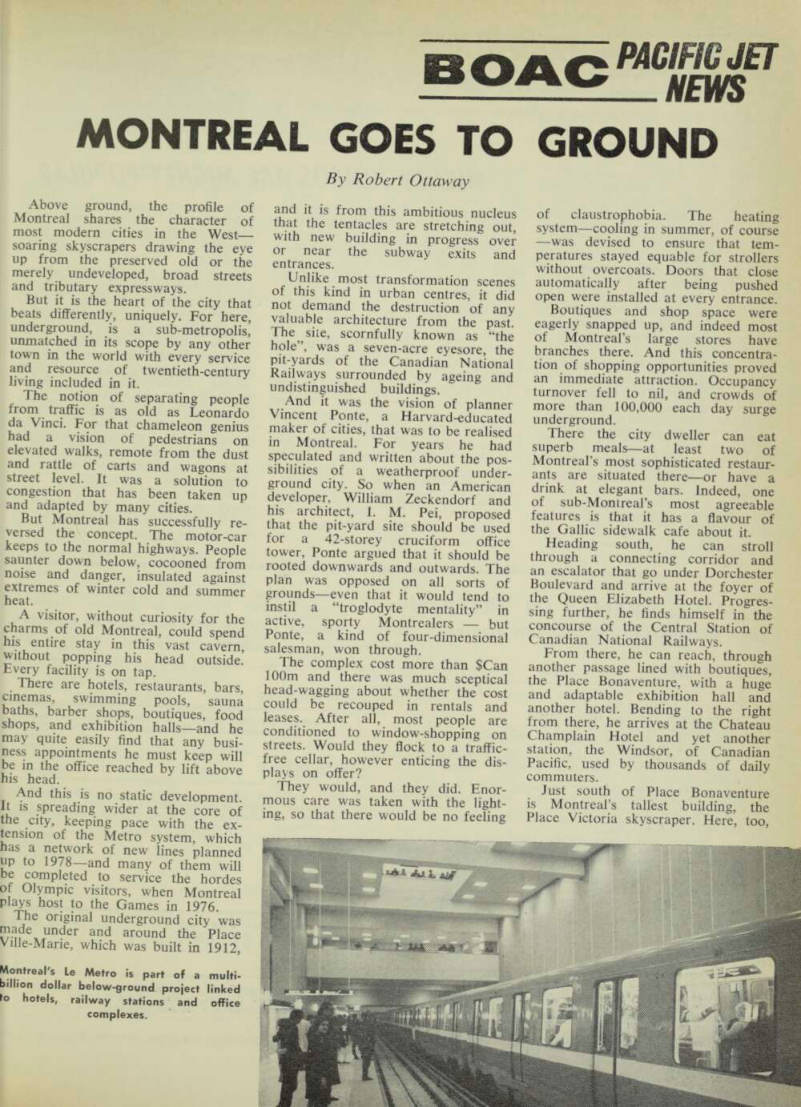
Montreal's Le Metro is part of a multi billion dollar below-ground project linked to hotels, railway stations and office complexes.
one of its towers will be linked with the rest of the underground complex, complete with its own profusion of shops.
The thrust of the underground city has been given by Montreal’s Metro system, which was only five years old when Place Ville-Marie was completed. Now it covers 16 miles, but another 26 are planned. As it spreads, so will the sub-city—for all architects’ plans now embody with the world down below.
It is, in fact, a triumph of man over his environment, shaping it to his own ends without destroying any precious heritage from its past.
The underground system of Mon treal was envisaged centuries ago, when tunnels were built under the old city to protect its inhabitants from marauders. Now that defence system has been turned into a positive assertion of metropolitan values.
“Montreal,” said one of its French poets, in rough translation, “has a soul where it should be—under the skin”.
You can get there from the south Pacific area by taking BO AC’s trans pacific VC 10s as far as New York and changing on to a local carrier.