Boac
pp. 115-116 · Read in the full issue
Pacific Jet
News
"Oranges And Lemons"
(BOAC Supplement—Advertisement)
London's Nursery Rhyme Churches
By Jenny Alexander
Oranges and lemons, say the bells of St Clement’s.
You owe me five farthings, say the bells of St Martin’s.
When will you pay me? say the bells of Old Bailey.
When I grow rich, say the bells of Shoreditch.
When will that be? say the bells of Stepney. / do not know, says the Great Bell of Bow.
The first known record of this favourite London nursery song is dated about 1744, but over the years doubts have arisen regarding the exact identity of one or two of the churches mentioned in it.
Two churches claim to be the St Clement’s of the old rhyme. First there is St Clement Danes in the Strand (nearest Underground station: Temple), which stands on the site of an earlier church and is believed to be the final burial place of Harold Harefoot and other Danes who settled in the area in Saxon times. Oranges and lemons were sold in nearby Clare Market which stood, like the
church, just outside the walls of the City of London. In medieval times a tax was levied on goods imported into the city markets, and it was probably in order to evade payment that some of the fruit was landed up stream of the old city boundary. It was then carried to Clare Market through the church grounds, for which privilege a portion of the cargo was given to the church wardens. Those days are recalled by a service held annually at the church in March, at which pupils of St Clement Danes Primary School and other children in the congregation are presented with oranges and lemons.
The other claimant, St Clement
Eastcheap (Underground station:
Monument), no longer stands where its name implies. The church itself has not been moved, but the western end of Eastcheap was abolished more than 100 years ago and St Clement’s now stands at the corner of St Clement’s Lane and King William Street, close to the river Thames.
The southern boundary of the parish is actually in the river just below the old Spanish Quay, where barges once brought citrus fruit from the Mediterranean—and the oranges and lemons were sold in East Cheape (or East Market).
There is also dissidence about the bells of St Martin’s, but of the two most likely churches, only St Martin in-the-Fields (Underground station: Trafalgar Square) remains today.
The fields which, in Saxon times, surrounded the first chapel are no longer to be seen, but this church is
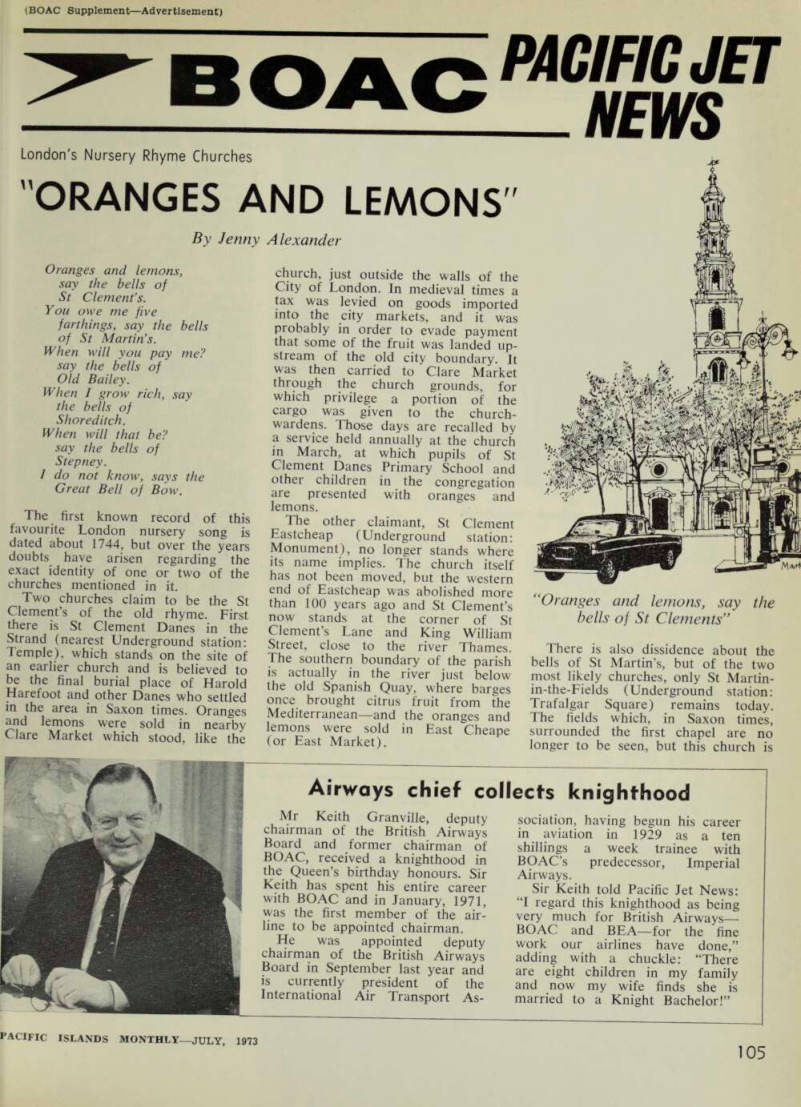
“Oranges and lemons, say the bells of St Clements”
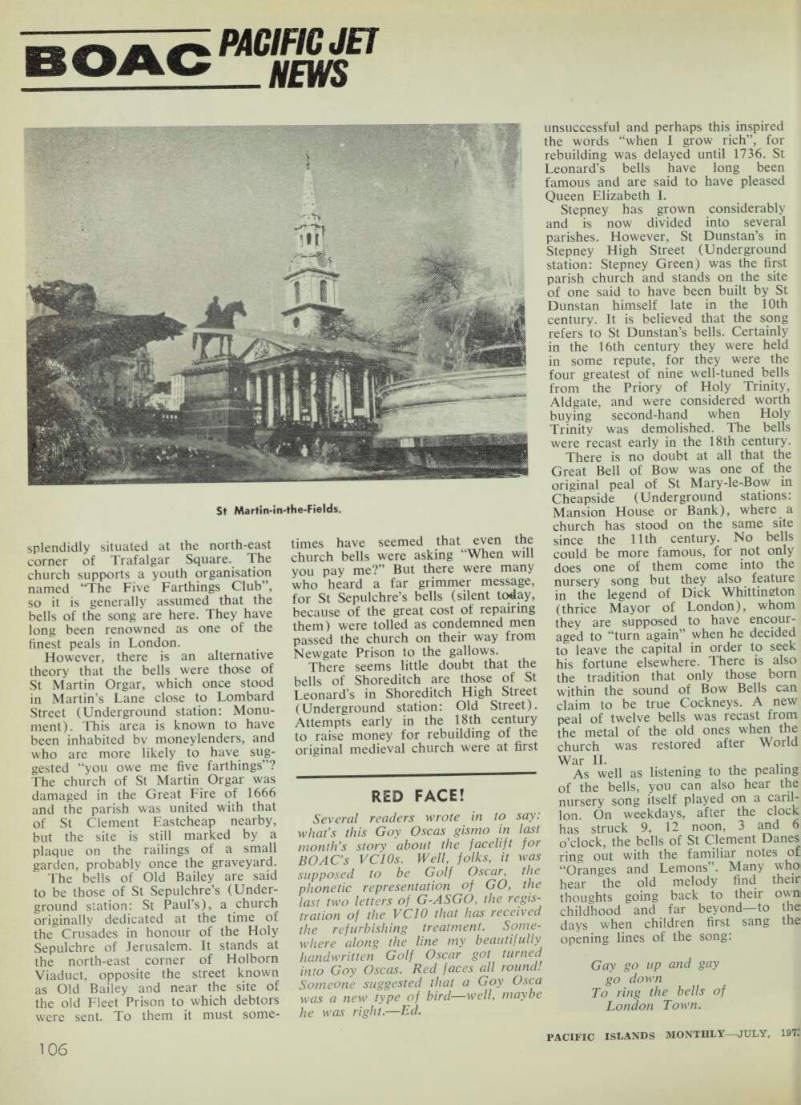
splendidly situated at the north-east corner of Trafalgar Square. The church supports a youth organisation named “The Five Farthings Club”, so it is generally assumed that the bells of the song are here. They have long been renowned as one of the finest peals in London.
However, there is an alternative theory that the bells were those of St Martin Orgar, which once stood in Martin’s Lane close to Lombard Street (Underground station: Monu ment). This area is known to have been inhabited by moneylenders, and who are more likely to have sug gested “you owe me five farthings”?
The church of St Martin Orgar was damaged in the Great Fire of 1666 and the parish was united with that of St Clement Eastcheap nearby, but the site is still marked by a plaque on the railings of a small garden, probably once the graveyard.
The bells of Old Bailey are said to be those of St Sepulchre’s (Under ground station: St Paul’s), a church originally dedicated at the time of the Crusades in honour of the Holy Sepulchre of Jerusalem. It stands at the north-east corner of Holborn Viaduct, opposite the street known as Old Bailey and near the site of the old Fleet Prison to which debtors were sent. To them it must some
times have seemed that even the church bells were asking When will you pay me?” But there were many who heard a far grimmer message, for St Sepulchres bells (silent today because of the great cost of re P ai ™J§ them) were tolled as condemned men passed the church on their way from Newgate Prison to the gallows, There seems little doubt that the bells of Shoreditch are those of St Leonards m Shoreditch High Street (Underground station: Old Street!
Attempts early in the 18th century to raise money for rebuilding of the original medieval church were at first
unsuccessful and perhaps this inspired the words “when I grow rich”, for rebuilding was delayed until 1736. St Leonard’s bells have long been famous and are said to have pleased Queen Elizabeth I.
Stepney has grown considerably and is now divided into several parishes. However, St Dunstan’s in Stepney High Street (Underground station: Stepney Green) was the first parish church and stands on the site of one said to have been built by St Dunstan himself late in the 10th century. It is believed that the song refers to St Dunstan’s bells. Certainly in the 16th century they were held in some repute, for they were the four greatest of nine well-tuned bells from the Priory of Holy Trinity, Aldgate, and were considered worth buying second-hand when Holy Trinity was demolished. The bells were recast early in the 18th century.
There is no doubt at all that the Great Bell of Bow was one of the original peal of St Mary-le-Bow in Cheapside (Underground stations: Mansion House or Bank), where a church has stood on the same site since the 11th century. No bells could be more famous, for not only does one of them come into the nursery song but they also feature in the legend of Dick Whittineton (thrice Mayor of London), whom they are supposed to have encour aged to “turn again” when he decided to leave the capital in order to seek his fortune elsewhere. There is also the tradition that only those born within the sound of Bow Bells can claim to be true Cockneys. A new peal of twelve bells was recast from the metal of the old ones when the church was restored after World War 11. , As well as listening to the pealing of the bells, you can also hear the nursery song itself played on a caril lon. On weekdays, after the clock has struck 9, 12 noon, 3 and 6 o’clock, the bells of St Clement Danes ring out with the familiar notes of “Oranges and Lemons”. Many who hear the old melody find their thoughts going back to their own childhood and far beyond—to the days when children first sang the opening lines of the song: Gay go up and gay go down To ring the bells of London Town.
St Martin-in-the-Fields.