Business and Development
pp. 101-108 · Read in the full issue

New Zealand's 'Quiet Revolution'
Moves Into The Islands
A quiet revolution is taking place in the New Zealand economy. Not that the economy base for about 90 years—fat lambs, dairy produce and wool—is likely to be threatened by secondary industry for many years.
But manufactured goods have been earning a bigger slice of the country’s foreign exchange, and are becoming more important as the country learns the benefits to be gained from diver sification.
A vigorous Department of Trade and Industry is continually exploring world markets, often backed by trade missions. The country has sent a number of trade missions to the Pacific in the last 10 years, the latest in 1972 to Fiji in what was known as “New Zealand Week”. The follow up to “New Zealand Week” is a building and furnishing display in Suva from July 23 to 28.
In taking a building and furnishing exhibition to Suva manufacturers are showing they are prepared to com pete wich strong local industries.
Fiji, certainly, is not self-sufficient in these fields, but does supply a quantity of quality raw materials, and offers a good finished product.
Many of the New Zealand pro ducts will complement local industry; in other cases New Zealand has the manufactured article to finish off the Fiji house or piece of furniture.
New Zealand companies have set up subsidiaries involved with the building industry in Fiji, either to manufacture locally, or to distribute New Zealand-made goods.
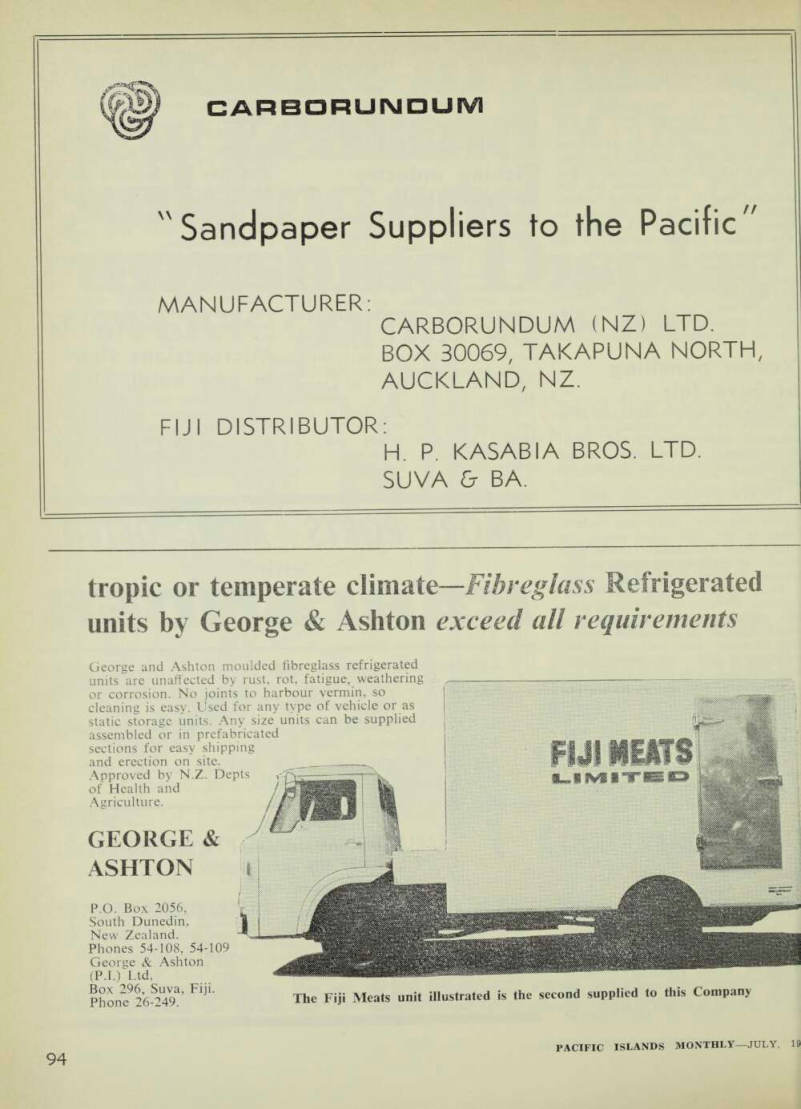
Two NZ firms, Fletcher Industries and New Zealand Steel Ltd, hold 16 per cent of the equity in a steel rol ling mill now being built in Suva.
This mill may draw some of its steel billets from New Zealand. The $750,000 steel reinforcing mill aims at eventually supplying all Pacific markets.
New Zealand Steel Ltd, in four years, has become a successful
marketer of galvanised sheet in the Islands. It also makes the base material for decorative roof tiles, which are in demand in the Islands.
The latest figure for exports over 12 months by this company to the Pacific was $900,000. The company believes it can soon reach $2 million a year in the area.
Lockwood International, of Rotorua, is selling specially-built hurricane-proof homes in the Pacific.
They are built of treated radiata sheathed in aluminium. The company expects to top the $1 million mark in sales to the Pacific in the current year. The hurricane-proof house has already been tested in a number of “big blows” and none has had to be repaired. The house has a specialised interlocking system, which features
a unique anti-hurricane reinforcing
rod system, bolted invisibly inside the solid wall, from roof trusses to foundation blocks.
Alex Harvey Industries Ltd has an annual export trade with Fiji worth about $1 million. It has now set up a branch in Suva to make pvc pipes, polythene film, cans and louvres. Two Auckland firms in the
Harvey group, L. J. Fisher and Co Ltd and Harvey Tile Co, are making protected metal roof tiling for the Islands.
The appliance field is another where New Zealand has built up a big market. One firm recently won a $500,000 contract to air-condition the first stage of the Pacific Harbour project at Deuba. That firm has already installed air-conditioning plant in Tonga and Niue.
In the last five years, McAlpine Refrigeration Ltd. has seen exports to the South Pacific jump from $47,000 in 1967-68 to almost $700,000 in 1971-72.
Clyde Engineering Ltd, of Lower Hutt, has set up a branch in Suva to sell industrial machinery in the South Pacific.
New Zealand is in a good position to capture an even larger share of the Pacific market. Australian re valuation has helped. Regular ship ping services to more territories and rising standards of packaging, sales manship and distribution are all in her favour. Her traditional trading area was the triangle of Island groups to the north—Fiji, Samoa and Tonga
The steel rolling mill in which two Now Zealand firms are interested takes shape in Suva's Walu Bay.
and the Cook Islands—plus Niue.
Now she goes as far east as Tahiti and west to Papua New Guinea, taking in the BSIP, the New Hebrides and New Caledonia on the way.
Pacific export figures show how rapidly New Zealand’s trade in that area has increased. In 1971, exports were up 22.5 per cent on 1970, and were worth $26.2 million. Fiji trade, worth $10.41 million, was up 36 per cent on 1970. New Zealand was the principal supplier to Western Samoa, selling goods worth $3 million. In Tonga, with sales of $1.5 million, New Zealand had 37 per cent of the market.
The New Caledonia market was worth $4 million, French Polynesia $4.3 million and American Samoa $2.26 million. New Zealand was the second biggest supplier, next to the US, to American Samoa.
Veneer panelling
at Suva fair
Bond and Rundle Ltd are New Zealand’s largest manufacturers of veneered wood panelling and they’ll be prominent at the New Zealand Building and Furnishing Display at Suva.
The firm produces a wide range of plywood panelling, some in imported woods like teak, sapele and walnut, some in the high class woods for which New Zealand is famous. All Bond and Rundle products are treated against termites and fungus.
This Auckland factory also manu factures Corinite Tru-Grain, a life like reproduction of wood panelling which appeals to customers looking for economy and uniformity. The panelling is made from photographic reproductions of practically any quality wood you like to name. The blown-up photograph is fused, not glued, to a plywood or particle board base under pressure at very high temperature and it even feels like wood grain veneer.
Tuna for Christmas!
A commercial tuna fishing project at Christmas Island is under way, but still has a long way to go before it is an accomplished fact. The project which will cost about $1 million, has been before the GEIC Executive Council, which passed it on to /arious departments for further scrutiny. It will then be submitted o the Foreign and Commonwealth Jffice in London.
The plan was prepared by Mr Jim Jughson, Chief Fisheries Develop nent Officer, who based it on the esults of a 16 months’ survey by Mr John Watt, of the Fisheries
Development Office on Christmas Island, which showed substantial re sources of surface tuna, sufficient to start a pilot commercial project.
Mr Hughson’s plan calls for a fleet of 20 30-35 ft fishing boats, with a mother ship, and freezing capacity to handle fish while the mother ship is selling catches elsewhere.
Fishing industry
for Marshalls
The fish resources of Micronesia will be exploited by a joint enterprise, the Marshall Islands Development Authority (MIDA) and the giant San Francisco food firm, Del Monte Corporation. The two parties have been negotiating an agreement for several months. Del Monte has yet to formally accept the agreement, but as it was a party to negotiations, acceptance is not likely to be withheld.
The enterprise will come into full commercial operation in three stages: • Del Monte Marshalls (as the new company is expected to be named) will start fishing, using a refrigerator barge, formerly a US naval ship. In the first year frozen
fish will be exported and fresh fish supplied to the local market; • Shore facilities, including a reefer, boat repair facilities, and more modern equipment needed for a full-scale shore operation, will be installed; • Setting up a processing plant, including a cannery, if one seems feasible, and provided the present US tariff laws are amended to allow free entry of Micronesian goods.
In the initial period Del Monte and MIDA will own all the shares.
Later MIDA shares may be bought by Micronesians.
Congress of Micronesia represen tative, Mr Charles Dominick, who is chairman of MIDA, said: “Shore facilities, when finally constructed, will provide new jobs and enhance the economic growth of the islands”.
Micronesians share
in new hotel
Micronesians will be given a share in a new 200-room hotel—the Saipan Beach Inter-Continental Inn beside Tanapac lagoon. This was announced recently by Mr Edward Swofford, a vice-president of Pan American Air
ways, of which Inter-Continental is a subsidiary. The hotel will be built •on a 7i-acre property by Pacific Micronesia Corporation.
Another Inter-Continental venture iis a 250-room hotel at Momi Bay, :about 15 miles from Nadi Airport.
This hotel will be finished late in 1974. It will be managed by Hos ipitality Hotel Management Corpora- Jtion, of Texas.
Micronesians to get
development bank
A development bank, rather than general commercial banks, would best meet the needs of Micronesians, says Mr Peter T. Coleman, Deputy High Commissioner, and also chair man of the Bank of Micronesia. The board of the Bank of Micronesia, after a long study, is close to reaching a decision in favour of the develop ment bank.
The theory behind a development bank was that it made available lecessary capital on a long-range ligh-risk loan arrangement, rather han on a strict collateral and ;ecurity-directed loan basis. The alter type of loan was available at :ommercial banks in Micronesia.
The board’s recommendation, when lecided, will go to the Congress of Micronesia, which authorised setting ip the Bank of Micronesia.
Mr Coleman said it was hoped the levelopment bank would be in operation by 1974.
"ocoo and copra
prices boom
A combination of drought and ood has helped to lift cocoa and opra prices to the highest levels for ;veral years. There is a world bortage of both commodities.
The cocoa market started to spiral i April and in May reached almost jcord levels. The Papua New Guinea rice on May 3 was $742 a ton fob. y May 24 it had risen to $994. here was a levelling off later in ie month and by the third week in me the July/September shipment as quoted at $829 and the October/ lecember shipment at $784. The
[arket was continuing strong,
though not expected to exceed the [ay 24 price.
Two factors contributed to the 5e drought in the main growing eas of West Africa (Ghana and igeria) and South America (Brazil) id a rush by chocolate manufac rers and speculators for cocoa :ans. Papua New Guinea produc )n also suffered from the drought
but the high prices to some extent are offset by smaller shipments.
The drought is also expected to affect the yield from the main African crop, to be harvested later this year.
With production down, buyers are using up reserve stocks, recently estimated at barely sufficient for
three months. This will fulfil forecasts that world cocoa bean con sumption in the 1972-73 year (to September 30) would exceed produc tion by 126,000 tons, and that sup plies would have to come from dwindling reserves.
Drought in the Philippines and
flooding of the Mississippi River were the “bed fellows” which lifted copra prices to the highest level for at least 12 months. Two years ago a long-shoremen’s strike on the US west coast virtually eliminated the United States as a copra and coconut oil buyer, and Europe was unable to absorb the resultant glut.
Now the world is short of vege table oils because of the Philippines’ drought and the Mississippi River flooding which has disrupted the soya bean planting programme. It is unlikely that either source will return to full production for another year.
Meantime, Pacific Islands growers are starting to recoup some of the losses which hit them heavily over
the last two years. In Fiji, prosperity showed signs of returning to some of the embattled plantations with deliveries of 10,070 tons of copra to the mills in the first 19 weeks of 1973. In the first 19 weeks of 1972 the deliveries totalled 9,517 tons.
In 1972, depending on grade, the prices in the first five months ranged from $40.25 to $88.25. This year the range was $47.75 to $128.75, with sharp rises in April, followed by equally sharp increases early in May.
By May’s end the price for the best grade was $lB4.
In May in Papua New Guinea, prices were lifted by $l7 a ton and in the GEIC by $23.
Early in June Tonga growers got
an increase of $29.40 a ton, to take the first grade to $130.60 and second grade to $124.60. Those prices were double the February rates and an increase of $76.60 this year.
During May the demand for copra in the US was so strong that prices reached $3OO. The market was in clined to be erratic because buyers withdrew and later returned.
Sugar is also booming. Red China has become a customer in Australia’s sugar market and this has had an effect on world prices. With prices so high, however, producers should use history as their guide. The boom of 1963 deteriorated into something like a slump.