Pacific Shipping
pp. 95-97 · Read in the full issue
Fiji's Ports And Wharfies Need Big
Improvements For Container Age
Fiji should take itself into the con tainer age with a special wharf of about 1,000 feet and a back-up area of about 25 acres to stack and store containers, and to act as a container freight station. This is one of many recommendations made by a com mission of inquiry into Fiji ports.
Apart from occasional small parcels of containers in conventional ships, the handling of combo and cellular container ships should be at a new terminal in another part of Suva harbour. Existing wharf facilities at Suva, taking into account growth rates of shipping and cargo, should cater for conventional and unit re quirements up to 1977.
The report was released as Fiji was about to receive its first full container service by the Union Steam Ship Co of NZ Ltd in a Tarros dass ship. Suva can probably handle container ships of this size without too much difficulty, but a container ship needs special wharf facilities and loading and unloading areas.
As Suva’s narrow streets are not made for the prime movers required to handle container cargoes, the commission’s recommendation for a container area of 25 acres is timely.
In Lautoka, there is plenty of open land near the wharf area for a container depot, if and when Lautoka comes into the container scheme. The comparatively new wharves at Suva and Lautoka were well on the way to completion before container ships became fashionable.
Major recommendations were that a ports authority, under the Minister for Communications, Works and Tourism, should be set up, and that the authority be as independent and free of political influence as possible.
Fiji has its own Marine Department at present, which grew from an oft forgotten section of the Customs Department operating under the direction of the Harbour Master.
The commission suggests that the authority, consisting of up to nine members, should have control of
planning, developing, administering
and operating the port industry of Fiji, and have power to raise loans.
An authority would be the sole employer of waterfront labour, and would exercise direct supervision of every phase of wharf operations— on board ship and anywhere within wharf or harbour areas. That would do away with the Labour Utilisation Board.
The commission was critical of the present system of working ships. It said Fiji labour tended to be flabby,
lacking in formal and organised training and ignorant of modern methods of cargo handling and skill.
The waterside worker was an im portant unit and had much to con tribute to the progress and prosperity of the ports and country. He needed to be responsible, loyal and dedicated.
It was unlikely that private enter prise, including the shipping com munity, could provide a highly trained ports labour force. Therefore, in the port of Suva, the authority
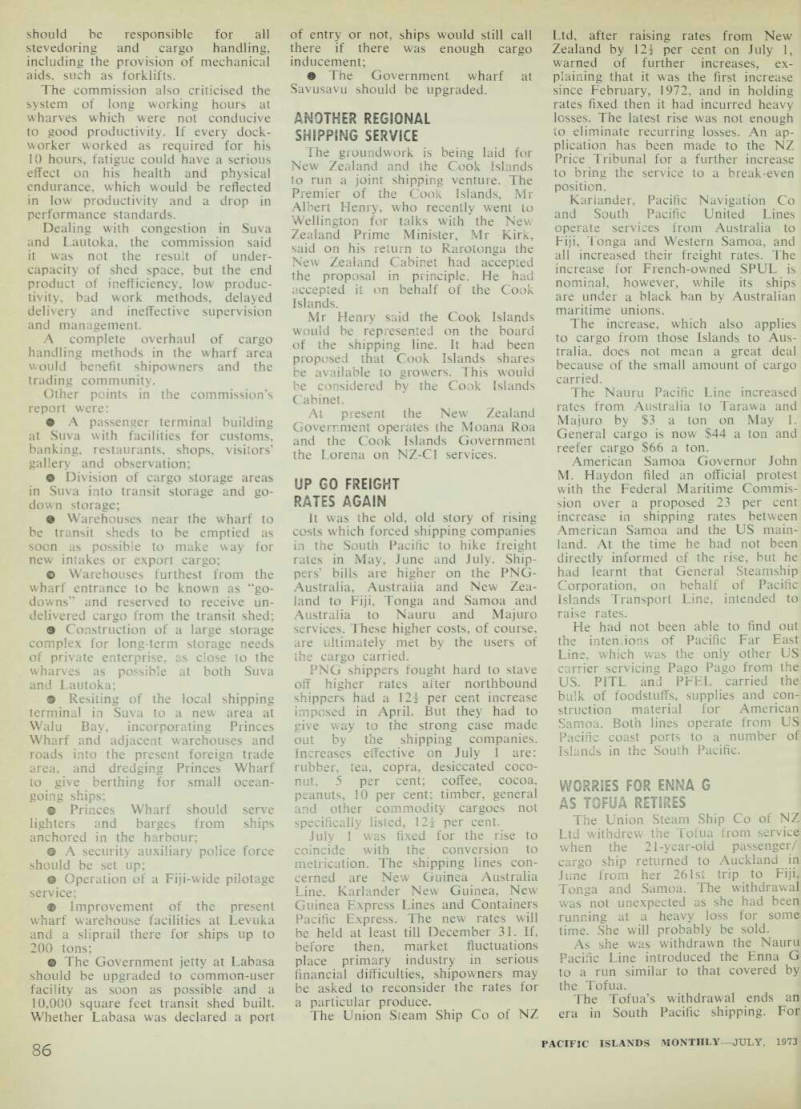
The new Columbus Line container carrier, Columbus Canada in Sydney Harbour. She is one of three new container ships Columbus will put on the Australia-American west coast service which will call at the GEIC, when the containers can be landed at Tarawa. The Columbus Canada has capacity for 400 20 ft containers, of which 140 can be refrigerated. The ships have 35-ton capacity cranes, which enable them to unload independently, if necessary. They have a service speed of 18 knots.
GEIC will have the best shipping service it ever had when the Columbus Shipping Line solves the problem of landing containers at Tarawa from its new ships, says the managing director of Columbus Overseas Services Pty Ltd, Mr H. W. Rilk. Mr Rilk told PIM in mid-June that the new container ships were not yet calling at Tarawa because the line has not yet solved the problem of landing the containers.
"We are working on the problem and will come up with a solution," he said. Mr Rilk was reluctant to give a time for solving the problem, but he thought it could be overcome in about eight weeks.
should be responsible for all stevedoring and cargo handling, including the provision of mechanical aids, such as forklifts.
The commission also criticised the system of long working hours at wharves which were not conducive to good productivity. If every dock worker worked as required for his 10 hours, fatigue could have a serious effect on his health and physical endurance, which would be reflected in low productivity and a drop in performance standards.
Dealing with congestion in Suva and Lautoka, the commission said it was not the result of under capacity of shed space, but the end product of inefficiency, low produc tivity, bad work methods, delayed delivery and ineffective supervision and management.
A complete overhaul of cargo handling methods in the wharf area would benefit shipowners and the trading community.
Other points in the commission’s report were: © A passenger terminal building at Suva with facilities for customs, banking, restaurants, shops, visitors’ gallery and observation; © Division of cargo storage areas in Suva into transit storage and go down storage; @ Warehouses near the wharf to be transit sheds to be emptied as soon as possible to make way for new intakes or export cargo; © Warehouses furthest from the wharf entrance to be known as “go downs” and reserved to receive un delivered cargo from the transit shed; 9 Construction of a large storage complex for long-term storage needs of private enterprise, as close to the wharves as possible at both Suva and Lautoka; 9 Resiting of the local shipping terminal in Suva to a new area at Walu Bay, incorporating Princes Wharf and adjacent warehouses and roads into the present foreign trade area, and dredging Princes Wharf to give berthing for small ocean going ships; © Princes Wharf should serve lighters and barges from ships anchored in the harbour; © A security auxiliary police force should be set up; @ Operation of a Fiji-wide pilotage service; ® Improvement of the present wharf warehouse facilities at Levuka and a sliprail there for ships up to 200 tons; © The Government jetty at Labasa should be upgraded to common-user facility as soon as possible and a 10,000 square feet transit shed built.
Whether Labasa was declared a port
of entry or not, ships would still call there if there was enough cargo inducement; © The Government wharf at Savusavu should be upgraded.
Another Regional
Shipping Service
The groundwork is being laid for New Zealand and the Cook Islands to run a joint shipping venture. The Premier of the Cook Islands, Mr Albert Henry, who recently went to Wellington for talks with the New Zealand Prime Minister, Mr Kirk, said on his return to Rarotonga the New Zealand Cabinet had accepted the proposal in principle. He had accepted it on behalf of the Cook Islands.
Mr Henry said the Cook Islands would be represented on the board of the shipping line. It had been proposed that Cook Islands shares be available to growers. This would be considered by the Cook Islands Cabinet.
At present the New Zealand Government operates the Moana Roa and the Cook Islands Government the Lorena on NZ-CI services.
Up 60 Freight
Rates Again
It was the old, old story of rising costs which forced shipping companies in the South Pacific to hike freight rates in May, June and July. Ship pers’ bills are higher on the PNG- Australia, Australia and New Zea land to Fiji, Tonga and Samoa and Australia to Nauru and Majuro services. These higher costs, of course, are ultimately met by the users of the cargo carried.
PNG shippers fought hard to stave off higher rates after northbound shippers had a 12k per cent increase imposed in April. But they had to give way to the strong case made out by the shipping companies.
Increases effective on July 1 are: rubber, tea, copra, desiccated coco nut, 5 per cent; coffee, cocoa, peanuts, 10 per cent; timber, general and other commodity cargoes not specifically listed, 12k per cent.
July 1 was fixed for the rise to coincide with the conversion to metrication. The shipping lines con cerned are New Guinea Australia Line, Karlander New Guinea, New Guinea Express Lines and Containers Pacific Express. The new rates will be held at least till December 31. If, before then, market fluctuations place primary industry in serious financial difficulties, shipowners may be asked to reconsider the rates for
a particular produce.
The Union Steam Ship Co of NZ
Ltd. after raising rates from New Zealand by 12k per cent on July 1, warned of further increases, ex plaining that it was the first increase since February, 1972, and in holding rates fixed then it had incurred heavy losses. The latest rise was not enough to eliminate recurring losses. An ap plication has been made to the NZ Price Tribunal for a further increase to bring the service to a break-even position.
Karlander, Pacific Navigation Co and South Pacific United Lines operate services from Australia to Fiji, Tonga and Western Samoa, and all increased their freight rates. The increase for French-owned SPUL is nominal, however, while its ships are under a black ban by Australian maritime unions.
The increase, which also applies to cargo from those Islands to Aus tralia, does not mean a great deal because of the small amount of cargo carried.
The Nauru Pacific Line increased rates from Australia to Tarawa and Majuro by $3 a ton on May L General cargo is now $44 a ton and reefer cargo $66 a ton.
American Samoa Governor John M. Haydon filed an official protest with the Federal Maritime Commis sion over a proposed 23 per cent increase in shipping rates between American Samoa and the US main land. At the time he had not been directly informed of the rise, but he had learnt that General Steamship Corporation, on behalf of Pacific Islands Transport Line, intended to raise rates.
He had not been able to find out the intendons of Pacific Far East Line, which was the only other US carrier servicing Pago Pago from the US. PITL and PFEL carried the bulk of foodstuffs, supplies and con struction material for American Samoa. Both lines operate from US Pacific coast ports to a number of Islands in the South Pacific.
Worries For Emma G
As Tofua Retires
The Union Steam Ship Co of NZ Ltd withdrew the Tofua from service
when the 21-year-old passenger/
cargo ship returned to Auckland in June from her 261st trip to Fiji, Tonga and Samoa, The withdrawal was not unexpected as she had been running at a heavy loss for some time. She will probably be sold.
As she was withdrawn the Nauru Pacific Line introduced the Enna G to a run similar to that covered by the Tofua.
The Tofua’s withdrawal ends an era in South Pacific shipping. For
many years the Tofua and Matua were the main supply ships for Fiji, Samoa, Niue and Tonga. In fact, local calendars were often marked “Tofua Day” or “Matua Day”, so rarely did some island ports see an overseas ship.
The Tofua went into service in January, 1952. She had only two masters —Captain N. H. Pearson, who sailed her out from Scotland on her delivery voyage, and Captain Peter Bennett, who was masier of the Matua before he succeeded Captain Pearson. Captain Pearson retired in 1963 and died about a year ago.
The Nauru Pacific Line’s Enna G was strike bound in New Zealand before it could make its first voyage on its new run—Auckland-Fiji- Tonga-Samoa. She was about to leave Wellington, where she had been in dry dock, for Auckland, when 23 Fijian seamen walked off after a dis pute over pay.
Mr Vin Brown, NZ representative of Nauru Pacific Line, said the sea men walked off at the instigation of the NZ Seamen’s Union. The NZ union told the Wellington Harbour Board it was boycotting the Enna G.
The Island members of the crew are paid about SF9S a month.
Nauru Pacific Line flew 12 Nauruans to Wellington as an advance party to replace the strikers.
But the president of the NZ Sea men s Union, Mr W. Martin, said if Nauru Pacific was thinking of sail ing with a replacement crew, “they have got another think coming”. The Seamen’s Union declared the ship black when Fijians walked off.
Rust Bucket Will
Be Sunk
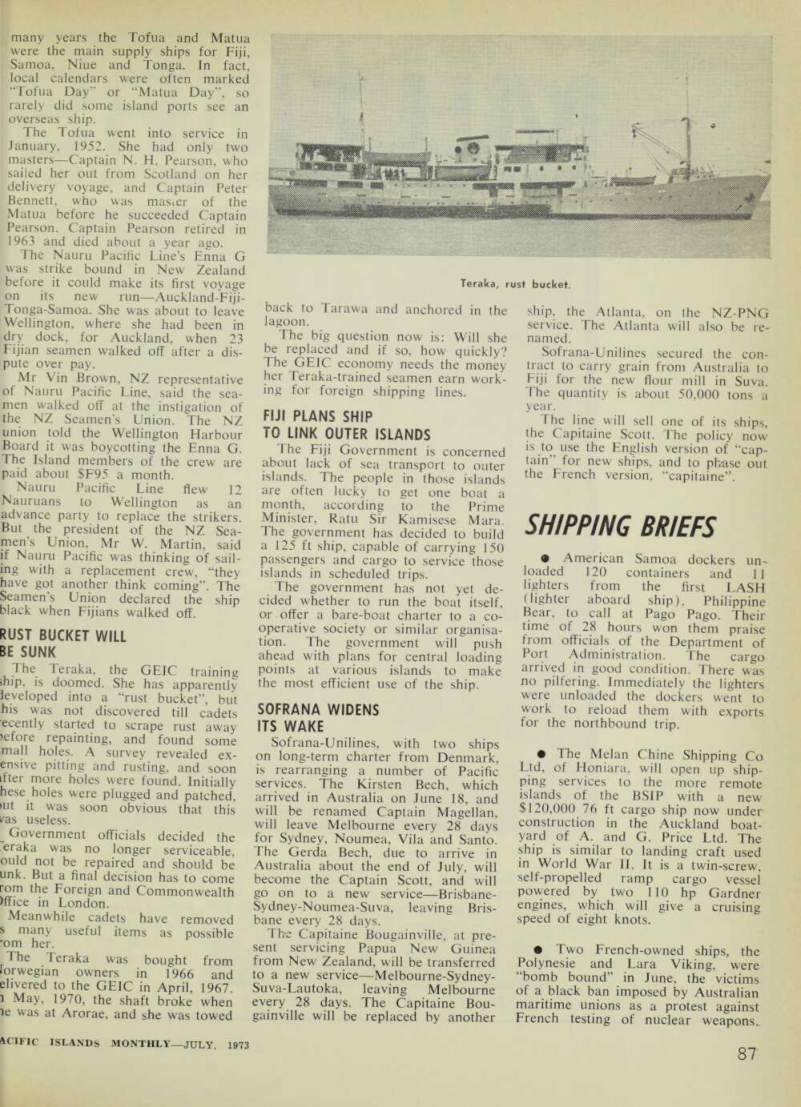
The Teraka, the GEIC training »hip, is doomed. She has apparently leve loped into a “rust bucket”, but his was not discovered till cadets ecently started to scrape rust away )efore repainting, and found some mall holes. A survey revealed ex ensive pitting and rusting, and soon ifter more holes were found. Initially hese holes were plugged and patched, •ut it was soon obvious that this vas useless, „ Government officials decided the eraka was no longer serviceable, ould not be repaired and should be unk. But a final decision has to come rom the Foreign and Commonwealth fffice in London.
Meanwhile cadets have removed s many useful items as possible 'om her.
The Teraka was bought from lorwegian owners in 1966 and ehvered to the GEIC in April, 1967. i May, 1970, the shaft broke when le was at Arorae, and she was towed
back to Tarawa and anchored in the lagoon.
The big question now is: Will she be replaced and if so, how quickly?
The GEIC economy needs the money her Teraka-trained seamen earn work ing for foreign shipping lines.
Fiji Plans Ship
To Link Outer Islands
The Fiji Government is concerned about lack of sea transport to outer islands. The people in those islands are often lucky to get one boat a month, according to the Prime Minister, Ratu Sir Kamisese Mara.
The government has decided to build a 125 ft ship, capable of carrying 150 passengers and cargo to service those islands in scheduled trips.
The government has not yet de cided whether to run the boat itself, or offer a bare-boat charter to a co operative society or similar organisa tion. The government will push ahead with plans for central loading points at various islands to make the most efficient use of the ship.
Sofrana Widens
Its Wake
Sofrana-Unilines, with two ships on long-term charter from Denmark, is rearranging a number of Pacific services. The Kirsten Bech, which arrived in Australia on June 18, and will be renamed Captain Magellan, will leave Melbourne every 28 days for Sydney, Noumea, Vila and Santo.
The Gerda Bech, due to arrive in Australia about the end of July, will become the Captain Scott, and will go on to a new service—Brisbane- Sydney-Noumea-Suva, leaving Bris bane every 28 days.
The Capitaine Bougainville, at pre sent servicing Papua New Guinea from New Zealand, will be transferred to a new service—Melbourne-Sydney- Suva-Lautoka, leaving Melbourne every 28 days. The Capitaine Bou gainville will be replaced by another
ship, the Atlanta, on the NZ-PNG service. The Atlanta will also be re named.
Sofrana-Unilines secured the con tract to carry grain from Australia to Fiji for the new flour mill in Suva.
The quantity is about 50,000 tons a year.
The line will sell one of its ships, the Capitaine Scott. The policy now > s .to use the English version of “cap tain” for new ships, and to phase out the French version, “capitaine”.
Shipping Briefs
• American Samoa dockers un loaded 120 containers and 11 lighters from the first LASH (lighter aboard ship), Philippine Bear, to call at Pago Pago. Their time of 28 hours won them praise from officials of the Department of Port Administration. The cargo arrived in good condition. There was no pilfering. Immediately the lighters were unloaded the dockers went to work to reload them with exports for the northbound trip. • The Melan Chine Shipping Co Ltd, of Honiara, will open up ship ping services to the more remote islands of the BSIP with a new $120,000 76 ft cargo ship now under construction in the Auckland boat yard of A. and G. Price Ltd. The ship is similar to landing craft used in World War 11. It is a twin-screw, self-propelled ramp cargo vessel powered by two 110 hp Gardner engines, which will give a cruising speed of eight knots. • Two French-owned ships, the Polynesie and Lara Viking, were “bomb bound” in June, the victims of a black ban imposed by Australian maritime unions as a protest against French testing of nuclear weapons.
Teraka, rust bucket.