Samoa’s Albert Wendt:
pp. 79-80 · Read in the full issue
Pacific Personality
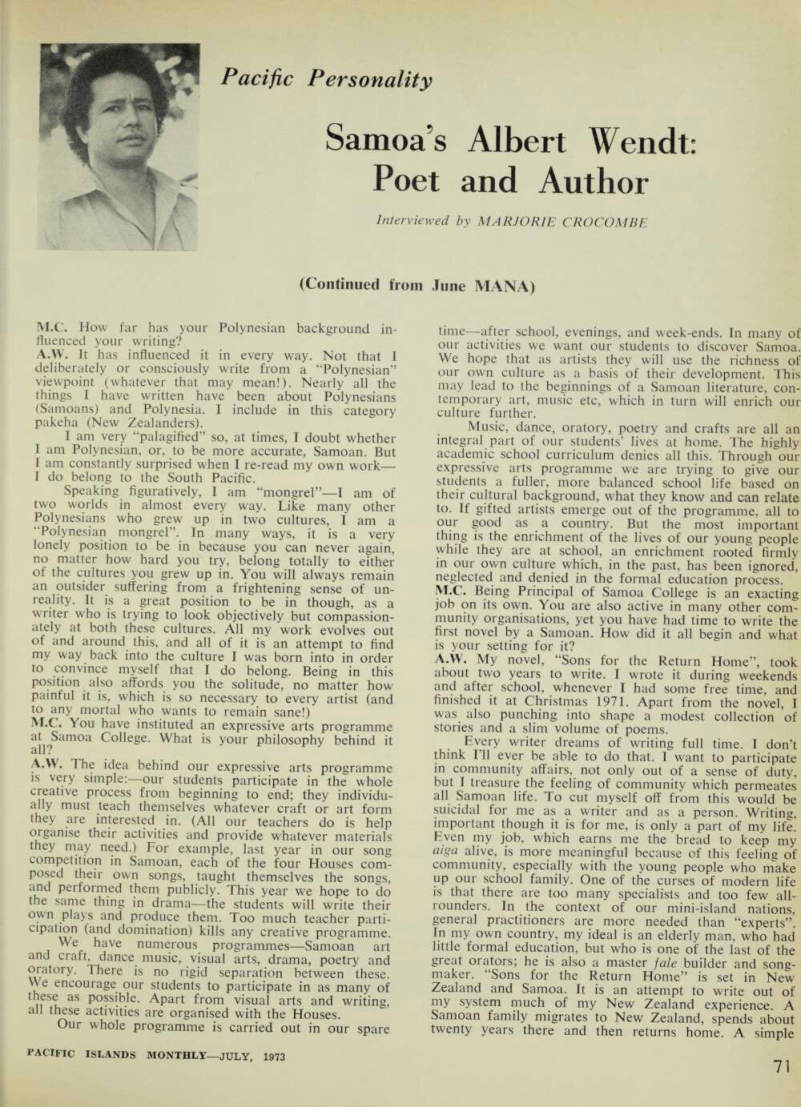
Samoa’s Albert Wendt: Poet and Author
Interviewed by MARJORIE CROCOMBE
(Continued from June MANA)
M.C. How far has your Polynesian background in fluenced your writing?
A.W. It has influenced it in every way. Not that I deliberately or consciously write from a “Polynesian” viewpoint (whatever that may mean!). Nearly all the things I have written have been about Polynesians (Samoans) and Polynesia. I include in this category pakeha (New Zealanders).
I am very “palagified” so, at times, I doubt whether I am Polynesian, or, to be more accurate, Samoan. But I am constantly surprised when I re-read my own work— I do belong to the South Pacific.
Speaking figuratively, I am “mongrel”—l am of two worlds in almost every way. Like many other Polynesians who grew up in two cultures, I am a “Polynesian mongrel”. In many ways, it is a very lonely position to be in because you can never again, no matter how hard you try, belong totally to either of the cultures you grew up in. You will always remain an outsider suffering from a frightening sense of un reality. It is a great position to be in though, as a writer who is trying to look objectively but compassion ately at both these cultures. All my work evolves out of and around this, and all of it is an attempt to find my way back into the culture I was born into in order to convince myself that I do belong. Being in this position also affords you the solitude, no matter how painful it is, which is so necessary to every artist (and to any mortal who wants to remain sane!) M.C. You have instituted an expressive arts programme at Samoa College. What is your philosophy behind it all?
A.W. The idea behind our expressive arts programme is very simple:—our students participate in the whole creative process from beginning to end; they individu ally must teach themselves whatever craft or art form they are interested in. (All our teachers do is help organise their activities and provide whatever materials they may need.) For example, last year in our song competition in Samoan, each of the four Houses com posed their own songs, taught themselves the songs, and performed them publicly. This year we hope to do the same thing in drama—the students will write their own plays and produce them. Too much teacher parti cipation (and domination) kills any creative programme.
We have numerous programmes—Samoan art and craft, dance music, visual arts, drama, poetry and oratory. There is no rigid separation between these.
We encourage our students to participate in as many of these as possible. Apart from visual arts and writing, all these activities are organised with the Houses.
Our whole programme is carried out in our spare
time—after school, evenings, and week-ends. In many of our activities we want our students to discover Samoa.
We hope that as artists they will use the richness of our own culture as a basis of their development. This may lead to the beginnings of a Samoan literature, con temporary art, music etc, which in turn will enrich our culture further.
Music, dance, oratory, poetry and crafts are all an integral part of our students’ lives at home. The highly academic school curriculum denies all this. Through our expressive arts programme we are trying to give our students a fuller, more balanced school life based on their cultural background, what they know and can relate to. If gifted artists emerge out of the programme, all to our good as a country. But the most important thing is the enrichment of the lives of our young people while they are at school, an enrichment rooted firmly in our own culture which, in the past, has been ignored, neglected and denied in the formal education process, M.C. Being Principal of Samoa College is an exacting job on its own. You are also active in many other com munity organisations, yet you have had time to write the first novel by a Samoan. How did it all begin and what is your setting for it?
A.W. My novel, “Sons for the Return Home”, took about two years to write. I wrote it during weekends and after school, whenever I had some free time, and finished it at Christmas 1971, Apart from the novel, I was also punching into shape a modest collection of stories and a slim volume of poems.
Every writer dreams of writing full time. I don’t think I’ll ever be able to do that. I want to participate in community affairs, not only out of a sense of duty, but I treasure the feeling of community which permeates all Samoan life. To cut myself off from this would be suicidal for me as a writer and as a person. Writing, important though it is for me, is only a part of my life.
Even my job, which earns me the bread to keep my aiga alive, is more meaningful because of this feeling of community, especially with the young people who make up our school family. One of the curses of modern life is that there are too many specialists and too few all rounders. In the context of our mini-island nations, general practitioners are more needed than “experts”.
In my own country, my ideal is an elderly man, who had little formal education, but who is one of the last of the great orators; he is also a master fale builder and song maker. “Sons for the Return Home” is set in New Zealand and Samoa. It is an attempt to write out of my system much of my New Zealand experience. A Samoan family migrates to New Zealand, spends about twenty years there and then returns home. A simple
love story holds the book together. I hope it’s an honest book. It at least tries to see New Zealand and Samoan societies from the viewpoint of a Pacific Islander. I think it’s going to upset and hurt (and even anger) many people in Samoa and New Zealand, even people I’m very close to and love. But it had to be written. I’m not much for compromising. To compromise with one’s integrity and honesty as a writer is a betrayal of one’s gift.
M.C. What is your message to others in the Islands who would like to write stories, poetry or music, create dance and drama, or paint?
A.W. No message as such. Just start now and keep working at it. It’s a lonely and difficult but enjoyable game. Just keep working, working, working, at it. Don’t worry about getting published or acknowledged. Any art form, if you work at it, is the most demanding form of self-discipline. Nobody can teach you, you’ve got to teach yourself—this is the only way you can discover the limitations of your talent, the only way you can pre serve, refine, and develop your own individual style and voice. And you’ve got to keep doing this until you go six feet down. Never become satisfied with your work.
And don’t sell out. True most of our mini-islander kingdoms are awaiting tourists (according to the gospels of our merchant prophets and experts and mini-leaders), but don’t sell out. The price is too high.
And don’t forget, brothers, art is for man’s sake.
It’s going to be rough going: the whiskey rot and flab, the grope of steel and hygienic plastic, the colonial technicolour Hollywood dream, all of the bourgeois death (and our so-called traditional societies are mightily bourgeois), are upon us. Perhaps we should go to our Christian churches and pray and sing and dance to our ancient gods. And sing up loud and clear no matter what incantation or chant or litany you may choose. And watch where you kneel—you may kneel on splintered, stained glass or on government sub sidised, mass-produced barbed-wire!