Custom Stories Of The
p. 78 · Read in the full issue
New Hebrides
Introduced by ANNE STAMFORD
THE telling of custom stories is very much a live art in the New Hebrides. Fathers and mothers, uncles and aunts, grandfathers and grand mothers still tell the children stories in the evenings when they come home after a day’s work in the gardens and eat their last meal of the day before going to bed. The women too tell stories among themselves as they weave their mats and baskets out of pandanus leaves, and the men as they sit in the meeting house drinking kava until late at night.
Because of the tremendous diversity of language and culture in the New Hebrides there is great variety in the stories. Few are common to the whole group, though local variations of the same story may be found on several neighbouring islands, for example the Tagaro stories of Aoba, Maewo and northern Pentecost or the Qat stories of the Banks.
THE story that Jerry lakavi tells is with minor variations common to many parts of the group from the Banks Islands in the north, the Shepherd Group in the centre, to Jerry’s own island of Tanna in the south. It also has its counterparts in the rest of the world, in Europe and other areas outside the Pacific region.
It has therefore what may be called a theme of universal interest, that of marriage with someone not of one’s own people and of the heartbreak that follows the break-up of such a marriage.
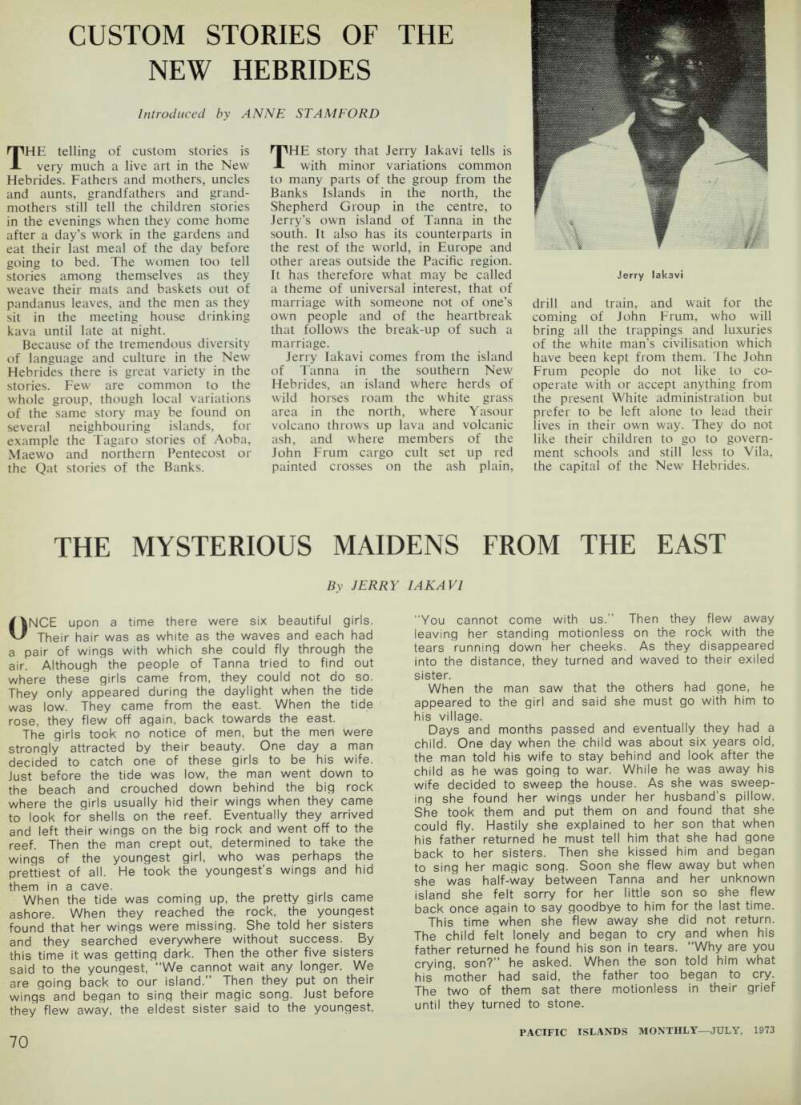
Jerry lakavi comes from the island of Tanna in the southern New Hebrides, an island where herds of wild horses roam the white grass area in the north, where Yasour volcano throws up lava and volcanic ash, and where members of the John Frum cargo cult set up red painted crosses on the ash plain,
drill and train, and wait for the coming of John Frum, who will bring all the trappings and luxuries of the white man’s civilisation which have been kept from them. The John Frum people do not like to co operate with or accept anything from the present White administration but prefer to be left alone to lead their lives in their own way. They do not like their children to go to govern ment schools and still less to Vila, the capital of the New Hebrides.
Jerry lakavi