Yhak Farn
pp. 73-74 · Read in the full issue
By Alison Fong
T are dimmishing llln and blr onlv OU the rustling of the leaves is heard Children’s voices carrv nvpr evening air; a bicyck passes with i jangle of notes. Y P th Outside Mother +• call to the ‘‘"a generallv to d F “Yhak farn yhak farn ”
Eat rice) while the eldest daughter' standing over a not at tF? UB^ ter ’ ploughs loose the rice with ° V a wooden spoon h “Farn lov vhak farn” (r and eat rice) Y Mother rallc from the backyard rat P t 8 thrice The children B nlav nn iu'oP’ begins to ! i the l leaves the gate to walk around “the f a pa!king y plTcT d for* h ra?ks iS u r n?u ly cessfnl in P i,~ I^ ns ucround walks backhand 8 gate She has becLn l g e. Mie has become used to the
“toe sarng”, the ways of these Chinese children born in Fiji.
Meanwhile Father has finished puttering around, washing the clean ing cloths and flaying the sacks free of dust. The shop is shut and the round table is laid for the six mem bers of the family. The bowls are filled, the chopsticks ready. Father makes his way to his seat and sits down. Mother does the same, and the two girls take their places. The places of the two boys are empty.
Father picks up his chopsticks, lubricates them in his soup, takes his rice-bowl in one hand, and starts to manipulate the grains into his mouth. This is the signal for the others to start after the head of the house.
The young sister relates topics of interest from school. She is an swered by the busy clicking sounds of numerous pairs of chopsticks manipulating rice grains and pick
ing up P ieces of “soong”, those dlshes of meat and ve g etable s which accompany white boiled rice. The first few minutes are for eating. Only after . th e initial hunger pangs are alleviated does anyone speak. Father ‘ells of some event in his day in the shop. Father might say, Y “Those Fijian people, they are very rough”. ° r he mi § ht generalise with, “Those Indian people. You can never trust them”. Sweeping statements such as these do not really carry much malice. It is just that it recalls per haps one unpleasant incident. At other times Father might do a com plete volte-face and says generously: “That Indian boy has a lot of coml !? onsense ' He always pays you. Even ' The talk is $ about The *hop’ or the family, and during it the others add side comments while Mother eats silently. She does not speak often Half-way through the meal there are
ihree firm knocks on the backyard door. That is the pre-arranged “code” knock of the children. One of the girls slides back the bolt, and the vounger brother enters the yard, talking all the while like a garrulous cricket. The older brother has just returned from his afternoon jogging exercise so he goes to the tap and washes vigorously. Once inside, they fill their bowls and are soon assimi lated with those who are still eating.
The chirpy cricket of a younger brother is still talking. He gesticulates and acts how he carried out some prank. Father heroically tries to keep a straight face but he fails for our younger brother is a comedian.
Father eventually bursts into laughter and Mother laughs spontaneously for the first time during the meal.
“Dor jeh, ma”, (Thank you, ma) one of the children remembers to say as they leave the table and pick up their bowls, chopsticks, spoon and plates. But they remain in the vicinity of the table until their parents finish their meal. With a satisfied last click.
Father manoeuvres the few remaining grains of rice from the bowl to his mouth. He rests a while, then starts on his daily share of fruit, usually bananas, which he loves. Satisfied at last, he gets a few toothpicks and goes over to Mother.
“A toothpick, Mother?” he says.
He then chooses one for himself, sits down and starts cleaning his teeth with it. Washing up is left aside for a while. Now, with a full stomach, everyone contributes to the conver sation.
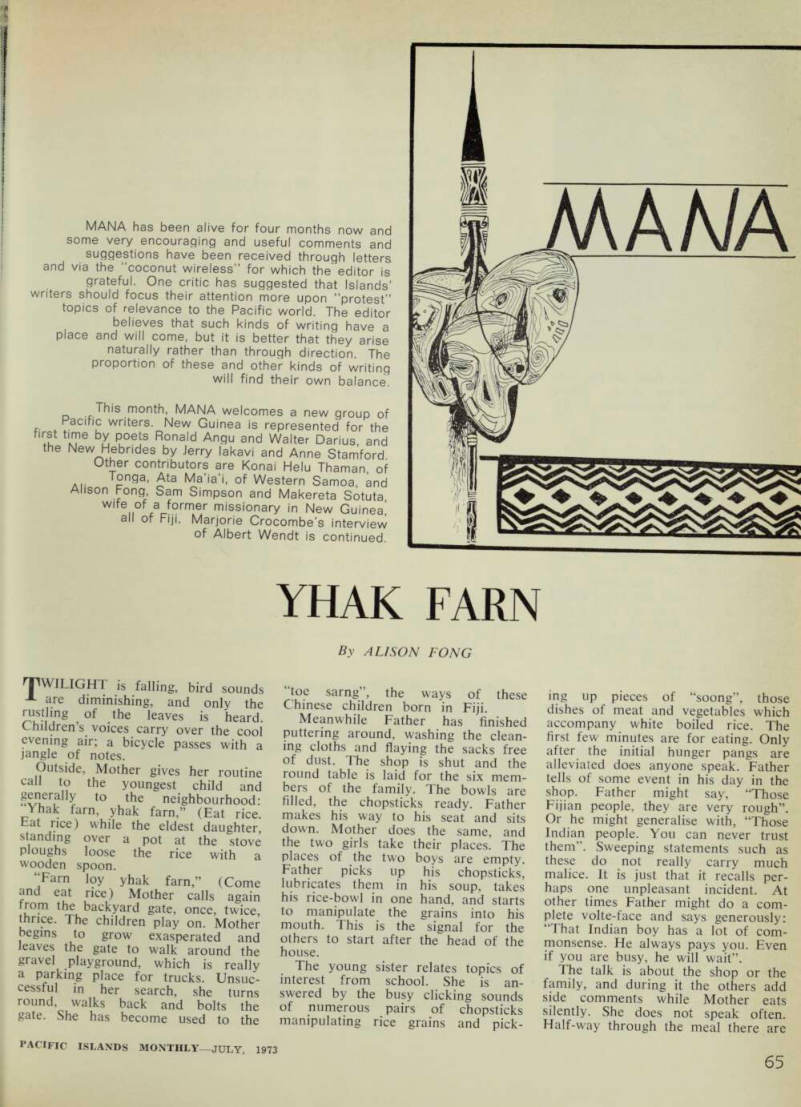
USP student, Alison Fong of Fiji, who is preparing a study of the Chinese community in Nausori.