* Footnotes
pp. 54-55 · Read in the full issue
Who's To Mediate
Between Moresby
And The Village
|AUE to the exigencies of editorial and printers’ deadlines, my June Footnotes were des patched before the House of Assembly’s Speaker, Barry Holloway, returned from an African tour with something to say on the same subject, namely, local government.
If press and radio reports of his views are to be relied on, he and I seem to be in agreement on one point—that the present local government system should be scrapped.
We also seem to agree that there should be local government at what he calls “community” and I call “village” level. In rural Papua New Guinea these two terms may be regarded as synonymous in most cases. Exceptions would be in re-settlement areas and perhaps in situations where the people of a cluster of hamlets com prise a single community.
Where we differ, if 1 have understood him correctly, is that Mr Holloway would not have
intermediate level decision-making bodies between the community or village on the one hand and central government on the other.
He appears to envisage that community councils would make their plans and then go to sub district or district administrative headquarters to plead their cause and obtain the green light and the wherewithal to carry out those plans.
Experiences in the past lead me
to suspect that they would be told to come back next week, or perhaps to go home and wait to be called. And they would wait a long, long time.
I am irreverent enough to suspect also that the brown kiaps of tomorrow will procrastinate just as much as the white kiaps of yesterday did. And inevitably so if they are merely the agents of a remote, centralised decision-making process.
I continue to maintain, as I have always done, that the establishment of intermediate level decision-making bodies is the only way in which there can be any hope of establishing national unity in Papua New Guinea without bloodshed.
The question then arises, at what level? Some years ago I advocated a level between that of our
present districts, of which there are 18, and that of our present regions, of which there are four.
Borrowing a term from Dr John Guise I sug gested that these units might be called “provinces”.
Nothing came of the idea, largely, I think, because at that time the tide of opinion was running strongly in the direction of centralisation.
Now time has run out on us. It is too late to devise and establish new units, and we have to choose between district government and regional government.
My own thinking has moved in the direction of a rather reluctant acceptance of the con cept of district government. But 1 have noted within the last few days that a well-known and highly regarded New Guinean, Water house Woiwoi, has made a sub mission to the Constitutional Planning Committee favouring a regional rather than a district level of intermediate government.
I can only hope that the com
mittee has accepted in principle the concept of intermediate government, and is prepared to keep an open mind about the level at which it should be established until it has completed its
grand tour.
When Osmar White’s Parliament of a Thousand Tribes was first published in 1965, I shied away from it, repelled by what I felt to be the journalese tang of the title. However, when it reappeared recently in an updated paperback edition, I decided to risk the modest sum of $1.75 on it. 1 was subsequently very glad I had done so, for I found it to be a book well able to hold its own alongside others of the same genre, such as Souter’s Last Unknown and Ryan’s Hot Land,
With Percy Chatterton
in Port Moresby
and definitely an easier book to read than either of them.
In a sympathetic chapter on Indonesia, White points out that the Indonesians have made their slogan of “Unity in Diversity” work by accepting “the premise that diverse communities were entitled to order their own business of daily living according to their own cultural traditions.
A central ‘national’ government required merely that they should acknowledge the confederation of all Indonesian communities, pay tribute where necessary to protect the confederation from foreign interference and exploitation, and refrain from forcible intervention in the affairs of neighbouring communities which might have different standards”.
White adds, “Any form less totalitarian at the federal level, or less permissive at the village level, would have blown the Republic apart”.
I find myself wondering how the practice of putting mountain pagans into pants and building mosques for coastal Christians, which is what is reported to have been happening in Irian Jaya, can be fitted into this rose-tinted picture. How ever, the concept, even if it is not always perfectly practised by its progenitors, is attractive; and Osmar White is probably right in suggesting that Papua New Guinea may have more to learn from the Indonesian than from the Westminster model.
JpOR a couple of years, from 1968 to 1970, I used “Niugini” in this column as con venient shorthand for the clumsy “Papua and New Guinea”, which was then the country’s official name. Then “Pagini” enjoyed a brief blossoming. Finally, or as it now seems semi finally, the House of Assembly rejected both “Niugini” and “Pagini” in favour of “Papua New Guinea”. Now “Niugini” appears to be staging a comeback.
It has been chosen as the name for PNG’s National Air Line, which is to be called “Air Niugini”; and there are strong rumours that the National Coalition Government intends to try to persuade the House of Assembly to adopt it as the name of the country.
The spelling “NIU GINI” has a long history.
It first appeared in print in a series of school books in Motu, prepared by Rev W. G. Lawes and published by the London Missionary Society in the 1870 s and 1880 s, and was in common use all along the southern coast of what was then British New Guinea till Australia changed the name of its newly-acquired colony to “Papua” sarly in the present century.
It is not, as has been wrongly asserted by some, the Pidgin spelling of New Guinea. This
is “Nu Gini”, a spelling which no doubt derives from the fact that most of the pisinophiles in post-war New Guinea have been Americans. They wrote NU because they pronounced it NU—as in Noo Yark.
It is true that Father Mihalic, in the latest edition of his famous dictionary, admits “Niu gini” as an alternative spelling—but grudgingly, in small print, and with obvious disapproval.
So Papuans, faced with the prospect of having their identity submerged in a wider one, can at least take some comfort in the fact that the new name for their country, if “Niugini” is indeed adopted, is of Papuan, not of New Guinean, origin.
T WISH that a happier simile could be found for the process of nation building than that used by one participant in the recent Waigani Seminar, namely, the word “weld”.
The process of welding calls for the application of very great heat, and if steel could talk I think that it would tell us that being welded is a most unpleasant experience for the material subjected to this process.
I would not like to see my Papuan and New Guinean friends being welded into a nation or into anything else, particularly if the job is to be done by PIR welders.
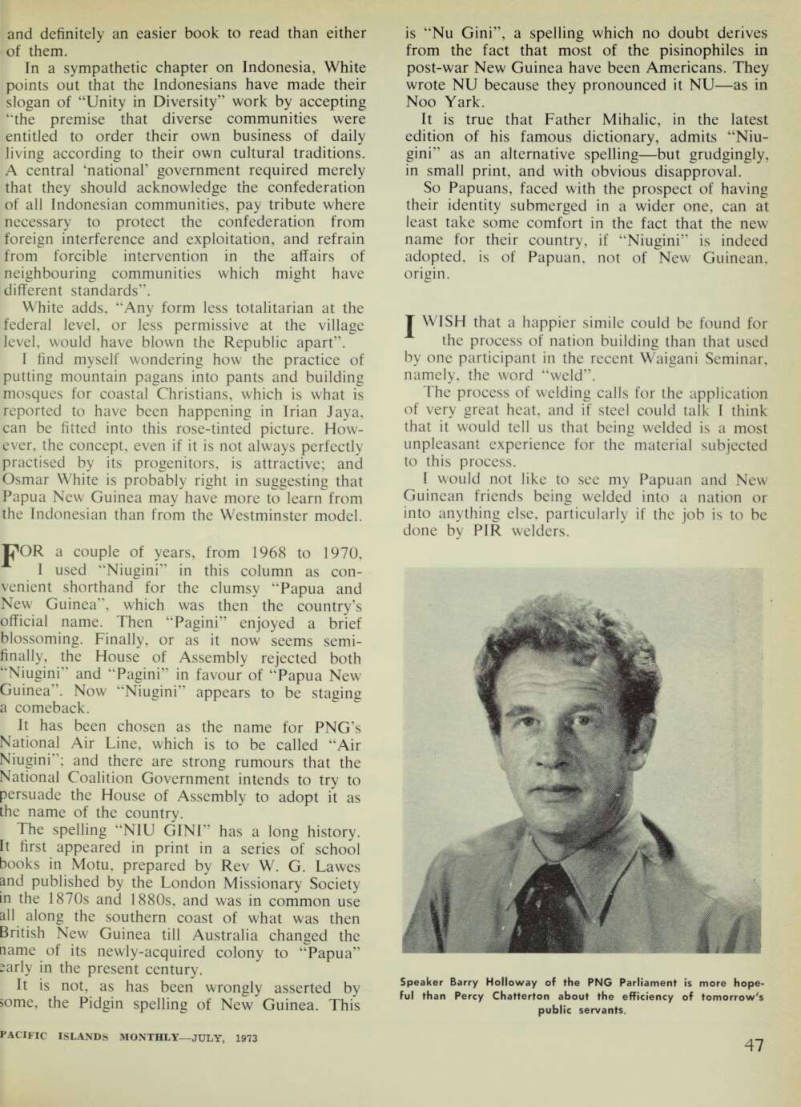
Speaker Barry Holloway of the PNG Parliament is more hope ful than Percy Chatterton about the efficiency of tomorrow's
public servants.