It Took An Election To Bring
pp. 49-51 · Read in the full issue
Anuta Into The Outside World
By Richard Feinberg
Its participation for the first time in the Solomon Islands’ general elections, in May and June, brought much more than usual attention to tiny Anuta in the Solomons’ Eastern Outer Islands.
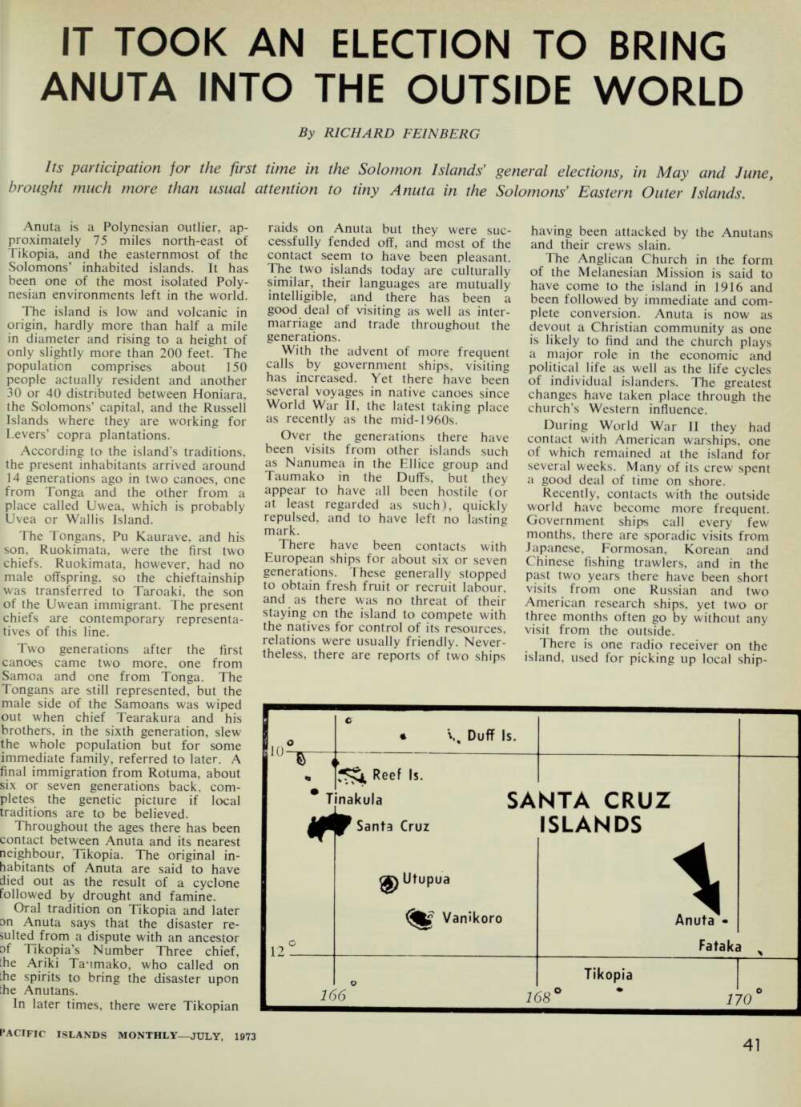
Anuta is a Polynesian outlier, ap proximately 75 miles north-east of Tikopia, and the easternmost of the Solomons’ inhabited islands. It has been one of the most isolated Poly nesian environments left in the world.
The island is low and volcanic in origin, hardly more than half a mile in diameter and rising to a height of only slightly more than 200 feet. The population comprises about 150 people actually resident and another 30 or 40 distributed between Honiara, the Solomons’ capital, and the Russell Islands where they are working for Levers’ copra plantations.
According to the island’s traditions, the present inhabitants arrived around 14 generations ago in two canoes, one from Tonga and the other from a place called Uwea, which is probably Uvea or Wallis Island.
The Tongans, Pu Kaurave, and his son, Ruokimata, were the first two chiefs. Ruokimata, however, had no male offspring, so the chieftainship was transferred to Taroaki, the son of the Uwean immigrant. The present chiefs are contemporary representa tives of this line.
Two generations after the first canoes came two more, one from Samoa and one from Tonga. The Tongans are still represented, but the male side of the Samoans was wiped out when chief Tearakura and his brothers, in the sixth generation, slew the whole population but for some immediate family, referred to later. A final immigration from Rotuma, about six or seven generations back, com pletes the genetic picture if local traditions are to be believed.
Throughout the ages there has been contact between Anuta and its nearest neighbour, Tikopia. The original in habitants of Anuta are said to have died out as the result of a cyclone followed by drought and famine.
Oral tradition on Tikopia and later on Anuta says that the disaster re sulted from a dispute with an ancestor of Tikopia’s Number Three chief, the Ariki Ta'imako, who called on the spirits to bring the disaster upon the Anutans.
In later times, there were Tikopian
raids on Anuta but they were suc cessfully fended off, and most of the contact seem to have been pleasant.
The two islands today are culturally similar, their languages are mutually intelligible, and there has been a good deal of visiting as well as inter marriage and trade throughout the generations.
With the advent of more frequent calls by government ships, visiting has increased. Yet there have been several voyages in native canoes since World War 11, the latest taking place as recently as the mid-19605.
Over the generations there have been visits from other islands such as Nanumea in the Ellice group and Taumako in the Duffs, but they appear to have all been hostile (or at least regarded as such), quickly repulsed, and to have left no lasting mark.
There have been contacts with European ships for about six or seven generations. These generally stopped to obtain fresh fruit or recruit labour, and as there was no threat of their staying on the island to compete with the natives for control of its resources, relations were usually friendly. Never theless, there are reports of two ships
having been attacked by the Anutans and their crews slain.
The Anglican Church in the form of the Melanesian Mission is said to have come to the island in 1916 and been followed by immediate and com plete conversion. Anuta is now as devout a Christian community as one is likely to find and the church plays a major role in the economic and political life as well as the life cycles of individual islanders. The greatest changes have taken place through the church’s Western influence.
During World War II they had contact with American warships, one of which remained at the island for several weeks. Many of its crew spent a good deal of time on shore.
Recently, contacts with the outside world have become more frequent.
Government ships call every few months, there are sporadic visits from Japanese, Formosan, Korean and Chinese fishing trawlers, and in the past two years there have been short visits from one Russian and two American research ships, yet two or three months often go by without any visit from the outside.
There is one radio receiver on the island, used for picking up local ship-
Anuta joins the world
ping reports from BSIP’s broadcasting service, and a two-way radio capable of making contact with the district sub-station at Santa Cruz, 250 miles away, was operating during about half of my stay.
Despite conversion, no one, includ ing the catechist, has the slightest doubt that the traditional deities exist and respond to the performance of kava rites. There is still universal agreement that the bush is inhabited by spirits which wander about frightening people at night. And out side the sphere of religion traditional customs remain extremely strong.
Along with Tikopia, Anuta is unique among the Solomons in that it is still ruled exclusively by tra ditional hereditary chiefs. There are four kainanga, or major corporate groups, whose members are deter mined primarily by descent through the male line from a group of three brothers and one brother-in-law who slew the rest of the island eight or nine generations ago.
Aside from being stripped of its religious functions, the kainanga system appears to be little changed from former times. The system of rank and honour remains strong al though there is a sense of modesty in interpersonal relations which may not have been there before the church.
A type of extended family rather than the common nuclear family of European society is the elementary social and economic unit. And a classificatory system of kinship ac cording to which everyone living on the island is both termed and treated as a relative remains perfectly intact.
Along with their physical isolation and cultural conservatism, the Anutans are a fiercely proud, self reliant, and independent-minded people. Despite a devastating cyclone in February, 1972, which destroyed much of the island’s food supply, they rejected a shipment of govern ment relief supplies out of fear that it would be used to undermine their own sovereignty.
One of their greatest worries is that the central government will at tempt to impose a tax on the island.
They recognise the existence of a central government and appreciate its shipping service, medical assistance, and the opportunity it provides them to go to Honiara or the Russell Is lands to engage in wage labour.
Most adult males have at some time in their lives taken advantage of this opportunity for at least short periods, and when I left there were perhaps three dozen people living off Anuta.
Yet they hardly even consider
themselves to be part of the Solo mons, a fact which is reflected in their very language. When an Anutan travels to the Eastern District head quarters at Kira Kira (on San Cristobal, or Makira, in the main Solomons chain), or any point fur ther west such as Honiara or the Russells, he is said to have gone to Solomon as opposed to someone who has spent his time on Anuta and Tikopia.
Only two people on the island speak any proper English and no more than a small handful speak reasonably good Pidgin (the Solo mons’ lingua franca).
In December, 1972, the four Tiko pian and one Anutan chief (the second Anutan chief at the time was visiting relatives in Honiara and was unable to attend), at the personal in vitation of the district officer, at tended a local government council meeting in Santa Cruz, and agreed for the first time to allow the people of the two islands to register and vote in the general elections. This is clearly a step towards integrating Anuta into the Solomons, and as such is an important development.
Nevertheless, the Anutan people when I left had little idea of how the government is organised and func tions, much less the issues which were facing the electorate and the per sonalities likely to be vying for Government Council seats.
Hence, the Anutan’s voting in the election, while perhaps a significant symbolic act, is from the practical point of view of directing the running of the government, of little value.
It is a first step, but a great deal of time, patience and effort, especi ally in the realm of education, will be necessary before this tiny Poly nesian island can be brought into meaningful participation in the political processes of the Solomon Islands.