people at
pp. 41-42 · Read in the full issue
Caring for people at $50,000 a year
In their own interest as well as for the good of the Islands, Burns Philp (South Seas), Pacific Island traders for 90 years, are pressing ahead with localisation measures.
Last year in Suva they selected eight school leavers to undergo an executive training programme.
Mr C. T. A. Black, manager of the Burns Philp South Seas division and a director of the company, says that the eight trainees were housed in bachelor quarters at the top of Waimanu Road, Suva, to provide a suitable environment for them. The quarters were supervised and each trainee was given his own room.
Some dropped out at the end of the first year but they have been replaced, the number of trainees for the moment being kept between eight and 10.
The trainees all attend the Der rick Technical Institute in Suva and, when not studying, they are paid to gain practical experience working in the merchandising, accountancy and other departments of Burns Philp stores.
“This is more a long-term type of training programme because the company won’t feel any material benefits from it for a number of years,” says Mr Black. “The scheme is quite expensive; it is costing the company about $50,000 a year. But we feel we have an obligation to do this type of thing, not only for our own good, but also for the good of the country”. The company is also training men for positions in the company’s technical departments like the motor division.
Mr Black says that in Fiji today the staff of 2,100 includes less than 2 per cent expatriates. They were in positions for which no locally qualified people were available. These would be replaced in time.
Local men in top executive positions now include Mr Phil Best, general manager of Burns Philp (SS) Ltd, Mr Lili Damu, manager of the timber division in Suva, and Mr Ranjit Singh, company secretary.
Burns Philp also has a training programme in Fiji entitled, “Caring for People”, a course developed by Australian management consultants, Talbot Smith and Associates. This
is geared to help employees become more effective in their work and for the company to get a better return fro ™ .
Mr Talbot Smith went to Fiji to start the course and a Burns Philp man was sent to Sydney to learn . ™ f.° cond uct it. Fie is now back m Fiji lecturing company employees on busmess procedures.
The course, Mr Black says, is primarily for people who, previously, had no chance to better themselves,
but who are of above average ability Burns Philp has the Fiji franchise for this course.
In Tonga, Burns Philp has an entirely local staff, except for the manager at Nukualofa who is also general manager for Tonga. The accountant at Nukualofa. Mr Kalepi Tupou, gained his degree in Sydney During the last year of his course Burns Philp employed him in their accountancy department in Sydney, “He is one of the most promising
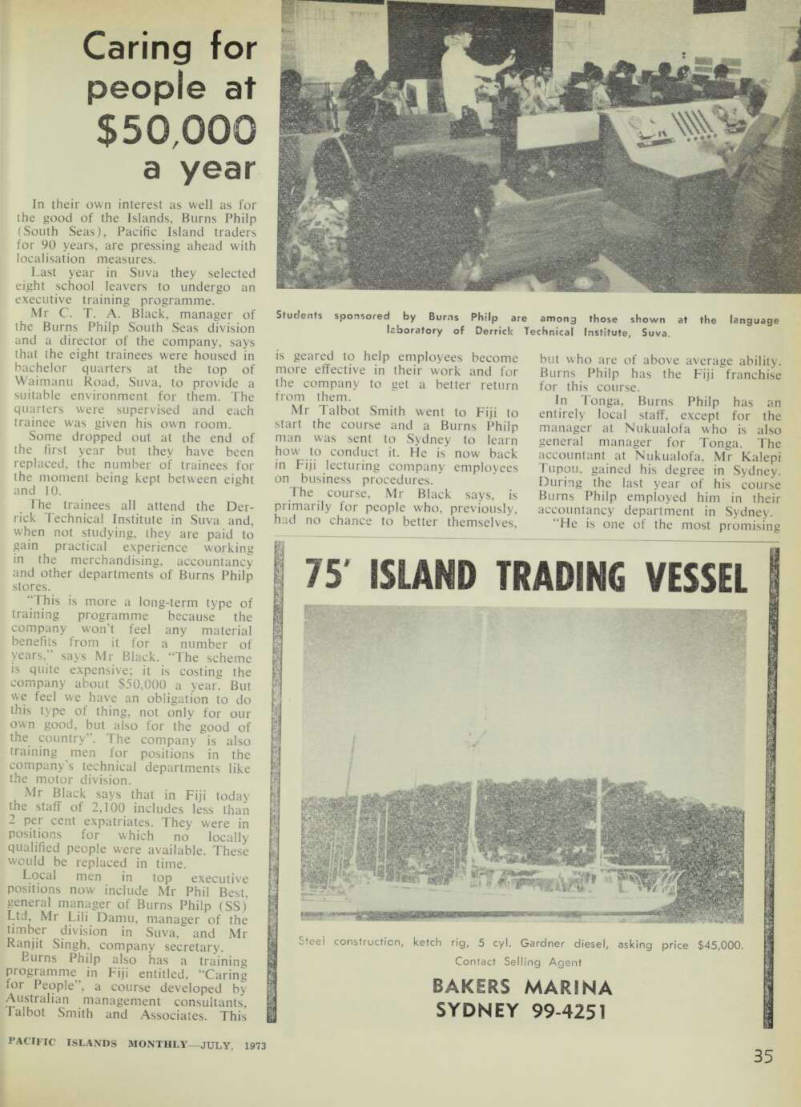
Students sponsored by Burns Philp are among those shown at the language laboratory of Derrick Technical Institute, Suva.
indigenes we have,” says Mr Black.
He said it had not been necessary for a training programme in Tonga similar to that in Fiji because Burns Philp did not have such a sophisti cated operation there.
In Western Samoa the entire staff, except for the accountant, is made up of locally-born Samoan people. The staff training programme in Suva will eventually be extended to take in people from Western Samoa.
All positions of responsibility in American Samoa are held by ex patriate staff except for a local man in charge of shipping.
In the New Hebrides where the French and British hold conflicting views on the future of the country,
Burns Philp has not started a staff training programme. But they are making a special point of giving more responsibility to local people who show they have ability and are willing to carry responsibility. There are no local people in senior positions in the New Hebrides.
Burns Philp also uses the Talbot Smith programme in Papua New Guinea where the government has laid down time-tables for replacement of expatriates in many types of work.
These are all “lower down the line” jobs to supervisor level. Burns Philp have a crash programme for training local people for positions filled at present by expatriates. But it will be much longer before local people get into executive positions.