The Flying Shuttle Brings
pp. 27-29 · Read in the full issue
Money To The Chimbu
Although spinning and weaving are skills which are traditional to the people of the Islands the use of looms and cotton and woollen yarns are not. Papuans and New Guineans have for a long time spun various fibres and made them into string bags called bilums. Or they have woven kunai grass, sago fronds and bam boos and used them for walls and screens in buildings.
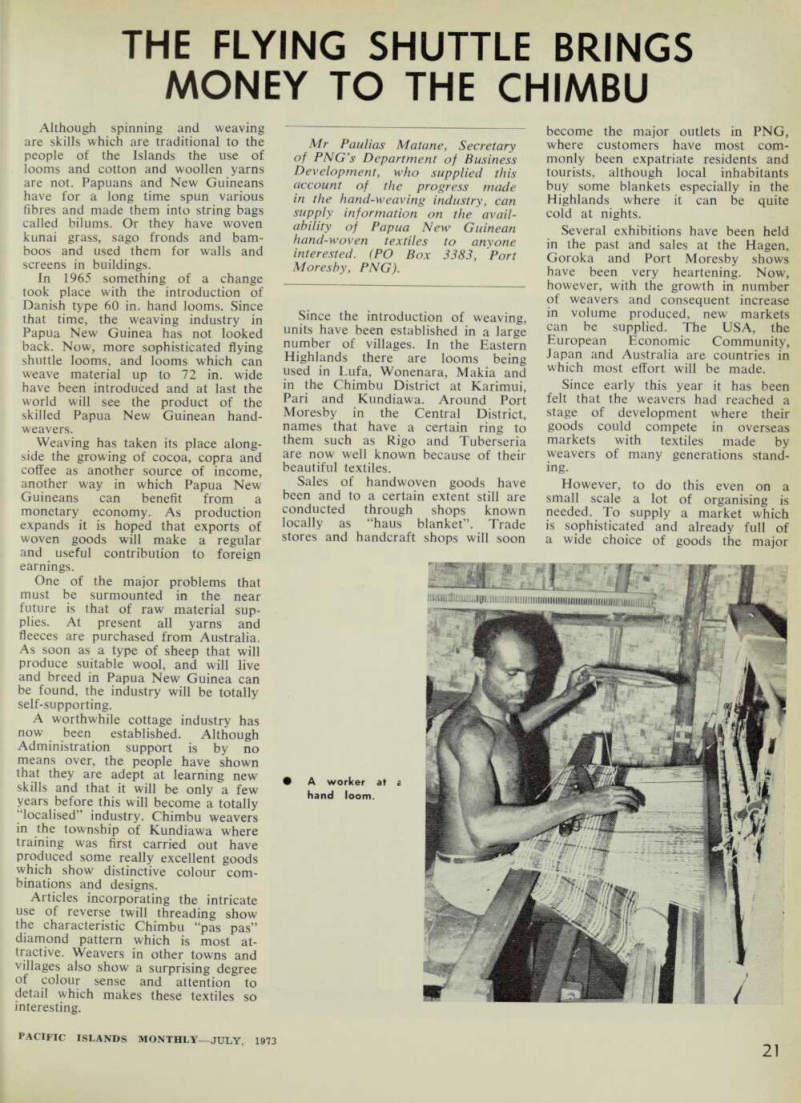
In 1965 something of a change took place with the introduction of Danish type 60 in. hand looms. Since that time, the weaving industry in Papua New Guinea has not looked back. Now, more sophisticated flying shuttle looms, and looms which can weave material up to 72 in. wide have been introduced and at last the world will see the product of the skilled Papua New Guinean hand weavers.
Weaving has taken its place along side the growing of cocoa, copra and coffee as another source of income, another way in which Papua New Guineans can benefit from a monetary economy. As production expands it is hoped that exports of woven goods will make a regular and useful contribution to foreign earnings.
One of the major problems that must be surmounted in the near future is that of raw material sup plies. At present all yarns and fleeces are purchased from Australia.
As soon as a type of sheep that will produce suitable wool, and will live and breed in Papua New Guinea can be found, the industry will be totally
self-supporting.
A worthwhile cottage industry has now been established. Although Administration support is by no means over, the people have shown that they are adept at learning new skills and that it will be only a few years before this will become a totally “localised” industry. Chimbu weavers in the township of Kundiawa where training was first carried out have produced some really excellent goods which show distinctive colour com binations and designs.
Articles incorporating the intricate use of reverse twill threading show the characteristic Chimbu “pas pas” diamond pattern which is most at tractive. Weavers in other towns and villages also show a surprising degree of colour sense and attention to detail which makes these textiles so
interesting.
Mr Paulias Matane, Secretary of PNG's Department of Business Development, who supplied this account of the progress made in the hand-weaving industry, can supply information on the avail ability of Papua New Guinean hand-woven textiles to anyone interested. (PO Box 3383, Port Moresby, PNG).
Since the introduction of weaving, units have been established in a large number of villages. In the Eastern Highlands there are looms being used in Lufa, Wonenara, Makia and in the Chimbu District at Karimui, Pari and Kundiawa. Around Port Moresby in the Central District, names that have a certain ring to them such as Rigo and Tuberseria are now well known because of their beautiful textiles.
Sales of handwoven goods have been and to a certain extent still are conducted through shops known locally as “haus blanket”. Trade stores and handcraft shops will soon
become the major outlets in PNG, where customers have most com monly been expatriate residents and tourists, although local inhabitants buy some blankets especially in the Highlands where it can be quite cold at nights.
Several exhibitions have been held in the past and sales at the Hagen, Goroka and Port Moresby shows have been very heartening. Now, however, with the growth in number of weavers and consequent increase in volume produced, new markets can be supplied. The USA, the European Economic Community, Japan and Australia are countries in which most effort will be made.
Since early this year it has been felt that the weavers had reached a stage of development where their goods could compete in overseas markets with textiles made by weavers of many generations stand ing.
However, to do this even on a small scale a lot of organising is needed. To supply a market which is sophisticated and already full of a wide choice of goods the major
• A worker at a hand loom.
concerns need to be fully under stood.
Continuity of supply, maintenance of high standards of quality and the establishment of fair and competitive prices were seen as the main points to be considered. As far as quality was concerned there were few prob lems. However, ensuring the con tinuity of sufficient quantity at a competitive price posed the bigger problem.
Throughout all centres of produc tion it was found that costs were different, prices were different and returns to the weaver were different.
To collect a quantity of woven goods sufficient to interest overseas buyers, it was obvious that changes had to be made. iMost of the weavers work at their homes in their villages, returning to certain centres to sell their finished goods and to buy new yarns. Now two centres act as material suppliers and finished goods purchasers. These are at Goroka and Boroko and although other places can handle overseas orders it is intended that these two should be the main whole salers for all markets.
The Hagen show on August 4 and 5 this year will see the introduction of a new range of handwoven tex tiles. Intended to be comprehensive in appeal and without restrictions on designs or colour combination, it allows the weaver’s individual charac teristics and traits to show them selves. Indeed the main attraction of these textiles is the individuality imparted to each piece. This is real hand-weaving where the weaver is the artist using cottons, wools and fleeces as his medium.
Altogether there are 16 items in the range which are described more fully in the brochure “Hand Woven Textiles of Papua New Guinea”.
They include blankets, rugs, pon chos and floor mats.
Ponchos are made in two different styles—“square” and “diamond”. In Pidgin the “square” poncho is known as a Kolsirt and the “diamond” one is Kito Kolsirt. The term Kolsirt means a garment to keep you from getting cold. Ponchos or Kolsirts are certainly effective at that! The floor mats are especially attractive and rather unusual in that they use a raw fleece on a thick cotton warp.
Combinations of natural white and coloured fleece are used on varying coloured warps but the most popular still remain natural white on white.
The welt is quite thick and the total effect is most pleasing. Lengths of material suitable for making into cushion covers and curtains are also available. Another material is ideal for dresses.