Tropicalities
pp. 18-19 · Read in the full issue
cuckoos IN
Samoan
Nests
Shades of colonialism! After 11 more or less pleasant years as an independent country, Western Samoa has come full circle. Its government has evicted some of its top local civil servants from their state-owned houses to make way for expatriate personnel.
Eight senior civil servants have been de-housed, the government tell ing them the accommodation was re quired for expatriates, mostly United Nations experts, and that they should ( seek their own accommodation be cause they are locals.
Why were locals permitted to occupy government houses in the first place, and why the sudden policy reversal? One reason seems to be that more and more UN experts and other expatriates are being employed in Western Samoa and the govern ment is short of houses for them. So out go the locals who must have been chagrined to discover that, un like the bureaucrats in other countries, climbing to the top of the civil ser vice ladder doesn’t make tin gods of them. It’s argued for the government that jWestern Samoa badly needs overseas experts and locals have plenty of kiga (relatives) who can help with accommodation if they haven’t houses of their own.
There are those who suspect that the new Mataafa government had Something against some of the “evicted” public servants; that some of them became too involved in poli tics in the past, but no evidence has been produced to support the “pay back” theory.
Among the homeless ones are the Secretary to Government, the Direc tor of Education, Director of Broad casting, Director of Agriculture, the Legal Officer, Chief Plumber, Chief Electrician and a dental officer.
They can swallow one crumb of comfort, maybe, with the thought that in Fiji Suva-based civil servants have to find their own accommodation while around a dozen very nice $
houses have been standing empty, for months, awaiting occupation by some overseas experts. In some cases, the last tenant was an ex patriate officer whose job was localised. His house wasn’t.
itowers row
over row result They take their rowing seriously in Western Samoa. A decision to re run a disputed race of the famous fautasi (longboats) on Apia harbour was enough to spark off a riot by the Oti rowers from Fagaloa, who claimed they won and should be given the trophies.
Missiles included rocks, sticks and beer bottles, one of which burst on the trophy table beside a police super intendent who immediately set off for reinforcements.
By the time the police had matters under control they had arrested eight men. No one suffered serious in juries till later, when there was an other flare-up, and a man had his arm broken. Those involved were members of the crews of the Oti and the Manulele Tautala, from Apolima, whose boat was placed second.
The race was part of the annual independence celebrations, and there was confusion from the start. The boats started rowing before the offi cial start, and could not be stopped, in spite of a chase by police in a speed boat. Prime Minister Mataafa managed a temporary halt after three miles of the five-mile course were covered. But the boats quickly took off again, and no one really had a clear view of what was happening.
Apparently Oti crossed the line first.
The women rowed without a row.
Minerva’s got
a Iwo-eolonr eoin
The King and Government of Tonga and the South Pacific Forum notwithstanding, the Republic of Minerva, the only government never to have occupied the land over which it holds sway, is still in there and fighting. Not for it abject accept ance of Tonga’s coup with the raising of the Tongan flag over the few square yards of Minerva.
It’s still the republic and not only
that, it has now, “in co-operation with the Minerva Development Bank Ltd”, issued its own coinage. And they’re not common or garden stuff either. They’re the world's first two colour coins, pure gold on one side and pure silver on the other.
According to the Numismatic News Weekly, of lola, Wisconsin, USA, the Republic of Minerva—a new nation, a new coin, says the advertisement— has authorised the Letcher Mint, of Lancaster, California, to strike 10,500 SMin3s coins, of which 6,000 will be available to collectors at $35 each.
The obverse bears a sculptured bust of the ancient goddess Minerva in gold (24K) against a background and lettering of pure silver (.999).
The reverse in pure silver shows the republic’s Torch of Freedom in frosted relief against a mirror-like background.
It looks as if the Minervans, who, the advertisement says, have been forced to set up a government in exile “until the conflict is settled”, have stolen a march on the Tongans.
Their attractive coronation coin was only in palladium!
Fiji gets
til in fever
People in Fiji have become rather blase about visiting celebrities, but American actor and producer Gregory Peck can still manage to create quite a stir.
Mr Peck and his Anglo-American Film Company crew are in Fiji shooting scenes for Here there be Dragons, a film about the lone-world voyage of a young yachtsman, Robin Lee Graham.
Graham set out from Los Angeles when he was 16 years old, and spent several years sailing the oceans. One of his first ports of call was Fiji, and it is here the film begins. The team has been busy for the past few weeks in the Yasawa Islands, getting “al sea” scenes and some local colour Delighted islanders have taken pan with great enthusiasm.
In sophisticated Suva, the crev still found any number of people with a secret urge to get in the movies. They had no trouble re cruiting crowds to wave at the adventurous boy, played by youn| almost-unknown, Joseph Bottoms arriving in his yacht, Dove.
A lively island night scene at thi Royal Suva Yacht Club was delayec by a technical hitch when rain deluge* dancers and cameras two nights ii a row. The merry revellers lendin, life and colour to the scene cost Ml Peck about $7OO a night in fre:
drinks and supner, and they still had to try again.
Almost the whole film is being made “on actual location”. After Fiji the team goes to Darwin and Perth, Mozambique, other African ports, South America and the Galapagos and finally Los Angeles. The final scene is a wild storm in a tank in a London studio, where the film company has its headquarters. Mr Peck decided to do that one under controlled conditions. He has had experience in previous films of trying to get the real thing amid 20 ft waves. “It’s just too dangerous,” he said.
Mr Peck said he was not appearing in the film himself. He is keeping busy organising the transport of hundreds of tons of equipment and more than 30 film crew members from one point to the next, and dealing with the unexpected dif ficulties like the transport of four cats from Los Angeles to a yacht in Fiji, without letting their tiny paws touch Fiji ground (agriculture import regulations prevent it). A helicopter solved that one, but another problem besetting him is the sale of the yacht used in the Fiji section of the film.
No point in taking it on, he explained.
There are seven more dotted around the globe waiting for the team to catch up.
Rocket for
Ponape’s 3IPS
A bit of a shock was in store for the lawmakers who sit on Ponape’s District Legislature when District Ad ministrator Leo A. Falcam rose to make the closing speech in the legis lature’s session.
There was none of the usual plati tudinous waffle which so often marks such ceremonies. As far as Mr Fal cam—the first Micronesian to serve as District Administrator in Ponape —was concerned, the legislative mem bers spent far too much time talking about long hair and short skirts in stead of more pressing issues.
Mr Falcam said: “I will be less than honest with myself, with my responsibilities as the District Ad ministrator . . . and with the people of Ponape District if I do not indicate to this body my great concern and disappointment at the recent session of this legislature.
“We placed before this honourable body for your consideration several measures. We fully realised the numerous other areas of interest which the members of this body have . . . but in my judgment it is definitely more important to talk about a measure which will clearly
define our responsibilities with legis lative, judicial and executive branches . . . than to spend our precious time talking about whether or not a male resident of this district should or should not have long hair.
“I believe that it is more essential to consider legislation to establish an economic development planning com mission for this district than to legis late the proper length of someone’s hair.”
Note: All the talk about hair and skirts didn’t get the anti-longhairs and anti-mini types anywhere; both moves for curbing legislation were re jected.
Komc'iliing (biiiiit in
the I*oiiclokbi iiiisi in !
What’s the New Hebrides got that no-one else has? Whatever it is it’s causing some peculiar mutations in plant and animal life. There’s hardly a week goes by without news of the longest snake, the biggest this and the smallest that.
The latest to anpear are a dwarf coconut tree, a dwarf banana plant and a four-legged chicken. The coco nut tree, at Aronbaratu village on Pentecost, is only a foot high but has two bunches of fruit, one already mature. The banana plant on north Pentecost is two feet high and its bunch of fruit is already touching the ground.
As for the four-leeeed chicken it lives at Ngala on Epi. It was hatched about the end of April, is fighting fit and doesn’t seem to feel uncomfort able as it walks around on all fours.
Carefully nurtured, it might pro duce a new species although we sus pect there are already many four legged, breastless chickens in the world—judging by the chicken dinners we’ve had in most restaurants!
Oolala! Here’s
>livs ( aleilonie
New Caledonia is becoming in creasingly aware of overseas interest in its French elegance and charm so added publicity is now bei.ng given to the Noumea troupe of marching girls and the young beauty queen soon to be chosen as Miss Caledonie.
The Noumea majorettes have just had special training under the skilled baton of Danielle, a young captain sent out from Paris as national instructress to improve the repertoire of the Noumea marching girls.
Danielle was sent to the island for three weeks in April, after the enthusiastic local troupe had been performing for about three years at Noumea festivals and official ceremonies under the guidance of Mme Houde, a secretarial teacher at the Chamber of Commerce.
The Noumea majorettes are be coming something of a tourist attrac tion, as they have performed at the quayside for certain visiting overseas ships. Tourist publicity for the island is also expected from the election in August of Miss Caledonie 1973. The beauty queen is to be chosen from among young contestants sponsored by sporting and other associations throughout the mainland and offshore islands.
The successful candidate will fly on to Tokyo to take part in the elec tion of Miss International in October.
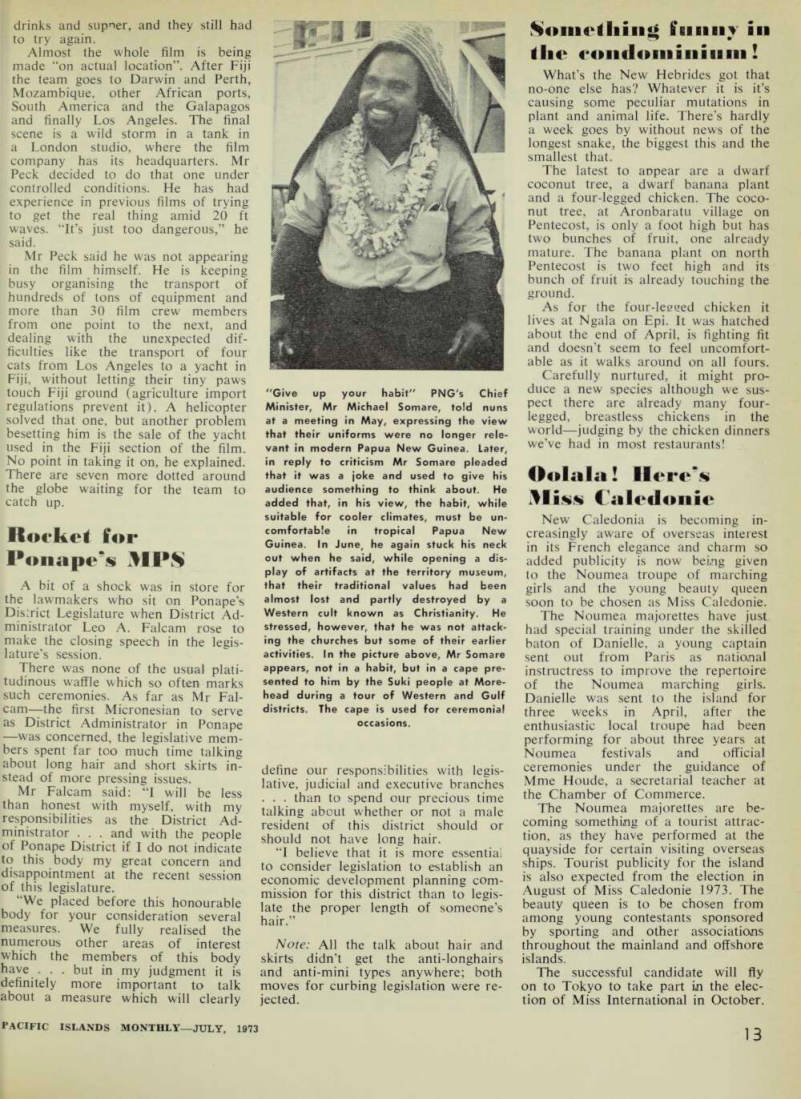
"Give up your habit" PNG's Chief Minister, Mr Michael Somare, told nuns at a meeting in May, expressing the view that their uniforms were no longer rele vant in modern Papua New Guinea. Later, in reply to criticism Mr Somare pleaded that it was a joke and used to give his audience something to think about. He added that, in his view, the habit, while suitable for cooler climates, must be un comfortable in tropical Papua New Guinea. In June, he again stuck his neck out when he said, while opening a dis play of artifacts at the territory museum, that their traditional values had been almost lost and partly destroyed by a Western cult known as Christianity. He stressed, however, that he was not attack ing the churches but some of their earlier activities. In the picture above, Mr Somare appears, not in a habit, but in a cape pre sented to him by the Suki people at More head during a tour of Western and Gulf districts. The cape is used for ceremonial occasions.