Treating Caledonian Maladie With
pp. 16-17 · Read in the full issue
Miracle Drugs And Transplants
From a Noumea correspondent New Caledonians these days find their favourite pastime involves discussion of a puzzling new disease which is prompting lively debate over its origins, treatment and likelihood of post-operative success.
Liver trouble
Of course, French illnesses, at least the socially accepted ones, have always differed markedly from the Anglo-Saxon ones. While English-speaking people can expect sympathy by talking of a “headache”, to the gastronomically-minded French the surest way of arousing compassion, even admiration, is to mention problems encountered with the digestive system, or more specifically le foie (liver). And so, the much debated affliction currently raging in New Caledonia can be described as a severe dose of over-eating, which is now followed by a very lean period, to which the victim is finding it difficult to adapt.
While some local physicians have pronounced the patient now past the most painful suffering, others are less optimistic and warn that worse is yet to come. In the meantime, there is no lack of suggested cures and advice on how to best maintain the victim’s confidence through this critical period. But the simple fact remains: a man who has been eating extremely well, rejoicing over more promised feasting ahead, suffers a severe blow when told to fasten his belt and keep his chin up during the current nickel recession.
In a recent chat with selected journalists, French Governor Louis Verger is quoted as saying “the patient is beginning to get up; he still has more to suffer, but he is back on his feet”. Other commentators, including a leader of the Caledonian Liberal Movement (MLC) have insisted however “we must restore confidence, for the sick man sees his fever rising”.
Just as the specialists are divided in their diagnosis of the expected recovery rate, so there are differing views over the origins of the Caledonian maladie and the treatment which should be prescribed.
For economic advisers in the French Administration, the Caledonian maladie is caused mainly by disappoint ment over the failure of the promised new nickel factories to materialise. The administration also holds US dollar devaluations and the nickel market slump as responsible for the Caledonian malaise. However, Caledonians themselves from all political spheres are blaming Paris bungling in the treatment of the Canadian nickel company INCO and Japanese ore buyers, who have been thwarted in their recent dealings with the Territory.
Medical chart
Meanwhile, the victim’s medical chart gives an indica tion of the present situation. While the feverish past few years have brought the worry of spiralling prices and a cost of living index which rose up to nine per cent a year, prices are now stabilising, so that in the second quarter of this year the index remained stationary. About the same time, the level of employ ment has dropped, so that the five months to the end of March saw a two per cent drop in the number of registered employees.
This local drop in temperature and pulse rate has
been provoked by the reduction in nickel prices. May talks between Japanese buyers and Caledonian nickel ore exporters resulted in a further nine per cent drop in the ore price, while the level of sales contracts fell tc 1.5 million tons in this Japanese financial year, togethei with 400,000 tons left over from last year. Caledonian nickel ore sales to Japan in the 1972 calendar year had already dropped to 2.2 million tons.
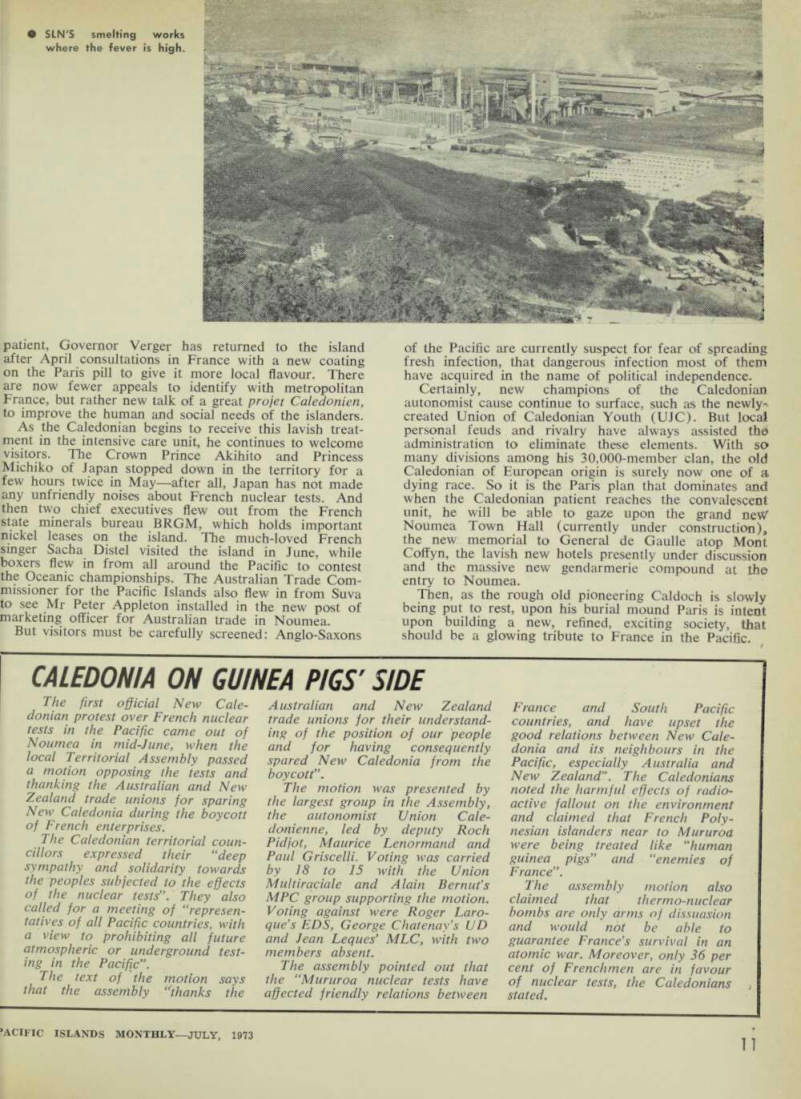
The island’s sole nickel smelting factory is also hare hit, since the SLN company is facing increased difficulty in selling its output. In a bid to save this Rothschild controlled group, the Paris government has indicate* that special assistance will be extended to the SLN to maintain its current level of production.
Miracle finance drug
As the Caledonian condition deteriorates, thi guarantee of help from Paris is seen by the Frend Administration as the soundest remedy to speed up th patient’s recovery. While the territorial budget face an increasing deficit and is over-strained to meet th heavy build-up of the French public service on th island, Governor Verger has promised SA6O million this year for state-backed development projects. T Paris, the miracle drug is French finance, and if th Caledonians are content to accept this relief, no dout they will be bound in future by increased gratitude an indebtedness to the mother country.
But the spirit of Caledonian individualism is not s easily anaesthetised. The local autonomist elemen seeking greater control of local affairs, refuses to swallow this heavy dose of Paris aid and insists that the ten* tory should be allowed to develop its nickel resource without unnecessary restraint from Paris, so that th patient can rise quickly from his bed and walk freel; without being propped up by Parisian crutches.
Governor Verger exhorts the Caledonians to ha\ confidence in France and to work united and in harmon to secure future well-being. The Caledonians then selves, however, from all political groups, are shoutir their impatience at Paris and demanding the installatic on the island of a second nickel factory, such j Canadian INCO has been proposing to build for tl past seven years. Knowing the immense potential < their island, the Caledonians are insisting that the economy should develop, without waiting upon extern aid from metropolitan France.
Of course, this degree of economic independen does not fit Paris plans, which are geared to facilita the installation of big French companies to develop tl island. The massive influx of metropolitan Frem construction groups, public servants, not to forget extj troops of gendarmes, are all part of this plan to bri: a larger slice of France to the Pacific to transform t; island. But the heart transplant continues to show sig of rejection. The rugged Caledonian does not eas;j accept the polished organ from Paris.
In a final-hour bid to rally the confidence of I
patient, Governor Verger has returned to the island after April consultations in France with a new coating on the Paris pill to give it more local flavour. There are now fewer appeals to identify with metropolitan France, but rather new talk of a great projet Caledonien, to improve the human and social needs of the islanders.
As the Caledonian begins to receive this lavish treat ment in the intensive care unit, he continues to welcome visitors. The Crown Prince Akihito and Princess Michiko of Japan stopped down in the territory for a few hours twice in May—after all, Japan has not made any unfriendly noises about French nuclear tests. And then two chief executives flew out from the French state minerals bureau BRGM, which holds important nickel leases on the island. The much-loved French singer Sacha Distel visited the island in June, while boxers flew in from all around the Pacific to contest the Oceanic championships. The Australian Trade Com missioner for the Pacific Islands also flew in from Suva to see Mr Peter Appleton installed in the new post of marketing officer for Australian trade in Noumea.
But visitors must be carefully screened: Anglo-Saxons
of the Pacific are currently suspect for fear of spreading fresh infection, that dangerous infection most of them have acquired in the name of political independence.
Certainly, new champions of the Caledonian autonomist cause continue to surface, such as the newly created Union of Caledonian Youth (UJC). But local personal feuds and rivalry have always assisted the administration to eliminate these elements. With so many divisions among his 30,000-member clan, the old Caledonian of European origin is surely now one of a dying race. So it is the Paris plan that dominates and when the Caledonian patient reaches the convalescent unit, he will be able to gaze upon the grand nevtf Noumea Town Hall (currently under construction), the new memorial to General de Gaulle atop Mont Coffyn, the lavish new hotels presently under discussion and the massive new gendarmerie compound at the entry to Noumea.
Then, as the rough old pioneering Caldoch is slowly being put to rest, upon his burial mound Paris is intent upon building a new, refined, exciting society, that should be a glowing tribute to France in the Pacific.
• SLN'S smelting works where the fever is high.