Tonga not changed? Of course it has!
pp. 43-47 · Read in the full issue



By Roger Cowell
Many of my friends say that Tonga has not changed. That it is still a case of Tonga monu’ia —“fortunate Tonga”. Certainly, there is still plenty of food, no one goes hungry and within the village community the stranger can ask at any house and be given something to eat. But it is ridiculous to think of Tonga as un changing.
In the years since 1969 the eco nomy has taken a severe battering.
Heavy rains in 1971/72 saturated the gardens, reducing crops and ruining most village roads. Even Nukualofa reading is disgraceful for a capital city.
Copra prices are down to 50 per cent of the 1969 level, and nuts are occasionally bought for about 1c each. Many villages no longer con tribute bananas for export, and the sheds are locked up except for meetings of a kava club, dances or films. Mangoes failed this year, as rains washed away the blossoms.
Breadfruit were late and small. Even village people are buying food from the town market. Watermelons at 20 to 50c each in 1969, now sell at Si to $1.50. Pineapples, once sc, now go for 40 to 50c each. The list of high priced food is endless.
But material goods are now even more widely sought, so the only answers in village minds are tourism or work overseas.
Tourism is booming. In 1969 there was a dribble of cruise ships, and handcraft was laid out along the waterfront. But it was pleasant enough, and one could stroll by, just looking at the goods, with no com pulsion to buy. In the villages there was a little weaving of baskets for the cruise ships or to send overseas, but working in the gardens and tend mg the crops, were the main sources of living. In my area a small dance group or “floorshow” was developing under the tutelage of a local woman who sometimes took them to perform at the Dateline Hotel. Evening enter tainment in the village comprised the weekly film and, periodically, con certs of Tongan dancing, at which the performers would be rewarded by the audience in the form of coins or notes a custom known as fakapale.
The money raised might be collected for church building or some local project.
On my latest visit I found cruise ships arrived almost every day in December-! anuary. Several “tour
In 1969 a young New Zea lander, ROGER COWELL, lived in the village of Ha’alalo, about eight miles from Nukualofa, Tonga’s capital. He taught at the Roman Catholic primary school at Houma, not far from the famous blowholes of the same name.
Three years later he returned to visit the village and found changes all along the line, not all of them good. In this article he writes about some of them.
companies” now organise the trips to scenic spots (the Blowholes, Flying Foxes, etc) and the so-called floor shows. People now buy space in long temporary shelters to sell their hand crafts. Perhaps it is all more efficient, but I was irritated and disappointed to find an almost universal hard-sell attitude. There is a continual pester ing with “buy this basket” or “neck lace for your girlfriend”, and so on.
Sellers buttonhole visitors to force attention on the wares and are openly resentful of lookers-on who don’t buy. I preferred to shop in the quiet of the women’s group, Langa Fonua, whose craft is of good quality and price.
But perhaps one cannot blame the sellers. Tourism is the livelihood of many now. In my village, many women do little else but make baskets, table mats, floor mats and tapa cloth,
assisted by sons, daughters, nieces, cousins and anyone else they can rope in. Several times our household worked through the night making table mats to sell in town and send to Fiji. The floor was strewn with pan tapa, dyes, cotton, and table mats in various stages of completion. One house in the village is also the centre for making “Tongan carvings”, and the local dance group now goes regu larly to town to perform for tourists.
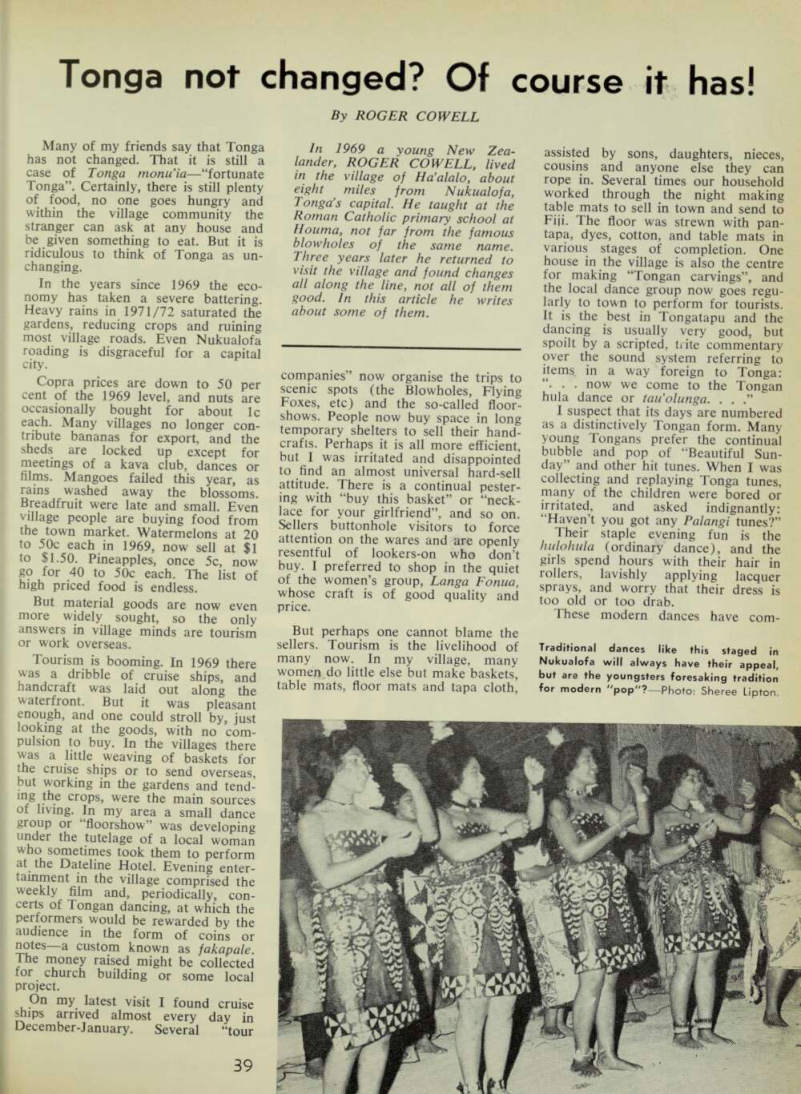
It is the best in Tongatapu and the dancing is usually very good, but spoilt by a scripted, trite commentary over the sound system referring to hems in a way foreign to Tonga: “. . . now we come to the Tongan hula dance or tau’olunga. . . .”
I suspect that its days are numbered as a distinctively Tongan form. Many young Tongans prefer the continual bubble and pop of “Beautiful Sun day” and other hit tunes. When I was collecting and replaying Tonga tunes, many of the children were bored or irritated, and asked indignantly: “Haven’t you got any Palangi tunes?”
Their staple evening fun is the hulohula (ordinary dance), and the girls spend hours with their hair in rollers, lavishly applying lacquer sprays, and worry that their dress is too old or too drab.
These modern dances have com-
Traditional dances like this staged in Nukualofa will always have their appeal, but are the youngsters foresaking tradition for modern "pop"? Photo: Sheree Lipton.
Fox-hunting teenagers
pletely replaced village concerts of Tongan dancing which provided pleasure and funds in 1969. But with so little money circulating, even these are a luxury, the tourists a better bet.
The turn from Tongan dancing was already evident in 1969. Small child ren who had yet to master tau’olunga were regarded with amused tolerance when they did go-go instead, but now they are often actively encouraged in modern dances.
The method of making music has also changed. In 1969 only a few halls had better than banjoes and acoustic guitars, and then only in the towns. Now, even in the villages, dance attendances drop unless electric guitars blast the night air, however tuneless and badly played. The sivi hiva or song contest, sponsored by the local radio station was poorly attended this year and written off by many as the worst in years. The sounds of electric guitars from the nearby Vuna Hall almost drowned out the Tongan singing and drew people away from this nice popular event.
Many Tongan parents, especially in the villages, are worried and con fused about their children. Many boys and girls aimlessly wander out until all hours, perhaps having home brew or spirits, and neglect manners and respect. There is openly acknowledged low-cost prostitution, tuli fokisi (liter ally, fox hunting) among teenagers, and fighting at the dances is not un common. One man with whom I spoke said he returned to Tonga after four or five years, and commented how cheeky the kids had become.
Certainly, a European can go vir tually nowhere in Tongatapu without being surrounded by unkempt small children begging for money or to have their photos taken, or to “sing a song’’—all for a price. I was thrilled with the contrast of Ha’apai, where no child ever asked me for money or photos. Some even expressed pleasure at my taking photos of their country, seeing it as a compliment.
Parents ask what is wrong, where have they failed, but I don’t think that is the point. The truth is that the present is rapidly catching up with Tonga, bringing her into line with the rest of the world, in attitudes, aspirations and youth culture.
But there is still much that I love about Tonga. There are still many kind and generous people, and I had great fun talking to them, especially the small children. We often went by bus to neighbouring villages for basketball and volleyball contests and,
Talk Around The Kava Bom
win or lose, between towns the bus was filled with raucous, undoubtedly happy singing. There were the pleasures, too, of the singing and feasting at family times of Christmas and New Year, when hospitality was lavish: chicken, pig, talo, kumala, pineapple, crab, corned beef, fish, tomatoes, the lot. At Christmas and New Year my village was further enlivened by the wandering singers and musicians who went from house to house and were given food as a reward for their entertainment.
Travel overseas is more common for Tongans than it was even four years ago. In 1969 I knew nobody in my area who had been overseas or for whom it was a remote possibility in the future. But since 1969 over a dozen had been to New Zealand, Australia or USA, scraping to get the fares and hunting for sponsors and permits.
The man with whom I stayed worked for over a year in the town market, for 80c a day, so he could go to New Zealand for six months.
There he worked long hours at West field Freezing Works, and went back to Tonga with a large amount of money to pay his children’s high school fees, and to build a cattle farm on his ‘api\ He now has 18 head of cattle, and has fenced all his property himself. But his case is ex ceptional. He is a fine leader in the village (being a church catechist), and never wastes his resources. By contrast, many who work overseas spend most of it on drink and betting, neglecting to send or take home money for their families. There is a good Tongan proverb for wasted work: Fangota fa’u ki he kato ava — shellfish put in a broken basket.
A kava club remains a focal point of evening activities and I spent many nights discussing topics ranging from Vietnam to banana growing, land problems, changes and future pros pects. With the discussions went periodic servings of kava and singing of the various groups. It struck me as very like a small pub, but with more discussion and few cliques. At times there were seven or eight groups in the banana shed or the club house, each of four to 10 people, who each paid, say, 20c for an evening’s kava, prepared by some girls and women who stayed in one corner.
Often the girls would serve the kava, too, putting up with frequent teasing and banter.
When I first returned, conversation about Tongan society was guarded, but after many visits we talked more freely. Some felt that the bush areas were neglected in comparison with the town, and suggested that the gov ernment was more concerned with the nobles, and the development of Nukualofa. One man felt the nobles’ land should be more extensively dis
tributed to alleviate the shortages among commoners and he felt that the government should assist only those who have no land or business to go to New Zealand on sponsored work schemes.
I count myself lucky to have seen it in 1969, on the verge of great change, and again in 1972-3, in the middle of upheaval. I fear for Tonga’s future—so many people and so few resources—but at the same time 1 love these islands and my friends there, and hope that solutions will be found to spare the people future shocks.