The Editor's Mailbag
pp. 33-39 · Read in the full issue

Gilbertese Writing And Mana
The Gilbertese are well-known for their expertise in writing with emotion and wit in the difficult disciplines of their own poetic form. It is good, therefore, to see in your new feature, MANA, a Gilbertese writing poetry in English, and heartening that the writer is a potentially important per son—a ‘trainee minister of the Gilbert Islands’.
I read the poem with interest, as I presume I was meant to, as being the “spontaneous overflow of power ful feelings”, since nowhere is it stated or suggested that the feelings or the incident related are second hand. However, if you will compare the poem with the enclosed extract from Sir Arthur Grimble’s book, A Pattern of Islands, first published in 1952, I think you will agree that the one is simply a twisted version of the other.
I have put in italics phrases which are either exactly the same as or very slightly different from those in the poem. In addition, it may be of in terest to note that the spelling “aa” for the long “a” sound is never used in modern Gilbertese, except in per sonal names. The only example of «f • s P ell * n S “baangota” meaning shrine that I have ever seen is in Grimble s work. Every other source, including both dictionaries, gives bangota”. . The distasteful conclusion seems inevitable that either Grimble dis honestly and without acknowledge ment copied Te Maunaa’s work or that the reverse is true.
Incidentally, what is a ‘trainee minister’? If Te Maunaa is to be a pastor of the GIPC, he has odd senti ments. If he is to be a politician, his status will be of great interest to the Gilbertese people here who are cur rently trying to decide whether to recommend to the Constitutional De velopment Committee that under the new Constitution there should be Ministerial Members as a possible preliminary to the appointment of full Ministers at an unknown date in the future.
Here are the examples. They are from A Pattern of Islands, Murray paperback edition, pp 135-137.
“The pagan was a gentle old fel low, recognised in his village for te akoi, which means, broadly, loving
kindness, and I was curious to know his reasons for remaining pagan.
He pointed to a rectangle of coral slabs planted edgewise beside his dwelling. ‘See there!’ he said. ‘That was the baangota (shrine) of my ancestors. My father’s skull was buried there, and his father’s, and his father’s fathers’ to five generations. I buried them so that their crowns stood forth above the sand. I saw them near me as I lay down to sleep; every evening I went down and an nointed them with oil; and I spoke to them, and they answered me, and / was happy with them. Thus it was until those men came and took them away from me.’ ‘Those men’ were a white mission ary and a rabble of native teachers whom he had trained to his ways. ‘lt began in this manner,’ the old man went on. ‘The white missionary sent a teacher to me one day, and the teacher said to me, “Thou shalt root up the skulls of thy baangota and throw them away.” ‘And this was my word to the teacher; “ These are the skulls of my fathers. They hurt no man and I love them. Why should I root them up and throw them away?” ‘The teacher answered, “Thy baan gota is an offence to the Christians who dwell in this village, for it is a sin in the eyes of our God. the only true God.” ‘But I said to him, “I beg thee, let each man turn away content with his own spirits. I am content with mine. Leave me alone with them.”
‘He answered, “Other men have obeyed the voice of the white mission ary and thrown away their skulls.
Thou alone in this village hast re fused.” ‘I said, “ The voices of my fathers are more precious to me than the voice of the white missionary. They are my roots and my trunk. I die without them. I beg thee, leave me alone with them.” ‘But he rose in anger, saying, “If thou art stiff-necked, our God will come to this village and destroy it because of thee.” ‘And the people of the village heard him and were afraid. They said to me, “We beg thee to throw away the skulls, lest we be destroyed because of thee.” ‘But I answered, “Fear not. My spirits will protect all of us from the anger of that cruel God. What kind of God is he who will not let me love my fathers? Is he a slave without ancestry?”
(Mrs) Vivienne Hayward
Bikenibeu, Tarawa, GEIC. • This is an edited version of Mrs Hayward’s letter, which contains further examples of material in the poem identical with the stories told by Grimble, in A Pattern of Islands.
We passed Mrs Hayward’s letter to Marjorie Crocombe, editor of MAN A. She forwarded a reply from poet Maunaa Itaia, together with her own comment and a comment from
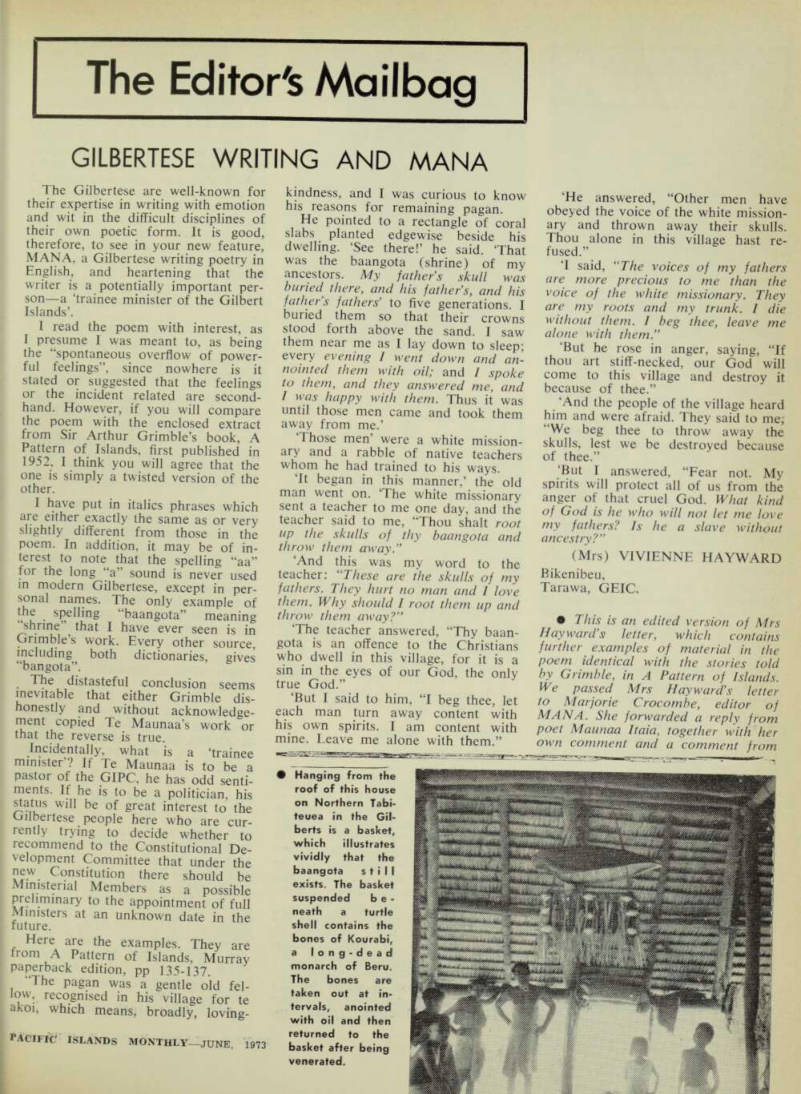
• Hanging from the roof of this house on Northern Tabi teuea in the Gil berts is a basket, which illustrates vividly that the baangota still exists. The basket suspended be neath a turtle shell contains the bones of Kourabi, a long-dead monarch of Beru.
The bones are taken out at in tervals, anointed with oil and then returned to the basket after being venerated.
Letters
the Rev John Garrett, of Suva, one of Maunaa s teachers at the Pacific Theological College, Suva.
First, the reply from Maunaa Itaia: “May I thank Mrs Hayward for her response to my poem, The Last Night of My Ancestors. She is right.
It was after reading Grimble’s account of the ‘baangota’ that I was moved to express my deep emotional feelings in poetic form. On the original copy of this poem I noted Grimble’s chapter as the basis of this poem. Un fortunately, I left off this note on the copy that was given to Mrs Crocombe for publication. As a begin ner, therefore, I am grateful to Mrs Hayward for putting me on the right path. I learn tremendously by this unconscious mistake.
“I also appreciate Mrs Hayward’s drawing the readers’ attention to the ‘incorrect’ spelling of ‘baangota’ as far as 'modern Gilbertese’ is con cerned. However, I do not accept this correction. As a poet I feel that for correct pronunciation and clarity’s sake the use of double ‘a’ is better, and to this mother root I cling. This is perfect Gilbertese, because the pronunciation is clear.
“Lastly, I am interested that Mrs Hayward is shocked by the end of the poem. These deep emotional feelings are Gilbertese and they are part of me.”
Mrs Crocombe comments: “Plagiarise means ‘to take and use another person’s thoughts, writings, inventions as one’s own. The material recorded by Grimble was not his ‘thoughts’; he merely recorded Gilbertese thoughts given him by his Gilbertese informants. If Grimble were alive today, being the man he was, he would probably be delighted that a Gilbertese would want to carry on again in a new form (as Grimble himself had done) the ideas of an earlier generation of Gilbertese, to produce something new yet essentially indigenous”.
Mrs Crocombe adds that the last two verses of Itaia’s poem had been interpreted in dramatic form in Suva the previous week. These two verses had been Maunaa’s feelings, and she said the example of the dramatic group interpreting them was ‘merely another form of the poem’. A song, even a film, could also be made from the same theme.
Rev John Garrett, one of Maunaa’s teachers, comments: “Maunaa is in training for the Congregational ministry. He has be come deeply interested in the tradi tions of his own people, which he has found recorded in Grimble’s writings.
What he finds in Grimble is simply a convenient echo and translation of all kinds of material that have been with him since childhood. He does not operate, and cannot be expected to do so, in accordance with European imported notions of ‘copyright’. To think that the folklore of the Gilbertese is the property of Grimble would amuse Grimble. Maunaa has a prior right to it —just as all Pacific Islanders have a prior right to what is theirs. In other words, what Maunaa has re-worked is as much his property as the phosphate on Ocean Island is the property of the Banabans”.
Mana
Congratulations on PlM’s new feature MANA.
That’s good forward thinking and shows publishing bravery when so few Pacific area publications dare to go out on a limb in such a venture.
It also shows sincere concern for the primary necessity of poets, writers and artists to be published—to be exhibited. I applaud you for it, and as a PIM addict look forward more than ever to my copy each month.
It occurs to me that writers in NZ could well offer some assistance to their colleagues in Pacific Islands who may (as probably all writers do) feel they’re working in a vacuum.
Are there ways in which we can help? Possibly not only in advice regarding publication (their ap
pearance in MANA shows that you have managed this aspect for them quite well) but in personal discussion regarding basic technique. Perhaps too, not only in the “in print” spheres, but in the arts of radio and television writing, both of which have yet to make an appearance in Pacific Islands I shall be travelling through PNG, BSIP, New Hebrides and Fiji at the end of this year and the beginning of next and should be pleased to meet writers who are interested in the New Zealand scene, in writing and in writers from other areas. In the meantime, of course, I should be delighted to correspond with any col leagues with problems.
John Gundry,
Writers Representative,
NZ Producers, Directors and Writers Guild
(National Committee).
19 Fraser Road, Devonport, Auckland F, NZ.
I was most interested in your feature on MANA. MANA is a fas
cinating phenomenon.
Jim Boutilier.
History Department,
Royal Roads Military College,
FMO Victoria BC, Canada.
This letter is to let you know how delighted I am to learn about MANA section to appear in future copies of
Pim.
I have lived in Papua New Guinea and travelled extensively throughout Melanesia and have always taken a keen interest in the art and written
expression of Island peoples.
I am now buying the PIM every month instead of reading it at the library.
(Mrs) Susi Robinson Collins
Auckland 5.
I read PIM every month with in terest and now that you have intro duced MANA I enjoy it even more.
Peter Mcquarrie
Tarawa.
Lid Off Geic
The interest that the well-informed and timely article on political issues in the Gilbert and Ellice Islands (PIM, March, p 23) has aroused in Tarawa and reflected in your Mailbag column (PIM, May, p 29) has been intense.
Your Mailbag correspondent who talked of “putting the cat among the pigeons” and “everybody here is having to sign the Official Secrets Act again” is not exaggerating the effect that your original article has had on the bureaucratic “top brass” in Bairiki, Tarawa.
A veritable witch-hunt has been
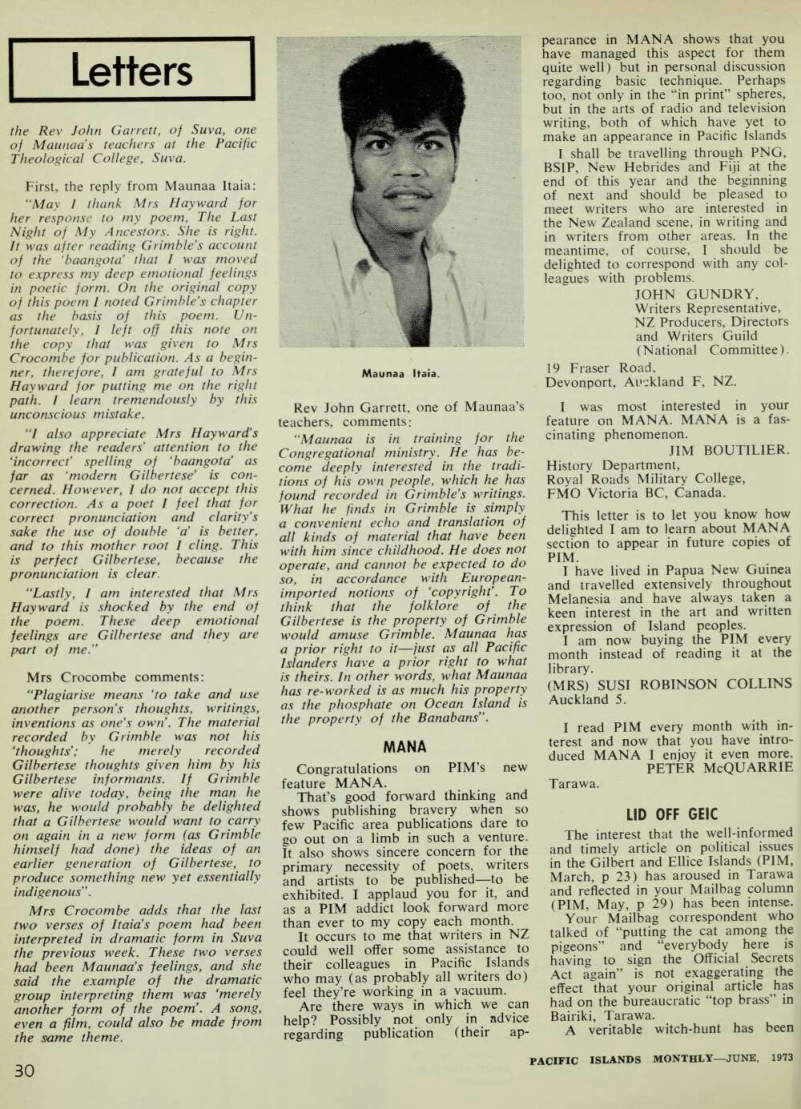
Maunaa Itaia.
Letters
going on in governmental circles to discover the author of this “seditious” piece, and the kind of probing that it has initiated has been official and thorough as well as devious and silly, it appears.
But there is one very important and serious reason why an article expressing political comment, even if fairly objectively put forward, as in the case of your article, should cause such a stir here. It is to be found in the following statement contained in a lengthy government circular of last year: “With immediate effect no officer may write to the press (or otherwise publish), speak in public, lecture or broadcast on any matter which may be regarded as of a political or administrative nature without first obtaining permission in writing from his Head of Department. . . . Heads of Department should refuse permis sion in any case where the comments or views to be expressed are not in accordance with Government policy.”
It is significant that our official newspaper the Atoll Pioneer has made no mention of the important article in PIM nor the considerable stir which it has engendered. Significant, when one remembers that such archaic, restrictive and damaging colonial regulations still hold sway and are condoned, one assumes, by the “Mother of the Free”. How hypocritical we are to point our liberated fingers at totalitarian states!
It is shameful that we are only able to express ideas and impart informa tion freely and without interference (Ref Article 10. Universal Declara tion of Human Rights) by means of anonymous articles and letters in your columns, but we are grateful to you for the opportunity, nevertheless.
Long may the PIM print reasoned thinking from all quarters.
Iraorao Ii.
Tarawa.
Islander Migrants
In Up front with the Editor (March PIM, p 3) you stated: “Any French man or American, providing he is white, can walk into a job in Aus tralia and take up residence without any special reason or qualification”.
This is a distortion of the facts.
If a Frenchman or American wants to come to this country for permanent residence, he has to make application to the Australian representatives in his country and give details of such
things as his education, the languages he speaks, his qualifications and whether he has any relatives in Aus tralia. If it turns out that the details he has supplied aren’t correct, he runs the risk that his application won’t be accepted.
He also has to go for an interview (nowadays lasting about an hour) with an Australian representative who attempts, by counselling and quest ioning, to find out what his prospects are for successful settlement in Aus tralia. If the interviewer feels that successful settlement isn’t likely, he tries to discourage the applicant from continuing with the application.
The applicant also has to undergo a medical examination to ensure that he’s free of diseases to which Aus tralian’s aren’t immune and that he isn’t likely to become a charge on public funds. He’s also expected to have a clean political and police record.
If, after these checks, the applicant seems to be suitable for settlement in Australia, he has to produce a valid French or American passport so that a visa to enter Australia can be stamped in it. He has to leave for Australia within a reasonable time after the visa has been issued, otherwise it’s no longer valid and he must make a new application.
Even if a Frenchman or American is admitted to this country lawfully, he has no absolute right to remain in this country as long as he isn’t naturalised. The Minister for Immi gration has wide powers, under the Migration Act, to order the deporta tion of immigrants who disobey our laws or who become a charge on public funds. Hundreds of such Europeans are deported every year— far more, in fact, than non-Euro peans, as the following table shows.
• Source: Commonwealth Parliamentary Debates, vol 74, p 1703 (29 and 30 September, 1971).
It’s clear, therefore, that there is no policy of “open slather” for Euro peans.
You also stated: “A Cook Islander, or an Indian, will get a visitor’s permit and no encouragement to stay permanently”. I don’t have any figures on immigration from the Cook Islands, but thousands of Indians and other non-Europeans are admit ted for permanent and long-term residence every year, as the follow ing table shows:
Nationality of permanent and long-term
• Source: “Australian Immigration: Consolidated Statistics” (Canberra, 1971).
Your magazine also carried (p 11) a statement that “the new Australian Government made much capital, before . . . the December elections, out of extracting racial bias from Australia’s immigration policy”. This isn’t my impression. I would say that Whitlam & Co deliberately evaded mentioning the subject at the elec tions, no doubt because they knew very well that if their policy on this question was ever placed fairly and squarely before the Australian people, it would be rejected and their political futures would go down the drain with it. Whitlam didn’t mention it in his policy speech—in fact as far as I know he has never explained or defended in public his views on non-racial immigration at all—and the issues which won him the election were the usual bread-and-butter ones' like employment and social services and the abolition of conscription.
Malcolm H. Brandon.
Canberra, ACT, • The requirements of language, qualifications, health, a clean record and a valid passport for intending migrants are normal requisites. The point was that no special difficulties are placed in the way of Europeans wanting to migrate to Australia, but skin colour is taken into account with intending applicants from some other areas, including the Pacific. Labor’s immigration policy was outlined in a
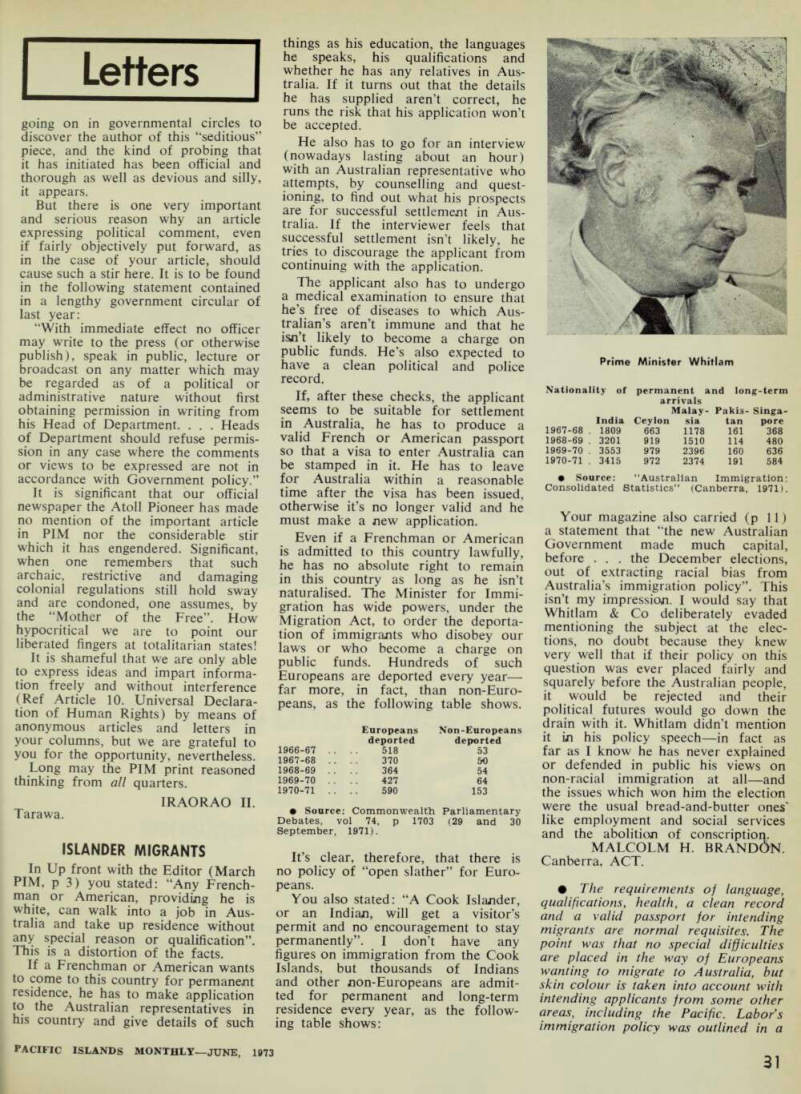
Prime Minister Whitlam
1966-67 . .
Europeans deported 518 Non-Europeans deported 53 1967-68 . . 370 50 1968-69 . . 364 54 1969-70 . . 427 64 1970-71 .. 590 153
arrivals Malay- Pakis- Singa- India Ceylon sia tan pore 1967-68 1809 663 1178 161 368 1968-69 . 3201 919 1510 114 480 1969-70 . 3553 979 2396 160 636 1970-71 . 3415 972 2374 191 584
long speech delivered to the Perth Press Club by Mr Whitlam on October 24, 1971. He said among other things that the policy would avoid “discrimination on any grounds of race, or colour of skin or nationality”. He gave as an example of “damage to Australia’s relations” the decision by the Liberal Govern ment to refuse to allow NZ citizens who are also Islanders to visit Aus tralia without visas, and said the decision could not be justified.
You Splendid People
PIM is a great pleasure to me. If I cannot spend more time in the South Pacific (work you know, etc) at least I can keep my memories and impressions alive through your maga zine. Occasionally I run across a person or place known to me from my travels of 71 (South Pacific Games—Tahiti, the Samoas, Tonga and Fiji) and of 72 when I attended and spoke before the First South Pacific Judicial Conference (I’m a probation officer and told the judges of the juvenile probation system in Los Angeles County—as you’ll re member, the judges’ sessions were “closed” so your reporter covered one of the “open” sessions running at the same time—on narcotics as I remember).
I wish to tell you, everyone of the South Pacific, how much I value your life and of my sincere and constant hope that it remain un spoiled. There is a calm beauty in the people I met on my travels and, not surprising, I found these splendid people in places of incomparable beauty. They have “the good life” courtesy of Nature. May Man never tamper with your life as he has with ours.
Thank you for the pleasure you send me inside the covers of each copy of PIM, Since I spent the bulk of my time in American Samoa, I do occasionally wish there was more material covering that particular corner of the South Pacific but Western Samoa is also dear to me and Felise Va’a does a capital job from Apia. Please tell him so for me.
James Ladd Patterson.
2640 Via Pacheco, Palos Verdes Estates, California, 90274,
Usa.
This Correspondence
Now Closed
Mr Graeme Kent’s letter (PIM, May, 29) objects to criticisms in my review of his book, Company of Heaven. His book is, as I said in my
Letters
review (PIM, March, p 81) a useful introductory description of mission history in the Pacific area, but it does contain an unusual number of errors and a reviewer is obliged to note this.
In fact, I only pointed out a small sampling of them.
His denial that he spells the word “Tubou” inconsistently is ridiculous.
On p 163 it is “Tubou”; on p 165, line two it becomes “Tobou”, as on p 168, last line. A namesake is spelt “Tubou” on p 122, “Tuhou” on p 126 and “Tukou” in the index.
Again he implies innocence about “Cakobau”, but whereas it is cor rectly spelt on p 129, line one, para graph four, three lines down it be comes “Cakabou”.
Some of the other spelling errors not mentioned in my review include “Congratgational” for “Congrega tional” (p 226); “Mendara” for “Mendana”; “curture’ for “culture” (p 228); “threkeld’ for Threlkeld” and Tinomano” for “Tinomana” (p 229); “Tuamoto’ for “Tuamotu” (p 230).
I could list a number of other points about the book which need modification if it is reprinted. In the meantime it remains a useful intro duction.
Marjorie Crocombe (Mrs)
Suva.
Book Prices
Thank you very much for your excellent book review on two of our boatbuilding books (PIM, Apr, p 75).
We were delighted with the re viewer’s comments, but we note that there was apparently a misunder standing concerning the price.
In the title reference at the end of
the review, Ferrocement Boat Con struction is listed as $l5 and Boat Building and Repairing with Fibre glass has no price mentioned. Actu ally, each book is priced at $U59.95.
Gordon A. Reims.
Sales Manager, International Marine Publishing Co, Camden, Maine,
Usa.
• The price given in PIM of SAIS was obtained from a big Sydney bookshop as its retail price.
Hey, Air Nauru
Your article “Small airline with big ideas and a big breakfast” (March, PIM, p 105) prompts me to wonder why Air Nauru has not considered rights into Santo.
They fly Tontouta/Honiara almost right over Santo, which has been abandoned by the international carriers UTA and Air Pacific. The Fokker F2B could use Pecoa airfield and surely passengers would find it convenient coming from Melbourne or Brisbane to have a direct flight.
Northbound there would be the Japanese businessmen from our local fishing industry returning home. The southern businessman would go to Vila to join Air Pacific or UTA by our local carrier, Air Melanesia, which in effect would be “fed” from both Vila and Santo.
Certainly Air Nauru would be welcomed by local citizens thoroughly fed-up with the bottleneck through Vila—let’s see if Mr Clodumar would like to take this suggestion one step further.
Ken Hutton.
Santo, New Hebrides.
Pioneer Futa
I would like to point out a small error in the article entitled “A Modem Socrates Builds his Athens”, which
• And this was the start of the "small airline with the big breakfast" (see letter above).
A smiling Presi dent Hammer DeRoburt was wreathed in smiles and a lei while Brisbane's Lord Mayor, Aid Clem Jones, looked on.
This picture was taken in 1970 during the festive flight for the new Jet.
appeared in the April issue of PIM.
Futa Helu was not ‘a student of Tupou College’ as Stuart Glauber man stated. Futa attended Tonga High School; in fact he was one of the pioneering students of that school.
Konai Helu Thaman
Geography Department University of California Santa Barbara.
Reaction To Fiji
You may be interested in the fol lowing letter I have sent to Burns Philp, Suva, following the holiday I and my family have just spent in Fiji: “I am writing to thank you for the arrangements made by your office in connection with my family’s recent visit to Fiji. We could not fault the arrangements made and we thoroughly enjoyed our stay in Fiji. In particu lar, the days we had at the old capital of Levuka and at Namale Plantation, near Savusavu, were some of the happiest we have ever spent on holiday anywhere.
“In case you are interested in general comments as well as praise (constructive, I hope), we had only two adverse reactions: “The Fijian Hotel—just another big hotel, disinterested staff, in stark contrast with Fiji hospitality in the other places (in particular, excellent friendly service at Travelodge in both Suva and Nadi, which surprised us, as we had expected indifferent “Big City” treatment).
“Prices at Nadi Airport’s so-called duty-free shop, which are outrageous, and must give Fiji a bad name with the transiting passenger. For ex ample, the bar prices—6o cents for a Scotch, 30 cents for a can of Fanta (in the duty free area!), and the price of a pair of Zeiss binoculars (Sl2O at the “Duty Free” compared with $93 at an ordinary store in Sydney).
“I didn’t mean to end with a sour comment, but thought you might be interested. Again, many thanks for making our holiday a memorable one.”
Michael Batten
Sydney.
Radio Australia
Visiting Australia recently I was astonished at the lively, intelligent and interesting news broadcasts on the Australian Broadcasting Commis sion’s TV channel.
Our only source of morning news is the ABC overseas radio service, and from listening to it over a period of years one concludes the Commis sion’s main purpose is to give as-
Letters
surance that all’s right with Empire.
We hear that foreign heads of state have left home for meetings in far-off places. We hear of their arrival for the meetings. We hear of their de parture after the meetings, which are described by both parties as cordial and useful. We hear that they have arrived back home and are expected to report on the trip.
At New Year we hear that the Pope regrets there is strife in the modern world—and so endlessly on and on, with rarely a thing you’d ever chat to the neighbours about.
We’d be interested to hear what’s really happening and to know what’s going on in Australia and the Pacific, as well as in Cairo. On the mainland the ABC provides provocative com ment and first-hand reports from around Australia and the world. Are real events and controversies thought to be too strong a medicine for the children of the islands?
Frustrated Listener
Norfolk Island.
Pim's Role
I really appreciate your monthly magazine because it is our only link with the rest of the Pacific. Here we seldom get news of Pacific territories especially on the government-owned and controlled radio or TV. We are aware of every detail of a strike oc curring in Paris but we don’t know almost anything of what is happen lnB in our neighbours’ islands.
PIM has a prominent (and, above all unique) part to play in acquainting Pacific Islanders with Pacific facts.
Michel Hugon
Papeete, Tahiti.
Paging W. A. Cowie
For some research I am doing on pk?fi tm r as Isla P d m the Central Facihc I am trying to trace Mr W A Cowie. Mr Cowie was involved in the r^° C 5 U?atl 2 n by Britain of Christmas ' s ,^ nd >" th e 1930s. If you have his address I would appreciate your send ing it to me. If he is deceased please give date and place of death if you have it. Mr Cowie was the subject PIM eVera artideS ° Ver the years in
Lester Gaynor
152 Burgess Avenue, Westwood, Mass. 02090,