swear by
pp. 25-26 · Read in the full issue
The Next 5 Pages
Are 'Faa Samoa'
Fishermen swear by hustle and heaven
From Bette Thompson
in Pago Pago .. a ew years ago, Samoans did little fishing. Trolling and bottom fishing with a hand line from a canoe to catch fish for one’s family was the extent of local fishing efforts in American Samoa. Today Samoans are taking to sea in fully-equipped boats and making their living bv catching fish.
The reasons for such little use of the sea’s resources were: (1) catch ing fish to sell was a new concept to Samoans, and (2) technology wasn’t available.
Progress first began in 1969 with the establishment of the Office of Marine Resources. Stan Swerdloff, present Director of Marine Re sources, said, “Naturally we’ve had some problems, but we managed to get funds appropriated and the small boat project underway. Presently there are 14 24-ft plywood Samoan fishing boats (a modified version of the open square transom Oregon Dory) in the water, two under con struction and six on order”. Response trom the Samoan community has been so enthusiastic that 50 groups most of which represent a single village, are on a waiting list for boats.
The effect on the Samoan people is good,” said Swerdloff. “We now have 50 full-time fishermen, whereas before we had none. And for the nrst time in many years, the people are getting a sufficient supply of fresh fish protein.”
By the end of 1973 there should be 20 boats heading out of Pago Pago harbour in search of snapper, grouper, jacks, and tuna. Being a fisherman is hard work. “You’ve got
to get in there and hustle every day,” says fisherman Wally Thompson.
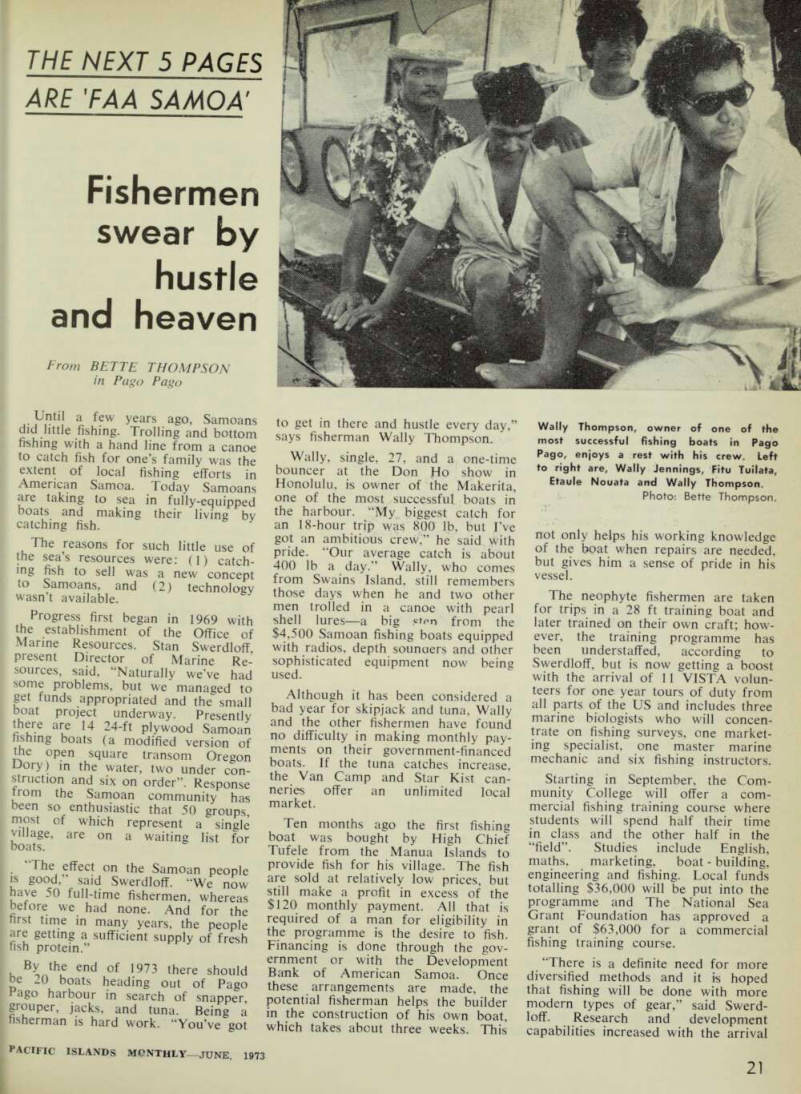
Wally, single, 27, and a one-time bouncer at the Don Ho show in Honolulu, is owner of the Makerita, one of the most successful boats in the harbour. “My biggest catch for an 18-hour trip was 800 lb, but I’ve got an ambitious crew,” he said with pride. “Our average catch is about 400 lb a day.” Wally, who comes from Swains Island, still remembers those days when he and two other men trolled in a canoe with pearl shell lures—a big ,«ten from the $4,500 Samoan fishing boats equipped with radios, depth sounaers and other sophisticated equipment now being used.
Although it has been considered a bad year for skipjack and tuna, Wally and the other fishermen have found no difficulty in making monthly pay ments on their government-financed boats. If the tuna catches increase, the Van Camp and Star Kist can neries offer an unlimited local market.
Ten months ago the first fishing boat was bought by High Chief Tufele from the Manua Islands to provide fish for his village. The fish are sold at relatively low prices, but still make a profit in excess of the $l2O monthly payment. All that is required of a man for eligibility in the programme is the desire to fish.
Financing is done through the gov ernment or with the Development Bank of American Samoa. Once these arrangements are made, the potential fisherman helps the builder in the construction of his own boat, which takes about three weeks. This
not only helps his working knowledge of the boat when repairs are needed, but gives him a sense of pride in his vessel.
The neophyte fishermen are taken for trips in a 28 ft training boat and later trained on their own craft; how ever, the training programme has been understaffed, according to Swerdloff, but is now getting a boost with the arrival of 11 VISTA volun teers for one year tours of duty from all parts of the US and includes three marine biologists who will concen trate on fishing surveys, one market ing specialist, one master marine mechanic and six fishing instructors.
Starting in September, the Com munity College will offer a com mercial fishing training course where students will spend half their time in class and the other half in the “field”. Studies include English, maths, marketing, boat - building, engineering and fishing. Local funds totalling $36,000 will be put into the programme and The National Sea Grant Foundation has approved a grant of $63,000 for a commercial fishing training course.
“There is a definite need for more diversified methods and it is hoped that fishing will be done with more modern types of gear,” said Swerd loff. Research and development capabilities increased with the arrival
Wally Thompson, owner of one of the most successful fishing boats in Pago Pago, enjoys a rest with his crew. Left to right are, Wally Jennings, Fitu Tuilata, Etaule Nouata and Wally Thompson.
Photo: Bette Thompson.
of a 50 ft survey vessel and a 28 ft demonstration training boat in 1972.
“WeTe really happy now that the new Samoan Fish Market (Star of the Seas Fisheries) is open,” said Wally sitting on the Makerita, having a beer with his three crew members.
“Now there is no hassle trying to sell our fish. Sometimes wed come back late in the day—no stores open, no one on the dock—we’d end up having to take the fish back to our
village. Since the new market is operating we now bring the catch in, have it weighed and collect 55c a pound.”
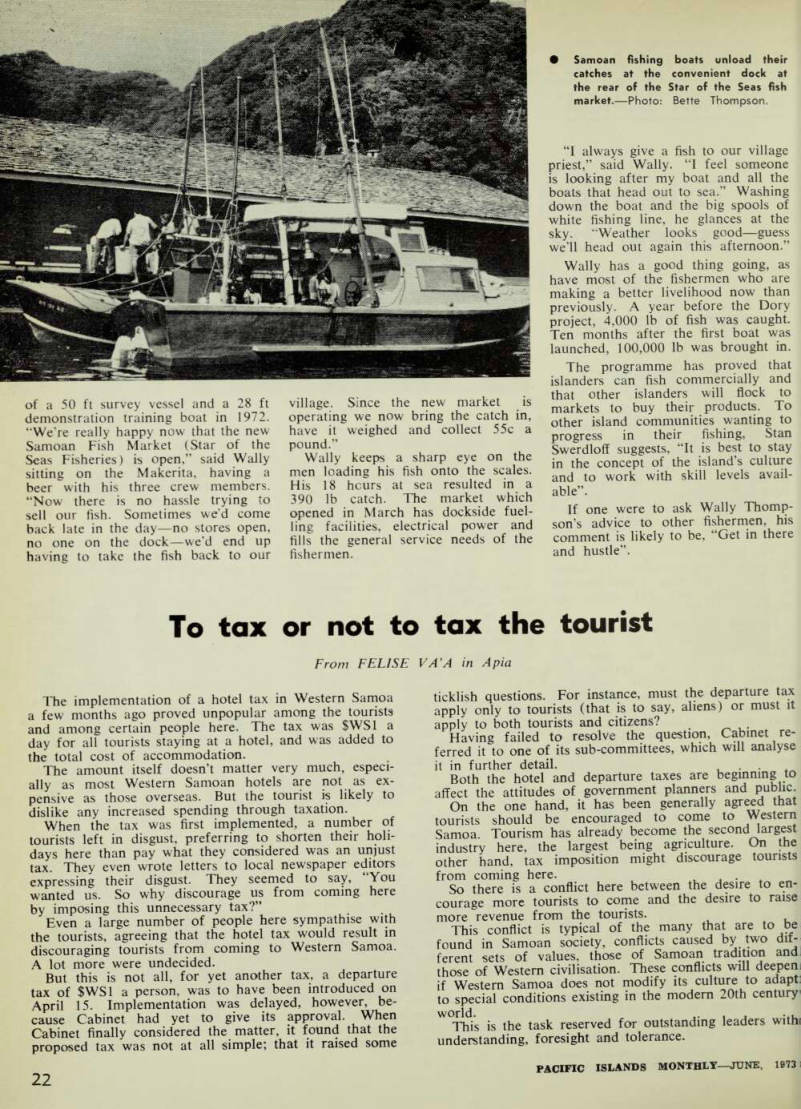
Wally keeps a sharp eye on the men loading his fish onto the scales.
His 18 hours at sea resulted in a 390 lb catch. The market which opened in March has dockside fuel ling facilities, electrical power and fills the general service needs of the fishermen.
“I always give a fish to our village priest,” said Wally. “I feel someone is looking after my boat and all the boats that head out to sea.” Washing down the boat and the big spools of white fishing line, he glances at the sky. “Weather looks good—guess we’ll head out again this afternoon.”
Wally has a good thing going, as have most of the fishermen who are making a better livelihood now than previously. A year before the Dory project, 4,000 lb of fish was caught.
Ten months after the first boat was launched, 100,000 lb was brought in.
The programme has proved that islanders can fish commercially and that other islanders will flock to markets to buy their products. To other island communities wanting to progress in their fishing, Stan Swerdloff suggests, “It is best to stay in the concept of the island’s culture and to work with skill levels avail able”.
If one were to ask Wally Thomp son’s advice to other fishermen, his comment is likely to be, “Get in there and hustle”.
• Samoan fishing boats unload their catches at the convenient dock at the rear of the Star of the Seas fish market. Photo: Bette Thompson.