Tropicalities
pp. 18-20 · Read in the full issue
All things
to all men
at Walgani
The Law, as a subject for dis cussion, can be as dry as the desic cated contents of a family solicitor’s deed box. But “Law and Develop ment in Melanesia”, the subject for the annual Waigani Seminar, the seventh in the series, held at the University of Papua New Guinea’s Waigani campus from April 29 to May 4, was anything but that.
All sorts of ideas emerged from it. There was even an attack on the Bougainville Copper agreement and one got the idea that the seminar, to some, was a kind of springboard for Papua New Guinea’s take-off into independence.
The seminar is obviously all things to all men. To politicians such as Australia’s William Morrison, Minister for External Territories, who gave a policy speech on the form of future Australian aid to PNG, and Paul Lapim, PNG’s Minister for Mines, who spoke on the country’s future mining policy, the seminar offers an ideal forum for making policy statements.
At the other extreme is the academic from abroad, for whom the seminar is a pleasant overseas trip, an occasion to renew former friend ships and a chance to present yet another erudite paper to add to his long list of publications.
Between these two extremes are people like George Chan (a former SPC environmental health officer) trying to “sell” his ideas on converting pig manure into gas; consultants trying to drum up future business; and UPNG law students who have been bribed into presenting papers by being offered exemption from certain university examinations.
Of about 80 speakers, a quarter were Papua New Guineans or Pacific Islanders. With speakers such as Michael Somare, the Chief Minister, questioning the relevance of Papua New Guinea’s laws; with Margaret Mead returning from the country’s past to look forward to its future and with Father John Momis, MHA Bougainville Regional, pressing the case of the “people” against that
monolithic Bougainville Copper, there was certainly plenty of variety.
One thing the seminar did was to pinpoint current burning issues in Papua New Guinea. The Bougainville copper project lurked behind all the sessions, and where it was not intro duced by speakers it was invariably introduced by questioners.
One participant, with international legal experience, described the agree ment between the PNG Government and Bougainville Copper as perhaps the most one-sided agreement of its type, and if the sentiments of the session on mining agreements is any indication PNG will very soon be seeing a re-negotiation of this agree ment.
Certainly Kennecott Copper, who are currently negotiating with the government over a proposed mining operation on the Fly River, will not get a repeat of the Bougainville-type of agreement.
The armed forces’ role in PNG’s future development was also an important issue. An evening session devoted to constitutional develop ment which included Margaret Mead, Bernard Narakobi, legal officer with the Constitutional Planning Com mittee, and Ulf Sundhaussen of UPNG as speakers ended up by largely ignoring constitutional development and focusing on Sund haussen’s paper on PNG’s armed forces.
Questioner after questioner com mented on the army’s expense, on its relevance and on fears of an army takeover in the future. Could this evening session and its discussion of the role of the armed forces have contributed in any way to the Chief Minister’s statement of May 17 that PNG’s defence expenditure would be reduced?
Another major issue was the relevance for the future development of the country of the laws and legal system which PNG has inherited from Australia. Many examples were given of the conflicts which occur between traditional and imported values and laws, and at times it seemed that the more enthusiastic PNG speakers would throw out the whole legal system in order to re place it by something “home-grown”.
The Chief Minister’s statement in his opening address that “We want to build a framework of laws and procedures that the people of Papua New Guinea can recognise as their own—not something imposed on them by outsiders”, must have had the Chief Justice quaking in his shoes at the thought of the work which lay ahead.
Permanent home
for old Samoa
Right from the day the United States took over American Samoa in 1900, people talked of establishing a museum in Pago Pago, But that’s all it was, talk, until 1969 when Jean Haydon landed in the territory with her husband, John M. Haydon, the new governor.
The hospitable Samoans loaded them with gifts which Mrs Haydon displayed in the reception area at Government House, One visitor re marked that the reception area looked like a museum, so a museum it be came with Mrs Haydon scraping together every cent and all the help she could get.
The collection, still in Govern ment House, officially became the museum on January 1, 1970. With the backing of Chief Tuiomanufiea, the governor’s police aide, and members of the Women’s Intercultural Society, museum items were collected and mounted.
In the first year more than 5,000 schoolchildren and tourists saw the collection. It grew and then came the thought, “Whoever heard of a
public museum in a chief executive’s house?”
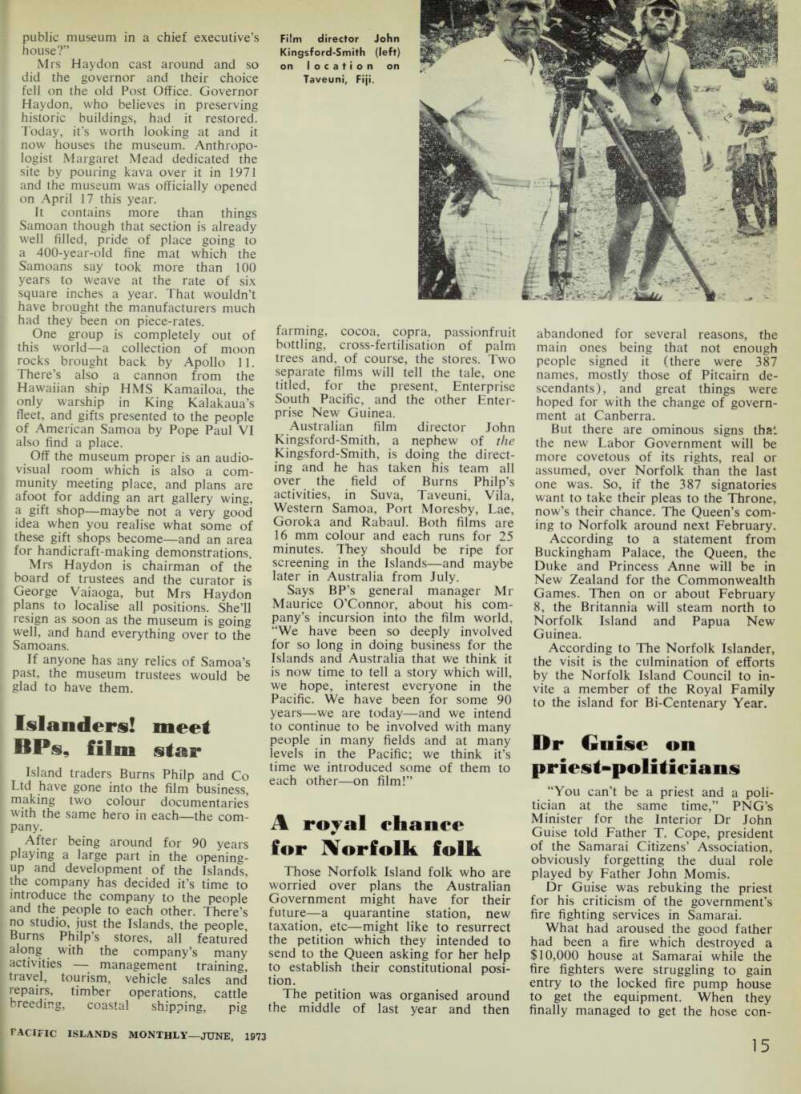
Mrs Haydon cast around and so did the governor and their choice fell on the old Post Office. Governor Haydon, who believes in preserving historic buildings, had it restored.
Today, it’s worth looking at and it now houses the museum. Anthropo logist Margaret Mead dedicated the site by pouring kava over it in 1971 and the museum was officially opened on April 17 this year.
It contains more than things Samoan though that section is already well filled, pride of place going to a 400-year-old fine mat which the Samoans say took more than 100 years to weave at the rate of six square inches a year. That wouldn’t have brought the manufacturers much had they been on piece-rates.
One group is completely out of this world—a collection of moon rocks brought back by Apollo 11.
There’s also a cannon from the Hawaiian ship HMS Kamailoa, the only warship in King Kalakaua’s fleet, and gifts presented to the people of American Samoa by Pope Paul VI also find a place.
Off the museum proper is an audio visual room which is also a com munity meeting place, and plans are afoot for adding an art gallery wing, a gift shop—maybe not a very good idea when you realise what some of these gift shops become—and an area for handicraft-making demonstrations.
Mrs Haydon is chairman of the board of trustees and the curator is George Vaiaoga, but Mrs Haydon plans to localise all positions. She’ll resign as soon as the museum is going well, and hand everything over to the Samoans.
If anyone has any relics of Samoa’s past, the museum trustees would be glad to have them.
Islanders! meet
BPs, Kim star
Island traders Burns Philp and Co Ltd have gone into the film business, making two colour documentaries with the same hero in each—the com pany.
After being around for 90 years playing a large part in the opening up and development of the Islands, the company has decided it’s time to introduce the company to the people and the people to each other. There’s no studio, just the Islands, the people, Burns Philp’s stores, all featured along with the company’s many activities management training, travel, tourism, vehicle sales and repairs, timber operations, cattle breeding, coastal shipping, pig
farming, cocoa, copra, passionfruit bottling, cross-fertilisation of palm trees and, of course, the stores. Two separate films will tell the tale, one titled, for the present, Enterprise South Pacific, and the other Enter prise New Guinea.
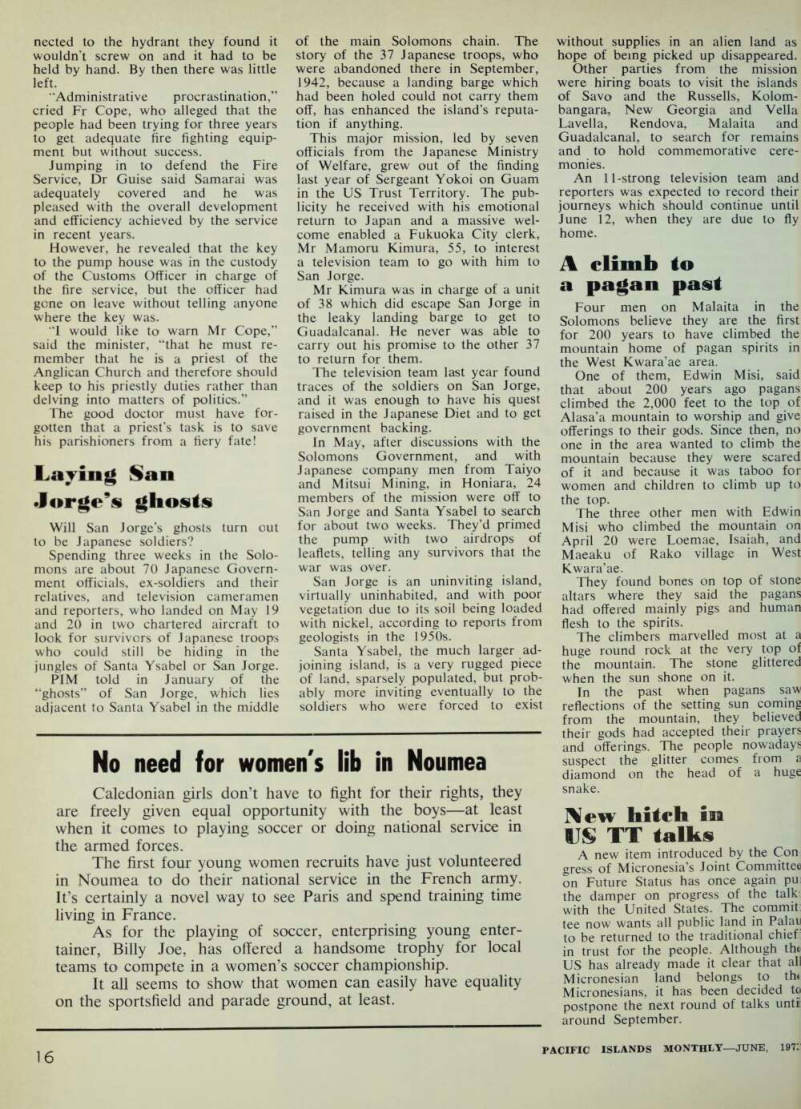
Australian film director John Kingsford-Smith, a nephew of the Kingsford-Smith, is doing the direct ing and he has taken his team all over the field of Burns Philp’s activities, in Suva, Taveuni, Vila, Western Samoa, Port Moresby, Lae, Goroka and Rabaul. Both films are 16 mm colour and each runs for 25 minutes. They should be ripe for screening in the Islands—and maybe later in Australia from July.
Says BP’s general manager Mr Maurice O’Connor, about his com pany’s incursion into the film world, “We have been so deeply involved for so long in doing business for the Islands and Australia that we think it is now time to tell a story which will, we hope, interest everyone in the Pacific. We have been for some 90 years—we are today—and we intend to continue to be involved with many people in many fields and at many levels in the Pacific; we think it’s time we introduced some of them to each other—on film!”
A royal chance
(or Norfolk folk
Those Norfolk Island folk who are worried over plans the Australian Government might have for their future—a quarantine station, new taxation, etc—might like to resurrect the petition which they intended to send to the Queen asking for her help to establish their constitutional posi tion.
The petition was organised around the middle of last year and then
abandoned for several reasons, the main ones being that not enough people signed it (there were 387 names, mostly those of Pitcairn de scendants), and great things were hoped for with the change of govern ment at Canberra.
But there are ominous signs that the new Labor Government will be more covetous of its rights, real or assumed, over Norfolk than the last one was. So, if the 387 signatories want to take their pleas to the Throne, now’s their chance. The Queen’s com ing to Norfolk around next February.
According to a statement from Buckingham Palace, the Queen, the Duke and Princess Anne will be in New Zealand for the Commonwealth Games. Then on or about February 8, the Britannia will steam north to Norfolk Island and Papua New Guinea.
According to The Norfolk Islander, the visit is the culmination of efforts by the Norfolk Island Council to in vite a member of the Royal Family to the island for Bi-Centenary Year.
Dr Guise on
priest-politicians
“You can’t be a priest and a poli tician at the same time,” PNG’s Minister for the Interior Dr John Guise told Father T. Cope, president of the Samarai Citizens’ Association, obviously forgetting the dual role played by Father John Momis.
Dr Guise was rebuking the priest for his criticism of the government’s fire fighting services in Samarai, What had aroused the good father had been a fire which destroyed a $lO,OOO house at Samarai while the fire fighters were struggling to gain entry to the locked fire pump house to get the equipment. When they finally managed to get the hose con
Film director John Kingsford-Smith (left) on location on Taveuni, Fiji.
nected to the hydrant they found it wouldn't screw on and it had to be held by hand. By then there was little left.
"Administrative procrastination,” cried Fr Cope, who alleged that the people had been trying for three years to get adequate fire fighting equip ment but without success.
Jumping in to defend the Fire Service, Dr Guise said Samarai was adequately covered and he was pleased with the overall development and efficiency achieved by the service in recent years.
However, he revealed that the key to the pump house was in the custody of the Customs Officer in charge of the fire service, but the officer had gene on leave without telling anyone where the key was.
"1 would like to warn Mr Cope,” said the minister, “that he must re member that he is a priest of the Anglican Church and therefore should keep to his priestly duties rather than delving into matters of politics.”
The good doctor must have for gotten that a priest’s task is to save his parishioners from a fiery fate!
Laying San
Jorge’s ghosts
Will San Jorge’s ghosts turn out to be Japanese soldiers?
Spending three weeks in the Solo mons are about 70 Japanese Govern ment officials, ex-soldiers and their relatives, and television cameramen and reporters, who landed on May 19 and 20 in two chartered aircraft to look for survivors of Japanese troops who could still be hiding in the jungles of Santa Ysabel or San Jorge.
PIM told in January of the “ghosts” of San Jorge, which lies adjacent to Santa Ysabel in the middle
of the main Solomons chain. The story of the 37 Japanese troops, who were abandoned there in September, 1942, because a landing barge which had been holed could not carry them off, has enhanced the island’s reputa tion if anything.
This major mission, led by seven officials from the Japanese Ministry of Welfare, grew out of the finding last year of Sergeant Yokoi on Guam in the US Trust Territory. The pub licity he received with his emotional return to Japan and a massive wel come enabled a Fukuoka City clerk, Mr Mamoru Kimura, 55, to interest a television team to go with him to San Jorge.
Mr Kimura was in charge of a unit of 38 which did escape San Jorge in the leaky landing barge to get to Guadalcanal. He never was able to carry out his promise to the other 37 to return for them.
The television team last year found traces of the soldiers on San Jorge, and it was enough to have his quest raised in the Japanese Diet and to get government backing.
In May, after discussions with the Solomons Government, and with Japanese company men from Taiyo and Mitsui Mining, in Honiara, 24 members of the mission were off to San Jorge and Santa Ysabel to search for about two weeks. They’d primed the pump with two airdrops of leaflets, telling any survivors that the war was over.
San Jorge is an uninviting island, virtually uninhabited, and with poor vegetation due to its soil being loaded with nickel, according to reports from geologists in the 19505.
Santa Ysabel, the much larger ad joining island, is a very rugged piece of land, sparsely populated, but prob ably more inviting eventually to the soldiers who were forced to exist
without supplies in an alien land as hope of being picked up disappeared.
Other parties from the mission were hiring boats to visit the islands of Savo and the Russells, Kolom bangara, New Georgia and Vella Lavella, Rendova, Malaita and Guadalcanal, to search for remains and to hold commemorative cere monies.
An 11-strong television team and reporters was expected to record their journeys which should continue until June 12, when they are due to fly home.
A climb to
a pagan past
Four men on Malaita in the Solomons believe they are the first for 200 years to have climbed the mountain home of pagan spirits in the West Kwara’ae area.
One of them, Edwin Misi, said that about 200 years ago pagans climbed the 2,000 feet to the top of Alasa’a mountain to worship and give offerings to their gods. Since then, no one in the area wanted to climb the mountain because they were scared of it and because it was taboo for women and children to climb up to the top.
The three other men with Edwin Misi who climbed the mountain on April 20 were Loemae, Isaiah, and Maeaku of Rako village in West Kwara’ae.
They found bones on top of stone altars where they said the pagans had offered mainly pigs and human flesh to the spirits.
The climbers marvelled most at a huge round rock at the very top of the mountain. The stone glittered when the sun shone on it.
In the past when pagans saw< reflections of the setting sun coming from the mountain, they believed their gods had accepted their prayers and offerings. The people nowadays suspect the glitter comes from a diamond on the head of a huge snake.
New hitch in
US TT talks
A new item introduced by the Com gress of Micronesia’s Joint Committee on Future Status has once again pui the damper on progress of the talk 1 : with the United States. The commit] tee now wants all public land in Palau to be returned to the traditional chief: in trust for the people. Although the US has already made it clear that all Micronesian land belongs to th*i Micronesians, it has been decided to postpone the next round of talks untit around September.