New Guinea names the dates
pp. 9-11 · Read in the full issue
Pacific Islands Monthly
Last month PIM spelt out the plans of Australian Minister for External Territories Mr Bill Morri son, for self-government and independence in PNG. Mr Morrison didn’t mention PNG’s Constitutional Planning Committee, which is a key to PNG’s internal constitutional problems. Here we publish a special PIM investigation into progress made by that committee.
Papua New Guinea’s Constitutional Planning Committee (CPC) has just begun an arduous “meet the people” tour of the country. By mid-August, it will have held public meetings in over 90 centres throughout every district. Meanwhile several hundred discussion groups have been estab lished through the Government Liaison Branch (formerly “Political Education”) and these report direct to the CPC their views on constitu tional issues. To help them, the groups use specially prepared illu strated discussion papers.
All this is a process designed to involve the people in formulating the home-grown constitution the com mittee will recommend to the House of Assembly early next year.
The CPC itself mainly comprises prominent government back-benchers and opposition members from all parties, led by Father John Momis (Bougainville regional who, as deputy to the ex officio chairman, PNG Chief Minister Michael Somare, is de facto chairman.) 1 l n addition to the Chief Minister, there are two other ministerial mem bers, both chairmen of previous select committees on constitutional development, but official duties have restricted their participation. 1 The CPC has its own offices, full time executive and legal officers, and three permanent consultants—two of them academics with experience in PNG and other Pacific states, and one a New Guinean law graduate, i The idea of such a committee
working independently owes much
to precedents elsewhere in the Pacific.
Experience in these other areas was (fid by the late Professor Jim Davidson, who was a consultant to the CPC until his sudden death in March. In PNG, however, the idea aas been elaborated, especially in public participation. The committee *opes that as a result the constitution
will be seen by New Guineans as belonging to them, and it will thus be more likely to avoid the fate of many independence constitutions drawn up by British Colonial Office lawyers for African countries.
But this imaginative approach has not been easy to implement.
PNG is both more populous and ethnically diverse than other Pacific states, and has a party system which, though lacking deep community roots, strongly affects the institutions of central government and has pro
duced a volatile situation between government and parliamentary op position.
Lately the CPC has developed an esprit de corps and a sense of com mon purpose, but these have been forged only in the process of long discussions behind closed doors and in two public crises.
The discussions have not yet resulted in much substantive decision making. Apart from a tentative plan for citizenship, and declared general support for new district-level govern ment, the CPC seems to have devoted most of its time to exploring the issues raised by its comprehensive terms of reference, before it gets down to the task of direct con sultation with the people.
Presumably the decisions will flow from September onwards, when the pressure will be on.
The viability of the CPC, as in most such bodies, depends on the hard work of about half its member ship of 15. But it depends most of all on its deputy chairman, Fr.
Momis, who combines considerable intellect and political ability with a deep sense of commitment to the idea of a constitution which will, in his frequently expressed phrase, “embody the felt needs and aspira tions of his people”.
Personally, he also has much at stake for, in seeking a viable frame work for PNG as a whole, he must also satisfy his Bougainville con stituents that their future lies in a larger Papua New Guinea nation, and not in any breakway movement.
The point has probably now been reached where the CPC’s survival is assured, not least because of the ex pectations it has aroused among the people. That survival has also owed much, however, to the relationship between Momis and Somare.
Although unlike in temoerament and other ways, both are essentially
nationalist and democratic in out look, and respect each other’s qualities. Their ability to get along has certainly helped the CPC to emerge strengthened from its two major crises.
The first of these had its origins in a row during the March meeting of the House of Assembly over the timing of independence (PIM, April, P 8).
Bitterly resenting the defeat of its attempt to put back the date by referring the matter to a referendum, the opposition United Party made it clear in the lobbies of the House that it would retaliate by boycotting the CPC—a tactic it had already used to delay the formation of the CPC last year.
The “official” pretext, however, was a complaint about the operation of the CPC, especially the role of its advisory staff, and allegations that the government was using the CPC as a “rubber stamp”. The United Party called for an additional con sultant to act as a kind of watchdog.
It made no attempt to substantiate these allegations after Fr. Momis denied them in detail.
It later appeared that they stem med less from any genuine grievance about the CPC than from suspicions which may well have been sown by advisers to the Leader of the Op position, Mr Matthias ToLiman; and to the discontent of Mr Tei Abal, who is a CPC member, at the govern ment’s failure to recognise his status as Deputy Leader of the Opposition by providing him with a personal assistant.
Thus the dispute was settled by an agreement that Mr ToLiman should receive regular personal briefings similar to those provided the Chief Minister, and that Mr Abal could have an assistant who might also advise other United Party members, outside the CPC, if they wished.
Fr. Momis and most members, how ever, preferred the CPC to continue to work as a team and to be served by its staff accordingly.
The second crisis arose when Aus tralian pressure to increase the pace of constitutional change became such
that the CPC believed it was being virtually ignored.
It issued a statement strongly con demning the Australian attitude, and the apparent willingness of officials in the Chief Minister’s Office to go along with it.
Matters came to a head when the Australian Minister for External Ter ritories, Mr Morrison, insisted on holding constitutional talks on April 28 despite requests from PNG for their deferment because there had been too little time to prepare for them. The CPC’s representatives withdrew in protest.
Fr. Momis also complained that in pushing ahead with power trans fers and other matters, officials were seeing problems only in “bureau cratic, legalistic and technical terms”, at the expense of important political considerations, and that some had never accepted the CPC.
In a reply marked by its concilia tory tone, the Chief Minister thought that the CPC had over-reacted to the talks and said that no firm agreements had been made.
While generally defending his officials, he did not deny some specific charges relating to the hold ing of the talks. He did deny another charge that officials had tried to undermine his confidence in the CPC by criticising it.
Underlying this public row, two issues stand out.
First, it is clear that the CPC was worried from the start that, as powers were transferred and began to be exercised in advance of con stitutional decisions, its options could be pre-empted, and vested interests created even in temporary arrange ments.
Conservative members, who did not want things rushed anyway, were thus joined by their more radical col leagues who wanted to examine the scope for making conditions more suitable for PNG.
The ministers, on the other hand,
growing in confidence, seemed coi tent to go along with bureaucrat! planning in the course of havir their powers extended. From the viewpoint, the CPC appeared undul obstructive. The government coul not stand still waiting for a coi stitution. The CPC’s stand must : times have seemed unrealistic.
However, there are perhaps ev« greater dangers for the government and the country—if, in getting ( with governing, the government n only ignores the opposition, but al: grows remote from its own bac benchers.
There has been recent evidence this, both in the United Party reactu to the timing of independence, ai in the announcement that a numb of coalition supporters in the Hou were involved in starting a ne party.
Secondly, the Australian Lab Government never accepted the id implicit in the declared timing self-government as “December 1973, or as soon as possible thei after”.
It decided firmly for December and the PNG ministers apparem agreed on this date even if the cc stitution would not be ready. Wh; ever New Guineans believed, Ai tralia saw the constitution as son thing for independence, and Decern! self-government would open the w for independence in mid-1974 whatever the internal opposition mij be.
But from the joint communiq which was issued following furtl talks on May 19 at which the Cl was fully represented, it is now cb that the PNG Government has co to a compromise with the CPC, a that Mr Morrison has seen the nec sity to accept it (See time-table, p vious page.) Under a two-stage formula, forr self-government will be introduo in December, with few instii tional changes, and then comple;
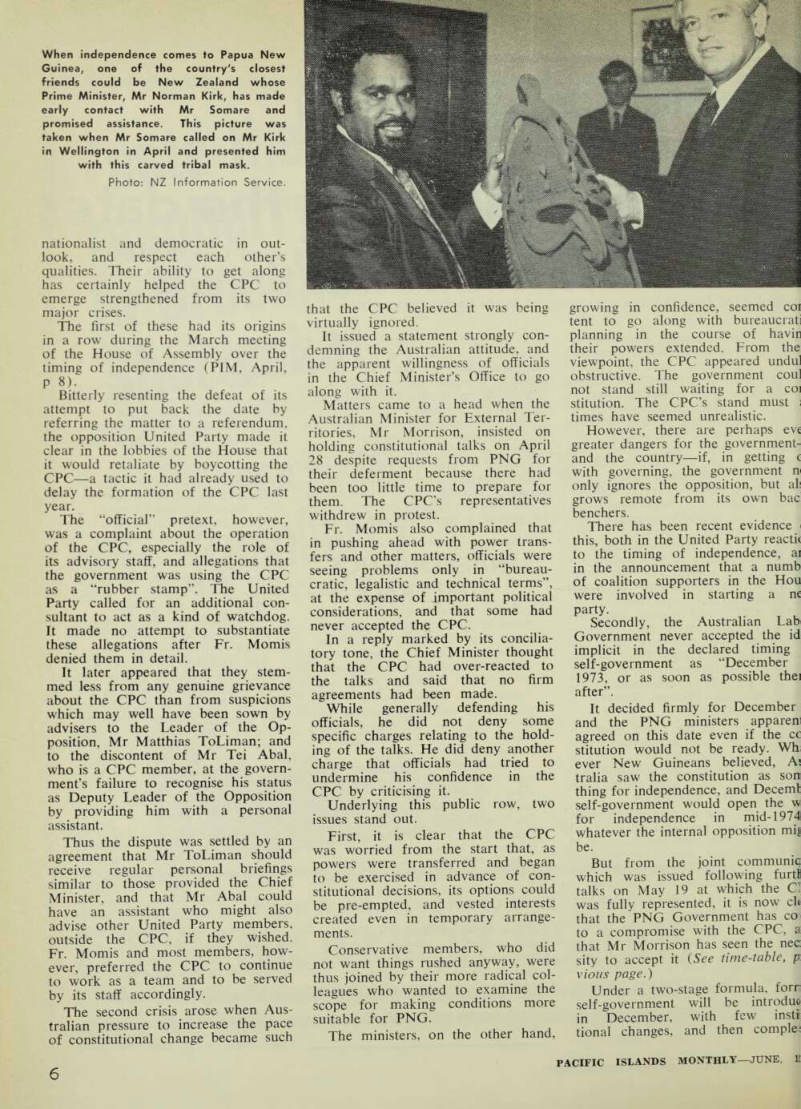
When independence comes to Papua New Guinea, one of the country's closest friends could be New Zealand whose Prime Minister, Mr Norman Kirk, has made early contact with Mr Somare and promised assistance. This picture was taken when Mr Somare called on Mr Kirk in Wellington in April and presented him with this carved tribal mask.
Photo: NZ Information Service.
in May, 1974, with the new consti tution.
Furthermore, the Australian Parliament, instead of enacting the constitution itself, will be enabling the Governor-General to assent to the constitution already passed by the House of Assembly next April. It is a welcome approach, which re cognises the New Guinean desire for a home-grown constitution whilst en suring the legal validity of the process.
As for independence, the com munique mentions that the constitu tion will include provisions for the transition period. Australia will un doubtedly still push for 1974, but it may now have to accept a date at least a few months later than it would have preferred.
In the task of constitution-making there is, meanwhile, room for more co-operation all round.
Some New Guinea ministers do not seem to have fully grasped what the CPC is all about; although, in the long run, Mr Somare has re mained faithful.
At various times, some bureau crats have been opposed to it, and the United Party suspicious.
The CPC has not helped by keep ing so much to itself. Its motives ap pear to have been the desire to main tain freedom of action and to avoid undue pressures. But the contacts it has assiduously cultivated with the people at large have been sadly lack ing in respect of both government and opposition leaders not immediately involved in its work.
Remedial action will be needed if unbridgeable gaps are not to open up when the CPC’s proposals start to come forward later this year.
And there is also an obvious lesson in all this for the Australian Government.
By pushing too hard and too avertly, it in no way helps the Papua New Guinea Coalition Government, md belies its declared wish to be rid )f the colonialist image.
Papua New Guinea will be indepen ient soon enough, but it will become 10 with harmony only if Australia larnesses the mood of change, ather than pushes it to intolerable imits.