Deaths of Islands People
pp. 133-134 · Read in the full issue
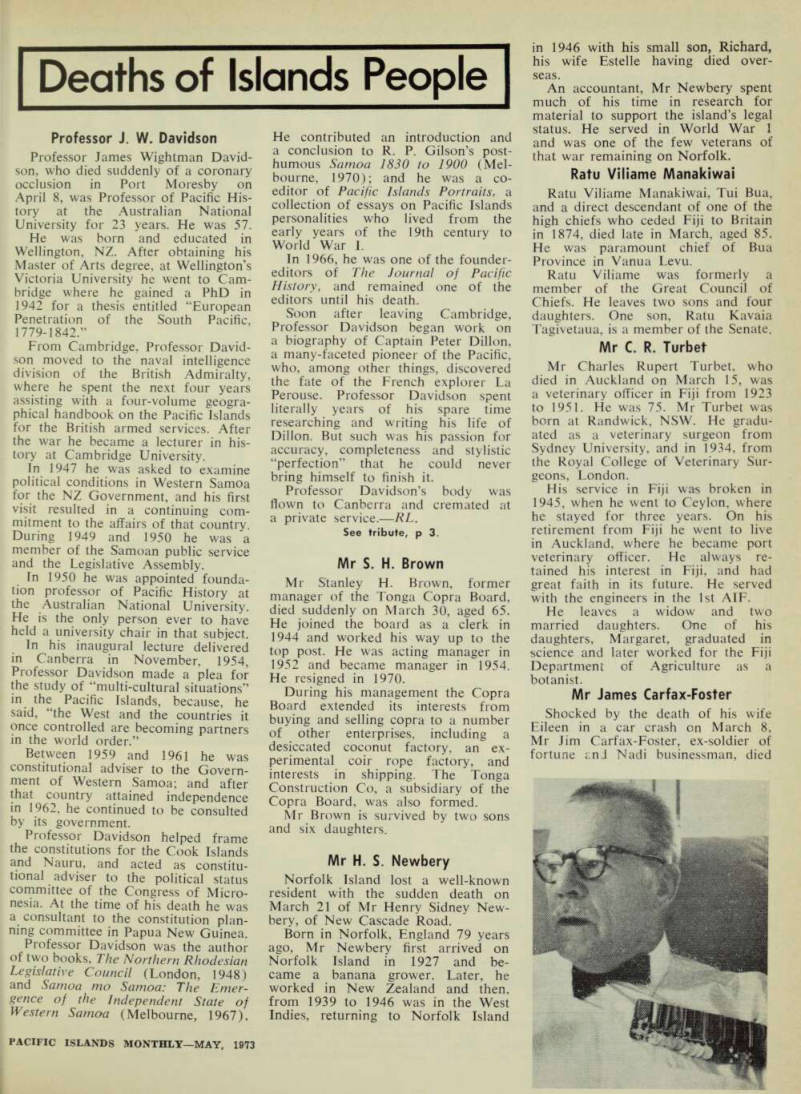
Professor J. W. Davidson Professor James Wightman David son, who died suddenly of a coronary occlusion in Port Moresby on April 8, was Professor of Pacific His tory at the Australian National University for 23 years. He was 57.
He was born and educated in Wellington, NZ. After obtaining his Master of Arts degree, at Wellington’s Victoria University he went to Cam bridge where he gained a PhD in 1942 for a thesis entitled “European Penetration of the South Pacific, 1779-1842.”
From Cambridge, Professor David son moved to the naval intelligence division of the British Admiralty, where he spent the next four years assisting with a four-volume geogra phical handbook on the Pacific Islands for the British armed services. After the war he became a lecturer in his tory at Cambridge University, In 1947 he was asked to examine political conditions in Western Samoa for the NZ Government, and his first visit resulted in a continuing com mitment to the affairs of that country.
During 1949 and 1950 he was a member of the Samoan public service and the Legislative Assembly.
In 1950 he was appointed founda tion professor of Pacific History at the Australian National University.
He is the only person ever to have held a university chair in that subject.
In his inaugural lecture delivered in Canberra in November, 1954, Professor Davidson made a plea for the study of “multi-cultural situations” in the Pacific Islands, because, he said, “the West and the countries it once controlled are becoming partners in the world order.”
Between 1959 and 1961 he was constitutional adviser to the Govern ment of Western Samoa; and after that country attained independence in 1962, he continued to be consulted by its government.
Professor Davidson helped frame the constitutions for the Cook Islands and Nauru, and acted as constitu tional adviser to the political status committee of the Congress of Micro nesia. At the time of his death he was a consultant to the constitution plan ning committee in Papua New Guinea.
Professor Davidson was the author of two books, The Northern Rhodesian Legislative Council (London, 1948) and Samoa mo Samoa: The Emer gence of the Independent State of Western Samoa (Melbourne, 1967).
He contributed an introduction and a conclusion to R. P. Gilson’s post humous Samoa 1830 to 1900 (Mel bourne, 1970); and he was a co editor of Pacific Islands Portraits, a collection of essays on Pacific Islands personalities who lived from the early years of the 19th century to World War I.
In 1966, he was one of the founder editors of The Journal of Pacific History, and remained one of the editors until his death.
Soon after leaving Cambridge, Professor Davidson began work on a biography of Captain Peter Dillon, a many-faceted pioneer of the Pacific, who, among other things, discovered the fate of the French explorer La Perouse. Professor Davidson spent literally years of his spare time researching and writing his life of Dillon. But such was his passion for accuracy, completeness and stylistic “perfection” that he could never bring himself to finish it.
Professor Davidson’s body was flown to Canberra and cremated at a private service.— RL.
See tribute, p 3.
Mr S. H. Brown Mr Stanley H. Brown, former manager of the Tonga Copra Board, died suddenly on March 30, aged 65.
He joined the board as a clerk in 1944 and worked his way up to the top post. He was acting manager in 1952 and became manager in 1954.
He resigned in 1970, During his management the Copra Board extended its interests from buying and selling copra to a number of other enterprises, including a desiccated coconut factory, an ex perimental coir rope factory, and interests in shipping. The Tonga Construction Co, a subsidiary of the Copra Board, was also formed.
Mr Brown is survived by two sons and six daughters.
Mr H. S. Newbery Norfolk Island lost a well-known resident with the sudden death on March 21 of Mr Henry Sidney New bery, of New Cascade Road.
Born in Norfolk, England 79 years ago, Mr Newbery first arrived on Norfolk Island in 1927 and be came a banana grower. Later, he worked in New Zealand and then, from 1939 to 1946 was in the West Indies, returning to Norfolk Island
in 1946 with his small son, Richard, his wife Estelle having died over seas.
An accountant, Mr Newbery spent much of his time in research for material to support the island’s legal status. He served in World War 1 and was one of the few veterans of that war remaining on Norfolk.
Ratu Viliame Manakiwai Ratu Viliame Manakiwai, Tui Bua, and a direct descendant of one of the high chiefs who ceded Fiji to Britain in 1874, died late in March, aged 85.
He was paramount chief of Bua Province in Vanua Levu.
Ratu Viliame was formerly a member of the Great Council of Chiefs. He leaves two sons and four daughters. One son, Ratu Kavaia Tagivetaua, is a member of the Senate.
Mr C. R. Turbet Mr Charles Rupert Turbet, who died in Auckland on March 15, was a veterinary officer in Fiji from 1923 to 1951. He was 75. Mr Turbet was born at Randwick, NSW. He gradu ated as a veterinary surgeon from Sydney University, and in 1934, from the Royal College of Veterinary Sur geons, London.
His service in Fiji was broken in 1945, when he went to Ceylon, where he stayed for three years. On his retirement from Fiji he went to live in Auckland, where he became port veterinary officer. He always re tained his interest in Fiji, and had great faith in its future. He served with the engineers in the Ist AIF.
He leaves a widow and two married daughters. One of his daughters, Margaret, graduated in science and later worked for the Fiji Department of Agriculture as a botanist.
Mr James Carfax-Foster Shocked by the death of his wife Eileen in a car crash on March 8, Mr Jim Carfax-Foster, ex-soldier of fortune and Nadi businessman, died
on April 4 at the home of his son, Mr E. Carfax-Foster, at Camden, New South Wales.
His death at the age of 73 ended a remarkable life of soldiering and adventuring in many parts of the world. He fought with the British Army in World War I, was with the Indian Army from 1919 to 1922 and then roved over numerous battle fields as a soldier in the Greek Army, fighting in East Africa, Mesopotamia, North Persia and South Russia. The Australian Army refused to enlist him for World War II on health grounds so he joined the United States Forces and served until 1946 in the Army Transportation Corps.
He collected several medals, the Military Medal and the Military Cross with the British Army, two French Croix de Guerre during his service in France, the Greek Order of Military Valour and also a Persian decoration.
Honours didn’t cease with the end
of his soldiering. After working as a planter in the Cook Islands, a dairy farmer, radio playwriter and journalist in New Zealand, he went to Fiji in 1947 and for his services to the business and local government world at Nadi was awarded the MBE in 1963. He worked as merchanting and shipping manager for Burns Philp from 1947 to 1952 and later joined Fiji Builders as Nadi manager.
For several years to 1962 he was manager of The Fiji Times branch office in Lautoka and later rejoined
Fiji Builders.
He was the founder and first presi dent of the Nadi Chamber of Com merce, served for several years on the Nadi Township Board and other local pursuits included rifle shooting with the Nadi Smallbore Rifle Club, golf with the Nadi Golf Club of which he was co-founder and mem bership of the Nadi Airport Club, of which he was president for several years.