Boac Pacific Jet
pp. 119-120 · Read in the full issue
News
Both sides of the Downs A pub tour in Southern England
(BOAC Supplement—Advertisement)
By Cyril Palmer
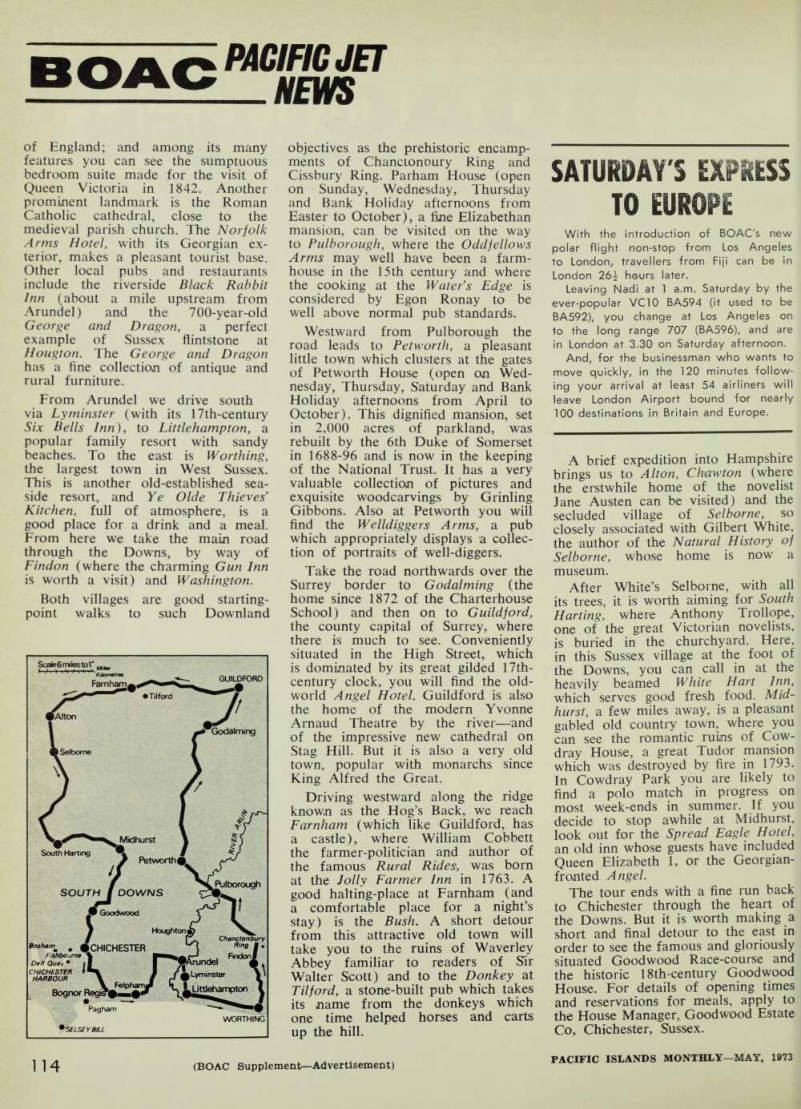
Here is a tour to interest holiday makers in search of a wide variety of activities, including yachting, horse-racing, theatre-going, bird watching and walking. The area is West Sussex and Surrey, and the starting point for a round trip through some of the most beautiful countryside in Southern England is the cathedral city of Chichester. The route includes a double crossing of the South Downs, those attractive chalk hills which form so prominent a feature of the Sussex landscape, and there are also splendid buildings to visit and some fine old pubs and inns for refreshment and accom modation.
Chichester, as well as being the starting point, is also a good place for our first overnight stop. The focal point of the city is the cathedral, which dates from the 12th and 13th centuries and stands near the junction of four main streets originally built by the Romans. Its 15th-century bell tower is the only detached cathedral belfry in the country, and in the cathedral itself the artistic innovations range from Bishop Langton’s stained glass of the 14th century to John Piper’s vivid tapestries of the present day. The city’s ornate Market Cross dates from about 1500, and there are many well-preserved Georgian houses.
In complete contrast is the hexagonal shaped Festival Theatre, built in 1961, where no one sitting in the tiered auditorium is more than 66 feet away from the arena stage. (The Festival lasts from May to September). For overnight accommodation Chichester’s hotels include the Dolphin and Anchor (originally two adjacent coaching inns), which faces the cathedral, and the Ship, which dates from the Georgian period.
The nearby Chichester Harbour is an inlet of the sea covering 27 square miles and is well worth exploring during your brief stay, for it is
popular with all those who enjoy messing about in boats. Dell Quay, for instance, is a relic of the city’s old port, and at the Crown and Anchor Inn you will find that at high tide the water laps against the bar appropriately named the Captain’s Cabin. Another interesting old village to visit is Bosham, where the church dates from the days of the Saxons.
On the way back to Chichester, you should allow time to call in at Fish bourne to see the extensive remains of the largest Roman residence so far discovered in Britain. If you want to make a quick visit to the sea, Selsey Bill is seven miles away; while Pagham Harbour, a tidal area with a lagoon, is a nature reserve and breeding ground for seabirds and
waterfowl. At Pagham you can refresh yourself at the Lamb, a tile hung and whitewashed pub, which also has a pleasant garden bar.
Bognor Regis is our first main stop on the tour —a popular holiday resort ever since the 1790’s when English men found that seabathing was so healthy. Queen Victoria knew it, and King George V added the “Regis” following his convalescence there in 1929. Devotees of William Blake, poet, artist and mystic, will probably know that he lived for a while in a thatched cottage at the nearby village of Felpham. You can stop at Felpham for a drink at the Fox, a flintstone building, where the pub sign is said to have been painted by the artist George Morland (1763-1804) —as payment for his bill!
The route now leads north to Arundel, whose steep streets climb up the slopes of the Downs from the river Arun. The town is famous for its impressive castle (open on several days each week from April to September), the ancestral home of the Duke of Norfolk who is also hereditary Marshal and Chief Butler
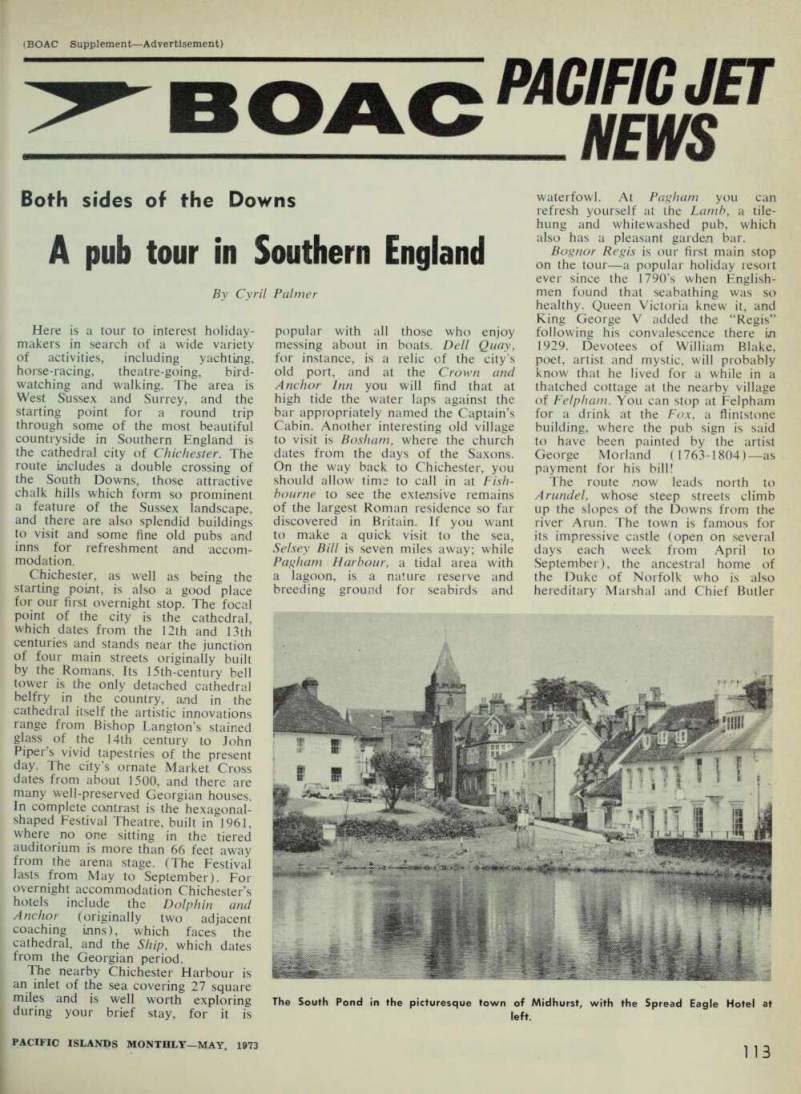
The South Pond in the picturesque town of Midhurst, with the Spread Eagle Hotel at left.
of England; and among its many features you can see the sumptuous bedroom suite made for the visit of Queen Victoria in 1842. Another prominent landmark is the Roman Catholic cathedral, close to the medieval parish church. The Norfolk Arms Hotel, with its Georgian ex terior, makes a pleasant tourist base.
Other local pubs and restaurants include the riverside Black Rabbit Inn (about a mile upstream from Arundel) and the 700-year-old George and Dragon, a perfect example of Sussex flintstone at Hougton. The George and Dragon has a fine collection of antique and rural furniture.
From Arundel we drive south via Lyminster (with its 17th-century Six Bells Inn), to Littlehampton, a popular family resort with sandy beaches. To the east is Worthing, the largest town in West Sussex.
This is another old-established sea side resort, and Ye Olde Thieves’
Kitchen, full of atmosphere, is a good place for a drink and a meal.
From here we take the main road through the Downs, by way of Findon (where the charming Gun Inn is worth a visit) and Washington.
Both villages are good starting point walks to such Downland
objectives as the prehistoric encamp ments of Chanctonbury Ring and Cissbury Ring. Parham House (open on Sunday, Wednesday, Thursday and Bank Holiday afternoons from Easter to October), a fine Elizabethan mansion, can be visited on the way to Pulborough, where the Oddfellows Arms may well have been a farm house in the 15th century and where the cooking at the Water’s Edge is considered by Egon Ronay to be well above normal pub standards.
Westward from Pulborough the road leads to Petworth, a pleasant little town which clusters at the gates of Petworth House (open on Wed nesday, Thursday, Saturday and Bank Holiday afternoons from April to October). This dignified mansion, set in 2,000 acres of parkland, was rebuilt by the 6th Duke of Somerset in 1688-96 and is now in the keeping of the National Trust. It has a very valuable collection of pictures and exquisite woodcarvings by Grinling Gibbons. Also at Petworth you will find the Welldiggers Arms, a pub which appropriately displays a collec tion of portraits of well-diggers.
Take the road northwards over the Surrey border to Godaiming (the home since 1872 of the Charterhouse School) and then on to Guildford, the county capital of Surrey, where there is much to see. Conveniently situated in the High Street, which is dominated by its great gilded 17th century clock, you will find the old world Angel Hotel. Guildford is also the home of the modern Yvonne Arnaud Theatre by the river—and of the impressive new cathedral on Stag Hill. But it is also a very old town, popular with monarchs since King Alfred the Great.
Driving westward along the ridge known as the Hog’s Back, we reach Farnham (which like Guildford, has a castle), where William Cobbett the farmer-politician and author of the famous Rural Rides, was born at the Jolly Farmer Inn in 1763. A good halting-place at Farnham (and a comfortable place for a night’s stay) is the Bush. A short detour from this attractive old town will take you to the ruins of Waverley Abbey familiar to readers of Sir Walter Scott) and to the Donkey at Tilford, a stone-built pub which takes its name from the donkeys which one time helped horses and carts up the hill.
A brief expedition into Hampshire brings us to Alton, Chawton (where the erstwhile home of the novelist Jane Austen can be visited) and the secluded village of Selborne, so closely associated with Gilbert White, the author of the Natural History of Selborne, whose home is now a museum.
After White’s Selborne, with all its trees, it is worth aiming for South Harting, where Anthony Trollope, one of the great Victorian novelists, is buried in the churchyard. Here, in this Sussex village at the foot of the Downs, you can call in at the heavily beamed White Hart Inn, which serves good fresh food. Mid hurst, a few miles away, is a pleasant gabled old country town, where you can see the romantic ruins of Cow dray House, a great Tudor mansion which was destroyed by fire in 1793.
In Cowdray Park you are likely to find a polo match in progress on most week-ends in summer. If you decide to stop awhile at Midhurst, look out for the Spread Eagle Hotel, an old inn whose guests have included Queen Elizabeth 1, or the Georgian fronted Angel.
The tour ends with a fine run back to Chichester through the heart of the Downs. But it is worth making a short and final detour to the east in order to see the famous and gloriously situated Goodwood Race-course and the historic 18th-century Goodwood House. For details of opening times and reservations for meals, apply to the House Manager, Goodwood Estate Co, Chichester, Sussex.
(BOAC Supplement—Advertisement)