Pacific Shipping
pp. 89-93 · Read in the full issue

Freight Rates Rise Was A Hair
Raiser To The New Guineans
The rise in Australia-Papua New i Guinea freight rates in April created a furore in PNG official circles. The immediate reaction of the Minister for Finance, Mr Julius Chan, was that the government would not accept them. Short-term, it is difficult f to see what he meant, for any retaliatory action would only send the rates up further.
Price Controller, Mr Harry Ritchie, in a typically low-key approach, warned consumers to “spend wisely”.
He also warned shopkeepers not to increase their prices prematurely or by too much.
Mr Ritchie said he failed to see how the increases could be justified, but in his next sentence he said PNG ; was reliant on exports and thus was at the mercy of freight increases and inflation in the exporting country.
He then hammered the theme he continually hammered when he was i Financial Secretary a~d later Minister for Finance in Fiji—increase local production. He also said that if [ goods from a particular country be ; came too expensive, then PNG should [look to a country which could pro duce them cheaper and ship them more cheaply.
He said the government intended to investigate ways of having its voice heard in matters like freight increases which were decided outside the country.
Mr Chan said that in the past sug gestions had been made for a national shipping line. The government would inow consider that alternative as the best long-term solution.
Later Mr Chan and Transport Minister, Mr Pruce Jephcott, examin ed legislative steps open to the govern me^f.
They said they were convinced ther- no justifiable vindication for the freight increase. The PNG section of shipping cos*s in loading and id'scharemg were much lower than in Australia. They believed PNG pro vided better facilities, berthage priorities and good industrial rela tions, which were an advantage to
overseas shipping.
They also welcomed a recent decision by the Shippers’ Council in Lae not to impose any increase in southbound freight. Mr Jephcott will go over seas soon to study the immediate and long-term shipping arrangements most beneficial to PNG. He will also make it known that PNG wants to be represented as a country in any decision which would have an effect on the economy.
The 12 i per cent increase represents a rise of $4.10 to $4.40 a ton. The new rates, with the amount of the increase in brackets, are: Sydney/
Brisbane to Lae/Rabaul/Madang, $36,70 ($4.10); Sydney/Brisbane to Port Moresby/Samarai, $36.50 ($4.10); Sydney/Brisbane to Kavieng/Kieta, $41.70 ($4.10); Mel bourne to Lae, $39.50 ($4.40); Mel bourne to Port Moresby, $38.15 ($4.40).
Mr Jephcott said he would fly to Australia to argue against the pro posed increases. He would make it known that PNG wished to be re presented as a country in any de cision which would have an effect on PNG’s economy. He would also put PNG’s case to shipping leaders in Australia. (Up to late on April 5, Mr Jeph cott had not been in touch with any of the shipping companies, based in Sydney, which serviced PNG from Australia).
Later he hopes to go to other countries to look into the establish ment of national shipping lines.
Meanwhile the PNG Public Ser vice Association came out in sup port of Mr Chan’s decision to oppose the freight increases. It would sup port any move to prevent a recur rence of unilateral decisions on freight costs which lifted prices of basic consumer items.
Transpac Sued
For $1.12 Million
Transpacific Lines Inc, which operates from the US west coast to the US Trust Territory, is being sued for $1.12 million by a Panamanian company, Naviera Oleron, controlled by Mr George C. Kiskaddon, of San Francisco, who also owns about half of Transpacific. Mr Kiskaddon said .he suit was merely to collect a loan.
Transpacific was formerly known as Micronesian Interocean Lines (MIL 1). It has been involved in a number of controversies since the change of name in 1971. Transpacific services from the US coast to the Trust Territory have been drastically curtailed through the withdrawal of two ships, the Grethe Reith and
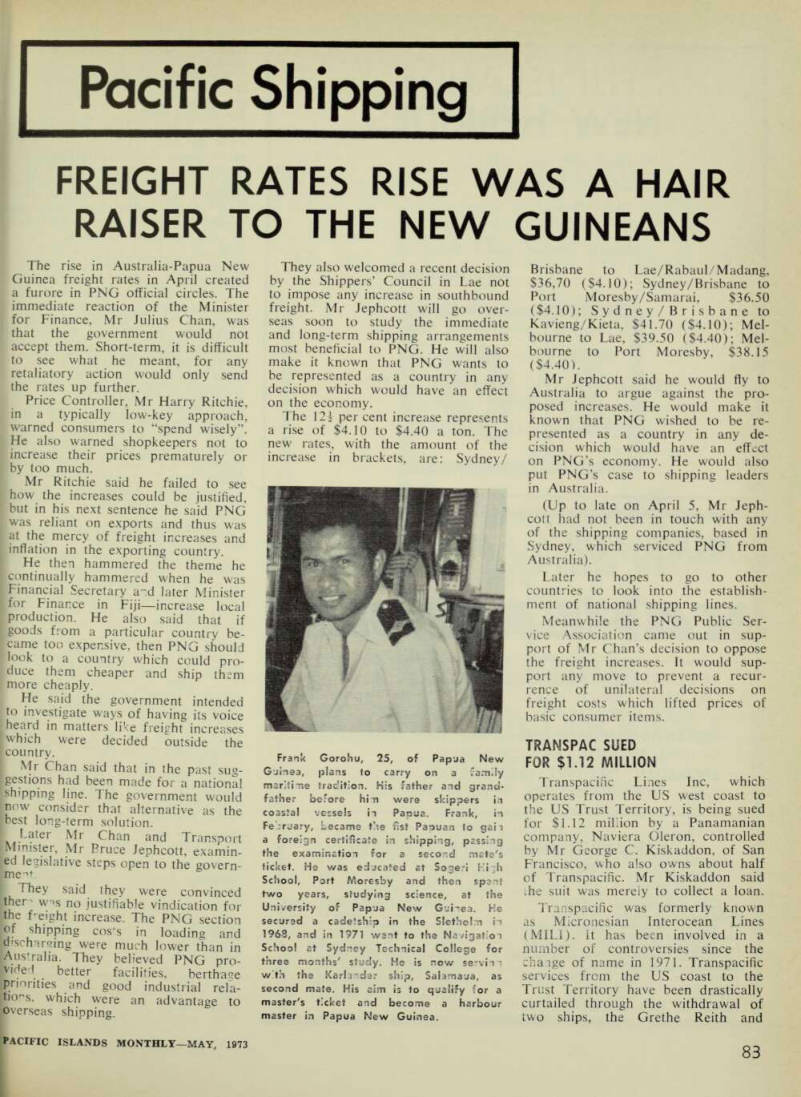
Frank Gorohu, 25, of Papua New Guinea, plans to carry on a vamily maritime tradition. His father and grand father before him were skippers in coastal vessels in Papua. Frank, in February, became the fist Papuan to gain a foreign certificate in shipping, passing the examination for a second mete's ticket. He was educated at Sogeri High School, Port Moresby and then spent two years, studying science, at the University of Papua New Guinea. He secured a cadetship in the Sletholm in 1968, and in 1971 went to the Navigation School at Sydney Technical College for three months' study. He is now serving
with the Karhnder ship, Saiamaua, as
second mate. His aim is to qualify for a master's ticket and become a harbour master in Papua New Guinea.
Matthias Reith, by their German owners.
Businessmen in the Trust Territory are concerned that urgently needed supplies are not arriving from the US.
The Grethe Reith recently had to un load a cargo in San Francisco to await the next sailing for Micronesia of the Lotte Reith. Transpacific also made plans to discontinue services with the Matthias Reith, to leave only the Lotte Reith on the service. They also opened negotiations with the Pacific Far East Line and US Lines to start a containerised service.
There were no apparent links be tween the Kiskaddon suit and the withdrawal of the German ships. II was reported that a separate disagree ment between Transpacific and the German owners caused the with drawal of the Grethe Reith. The German owners were said to want £ charter rate of SUS3,OOO a day in stead of 5U52,350 because of de valuation of the US dollar.
Mr Kiskaddon, who is president o a San Francisco firm, Marine Char tering Co, has no say in the manage ment of Transpacific, in spite of hi: big holding in it. He has been havinj difficulties with Transpacific sino 1971, when Transpacific sufferee heavy losses through a maritimi strike.
He said he secured loans of million for Transpacific in 1971, o which Si. 12 million was from his owi company, Naviera Oleron. In 1971 after the maritime strike, the Trus Territory Government helped to re form MILI to assure a continue! service for the area.
Since then the management o
Transpacific was in question for :
time. There was controversy in Jul> 1972, when it announced expansioi of its services to the Orient to in elude Kaohsiung, Keelung, Kob and Yokohama. Hawaiian business men did not like this move, whic] meant stopping in Honolulu on east bound voyages, rather than west bound. Before that change the Trans pacific ships had stopped at Hone lulu on their way to the Trust Tern tory. The new schedule meant ths Hawaiian goods for Micronesia ha. to be carried to San Francisco first., The chairman of Transpac, Ml Bilimon Amram said there was marked dron in cargo bookings froe both the US west coast and Japar Mr Amram said the usual cargo fc 30 days out of Japan was about 3,50( tons, but .now Transpac was onll receiving 1,107 tons for 30 days.
The same trend was apparent oc the US west coast. If the Greth Reith picked up all the cargo then there would be nothing left for th
Lotte Reith. Price changes for food and lumber were also having an effect on cargo. Many businessmen in the [Trust Territory were in financial difficulties and were holding off making large purchases because of , big increases in the price of goods.
Japanese Tourists
Will Sail To Png
In July the first of a monthly 1 series of ship cruises will reach Papua New Guinea from Japan. At least 250 I passengers are provided for on the new 10,000 ton liner of the Kanbara Shipping Co, Tropical Rainbow. In conjunction with TAA the passengers will be provided with package tours of PNG.
An announcement of this was made recently by TAA manager for Papua New Guinea, Mr R. Conley and the manager of the New Guinea Develop ment Department of the Kanbara Shipping Co, Mr Y. Ichikawa. Talks between TAA and the Japanese com pany began last year in Port Moresby and continued in Tokyo in February this year.
Tours will take in most areas of Papua New Guinea, the Solomon Islands and Australia. Mr Ichikawa said his company had great confidence in the future development of Papua New Guinea. It would depend on growth of the passenger trade whether additional vessels would be put on the route.
Us Tt To Close
Loran Stations
Five navigational aid stations in the US Trust Territory at Saipan, Angaur, Eniwetok, Ebeye and Wake Island will be closed this year, ac cording to a US Coast Guard an nouncement. One station, at Yap, will remain open. The announcement said the stations were closed to reduce costs.
Captain Martin W. Flesh, com mander of the Marianas section of the Coast Guard, said the cutter, Mallow, would be moved from Guam to Alaska. The Basswood would continue to maintain buoys and lights.
He said ships which had been using the electronic aids would have to turn to alternative methods, of which there was a number available.
From Tons To Tonnes
Shipping lines in Australia servicing Papua New Guinea will “go metric” on July 1. The terms “long tons” and “short tons” will disappear, to be replaced by “tonnes” (1,000 kilo grams). Freight charges, on a weight basis, will be exactly the same as those applied under the Imperial system.
Ferries To Compete
With Barges In Fiji
A new company in Fiji plans to operate inter-island ferries to counteract the trend to cargo carrying barges. The traditional cargo/passenger ships are gradually disappearing from service and the barges are not suitable for passengers.
The principal in the venture is an Auckland businessman, who was born in Fiji, Mr Leo Smith. Associated with him as directors of the new com pany, Seatrans Fiji Ltd, are Mr Jack Gosling, retiring shipping manager of Burns Philp (SS) Co Ltd, and
Mr Aminiasi Katonivualiku, a Suva lawyer.
Seatrans, initially, will offer a customs clearance, import and export costing, cartage and overseas market ing service. It is discussing the ferry projects with the Fiji Government.
Another Ship For
China Navigation
The China Navigation Co has added the Kwangtung to the Hong Kong-Pacific Islands service. With the Chengtu it will call at Rabaul, Wewak, Lae, Port Moresby and Honiara. There will also be induce
mant calls at Kieta. The service also extends to New Caledonia and New Hebrides with the Chengtu and to Samoa and Tahiti with the Kwang tung.
New Agency
Opens In Sydney
Swire and Gilchrist and Inter ! ocean Australia Services have set up an agency to handle a number of shipping lines in I Sydney. Each company will con- I tinue to provide its own management. : The agency will act on instructions I from the principals. A new company, Interocean Swire Pty Ltd, has been formed, and will start operations in > Swire House, Sydney, on May 14.
It will represent the China Navi gation Co, Royal Interocean Lines, New Guinea Australia Line, Saf ocean, Blue Funnel Line and Mer- I cury Shipping Co. It will handle marketing, booking of cargo, loading of ships, documentation and account ing.
Mr B. A. Hinwood, of Interocean Australia Services, has been appointed [ manager. The board comprises three representatives from each company —Mr H. Wever (the first chairman), Mr J. C. P. van Diepen and Mr Hinwood, from Interocean Australia Services, and Mr E. J. R. Scott, Mr W. R. Gregg and Mr R. Smith, from I Swire and Gilchrist.
Shipping Briefs
The US Trust Territory plans to [restrict inter-district shipping services Ito local companies. A bill has been sent to the High Commissioner, Mr Edward E. Johnston, to limit to I wholly Micronesian-owned shipping companies, exclusive licences for ship- I ping between and among the admini strative districts. • The Nauru Pacific Line has I made two minor alterations to Aus tralia-Pacific Islands services. The New Hebrides has been omitted from the Australia-South Pacific-Coral Sea run and replaced by Noumea, while the Philippines has been omitted from the Australia - Nauru - Marshall Is - GEIC service. • Three “off beat” Cook Islands, Mauke, Mitiaro and Atiu, have be come permanent ports of call for the jWest Star on her South Pacific cruises. Atiu, the latest island added to the itinerary, was visited for the [first time in March. The tourists were greeted with excellent weather and a team of dancing girls. • The Cook Islands Price Tribunal jhas given the Cook Islands Shipping |Co permission to increase rates by
2i per cent on all freight carried between Auckland and Rarotonga and islands in the southern part of the group, and vice versa. A similar increase may be applied to outer islands cargo.
The tribunal also allowed an in crease of 10 per cent on all cargo carried from Rarotonga and southern islands to southern ports in New Zea land. The new rates became effective on April 1. • Pitcairn Island had 61 visits from overseas vessels in 1972. There were 42 merchant vessels, 11 naval ships, seven yachts and one cruise
ship.
• Captain John Sutherland, master
of the Lorena of the Cook Islands Shipping Company, had a surprise reunion recently when he berthed at Rarotonga. The cruise ship West Star was alongside and among its pas sengers were his uncle and aunt who had flown from Scotland for a South Seas cruise. • The New Hebrides inter-island trader, Neptune, is believed to be a total loss. She recently struck a reef opposite the airstrip at Lamap during a heavy storm. The Neptune’s barge and most of the cargo were recovered.
The owners of the Neptune, Captain Tween Cain and Mr Martin, hope to replace the Neptune and continue their inter-island service.