Ta Makirere will help
pp. 79-80 · Read in the full issue
Pacific personality Ta Makirere will help Islands songwriters
Interviewed By Marjorie Crocombe
M.C. Ta, you have done quite a lot in music—you write music, you sing, and you play eight or nine musical instruments. Your records are sold commercially, and you are organising a workshop of Pacific musicians.
Now, how did it all start?
T.M. Well, I remember way back when the American soldiers were still in my home island of Aitutaki during the war, my elder brother and I used to sing for the soldiers or at concerts. I was about five or six then, and my brother played the guitar and I sang and played the ukulele with him. I learnt very early to play the uke with the help of my brother and members of my family. We also had a gramophone given to Dad by an American friend and we had records, hundreds of them, and some cowboy songs, western songs and sentimental love songs—you know, the American stuff —and I used to sit by that gramophone with members of my family and listen and listen and then sing, playing the ukulele to these songs and in concerts, M.C. Tell us a bit of your home island.
T.M. As you know, Aitutaki is my home island. It is one of the Southern Cook Islands, very small, only two or three thousand people, and rather isolated.
M.C. But Aitutakians have a Pacific wide reputation for talents in creating songs and dances and for ex pressiveness generally. Did your musical interests con tinue when you went to high school in New Zealand?
T.M. Yes. When I went to school in New Zealand the matron caught me in a music room when there wasn’t supposed to be any noise there. But I was so fascinated by the piano and that was the first time I’d ever seen one, that I sat down and banged my first note. It brought forth all the desire to play the thing and it suddenly overtook me. When the matron came in I was banging out some simple songs. She said, “Would you like to learn music?’* “Yes please,” I said. I don’t know how many stars there were in my eyes when I said it. She asked the music teacher who was willing to teach me, so that’s how I learned to play the piano.
M.C. How did you learn to play the guitar?
T.M. I was really self-taught. I got books and when I played the chords I tried to remember what they were and perhaps because of my tremendous interest in music, they stuck. I remembered the chords. That’s how my knowledge of the guitar came.
M.C. How many musical instruments do you play?
T.M. Well, I wouldn’t claim to be an expert in all these but I can play the piano, the guitar, ukulele, saxophone, trumpet, mouth organ, the recorder, and the steel guitar. I played the tenor horn and the tuba in a brass band for four years, but it’s the same principle as the trumpet and I used the trumpet back home in Aitutaki when I started a dance band just before I came to Fiji to study at the Pacific Theological College, M.C. You have also made some records haven’t you?
T.M. When I went back home, I was asked to make some recordings and we did some tapes in Rarotonga in the Cook Islands and sent them to Viking Recording
Company in New Zealand. But I had done a bit of music in New Zealand and I was about to do some recording there too when I was called back to the Cook Islands. Anyway, I wanted to go back so that chance of making more recorded music fell through, M.C. What did you do in the Cook Islands?
T.M. I went back as a teacher. I trained at Ardmore Training College near Auckland and went back home to teach in Rarotonga and in Aitutaki at the newly opened Junior High School. I taught history and English, and music for the whole school. Then for a while I went into the Government to translate and interpret for the Legislative Assembly, Then I decided to take up teaching again. Later I had the idea of becoming a church minister so I came to the Pacific Theological College in Suva to train as a minister.
M.C. Did you keep up your musical interests at the Theological College?
T.M. I was choirmaster there and I did a couple of songs with the help of Dr Garrett. One was Sweet Pacific Prince which I sang in a Pacific Christmas pageant in the Suva Town Hall. I also did an Easter song. The tune of that song came to me at two o’clock in the morning so 1 got up and sang the tune onto a tape recorder so I wouldn’t forget it the next morning. I certainly kept up my interest in music. How could I give it up?
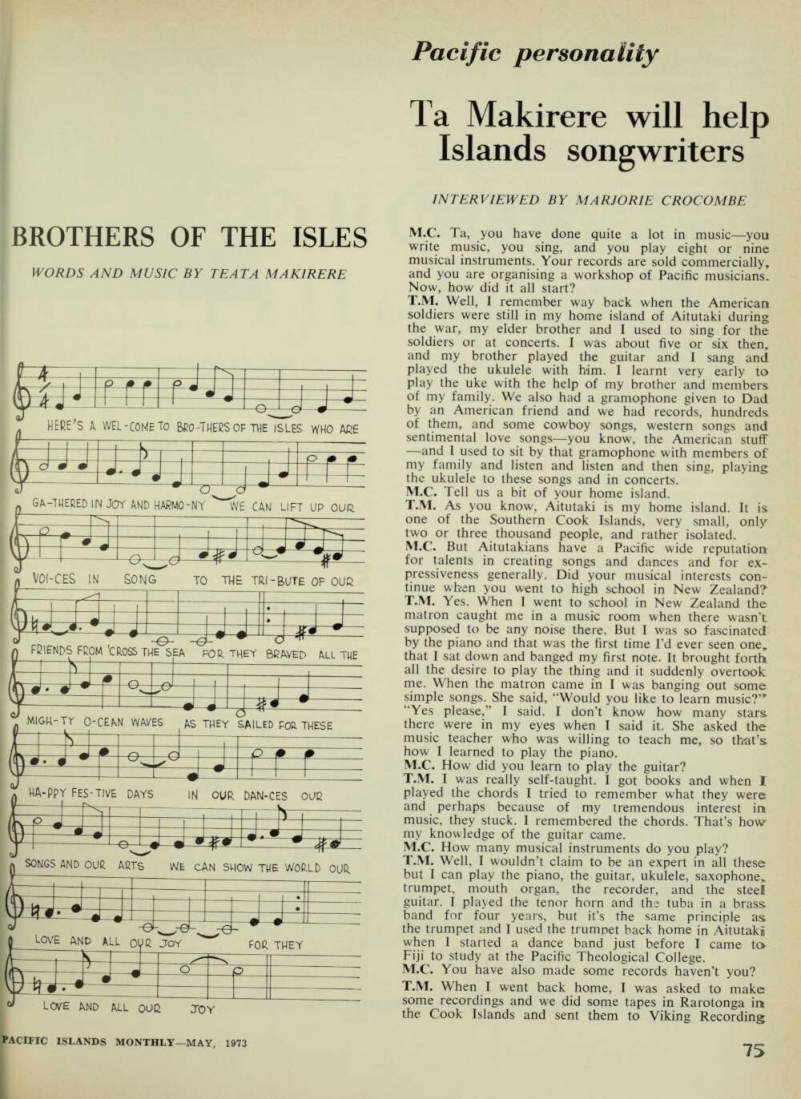
M.C. What about the song you composed for the first South Pacific Arts Festival which won the first prize?
T.M. That was a wild attempt but it paid off I guess.
It was called Brothers of the Isles. It was actually de veloped from the first song I ever composed in the Cook Islands. I used the tune of it for the Festival song.
I’m sure Cook Islanders would recognise the song Uuna Koe, meaning “You hide your love”. I used that tune for Brothers of the Isles.
M.C. After your theological training in Suva you went back to the Cook Islands. Did you have time to com pose?
T.M. At the end of 1971 I went home and assisted in one of the Aitutaki parishes. I was busy but I managed to do some music teaching with the Boys Brigade and Sunday School. In fact, I took guitar lessons for the Boys Brigade, learnt the Aitutaki style of strumming and tnught the boys staff notation. The Boys Brigade was then planning to buy a brass band and so my idea was to get them in tune musically so that they would know enough by the time their musical instruments arrived.
M.C. And now your new job concerns all the Pacific Islands. I understand you are training to be Associate Director of the Media section of the Christian Education and Communication section or CEAC. What is CEAC?
T.M. CEAC is the merging of the two sections of the Pacific Conference of Churches —the Pacific Islands Christian Education Curriculum, or PICEC, a.nd Chris tian Communications. They have now come together to form CEAC. Our headquarters are in Suva at the Pacific Theological College campus. At present Bill Mathews and I are working on radio programmes for broadcast to the various churches in the Pacific. The media section is really to do with communication through radio — training people, especially ministers, to be better broad casters —while the Christian Education : on is re sponsible for publishing material written for the islands.
And all the better if they are written by islanders.
M.C. What sorts of programmes do you do in radio?
T.M. Bill and I have been setting up classes and work shops to get people to know the technical s’de of radio work such as how to handle a mike and how to pre pare effective programmes for broadcasting, say in worship. These programmes will be sent to all countries in the Pacific region.
M.C. This week yoa are having a Pacific Musicians Practicum. What is that?
T.M. It is really a getting together of Pacific Islanders who are interested in music and who would like to learn more of the skills of composing. The main idea behind it is to get the musical talents that Pacific Islanders have in their heads down on paper. CEAC has a plan ning committee which organised the day to day pro gramme of the Practicum.
M.C. How many people are taking part in the Practicum?
T.M. About twenty to twenty-five from as far west as Papua New Guinea and the Cook Islands way to the east.
M.C. Could you tell us something about the topics to be covered?
T.M. The Practicum would give some training in music theory beginning with the universals i.n music as a language. We are having workshops in tonic solfa which is widely used in the Pacific. Then there will be staff notation, and these two will take up most of the time. Following these will be com position of music, harmony and rhythm, sacred and secular music, the publication and production of music, stage lighting and sound, and we hope to do some re cording too. The emphasis will be on local music rather than imported, but in this case we’ll have to use the western terminology to get our music across to the rest of the world. As I said the emphasis will be on the preservation of traditional music styles and the deve lopment of new forms. We also hope to hold a sym posium at the end of the Practicum to bring together community members interested in music to talk about it together.
M.C. Do you see a wider opening for you in the field of composition from now on?
T.M. Oh yes. The whole job of Associate Director of Media will provide all the chances I need, and I’m hoping to learn some more about composing during this music workshop.
M.C. What is your advice to others interested in writing music? Can they send their composition to your office for possible help and maybe publish them?
T.M. I’d like to say to anybody who is interested in composing music to send compositions in to us at the CEAC office, Box 208, in Suva. We might be able to help you in some way, I am very interested in music and anyone else who is—man, we are in the same boat here.
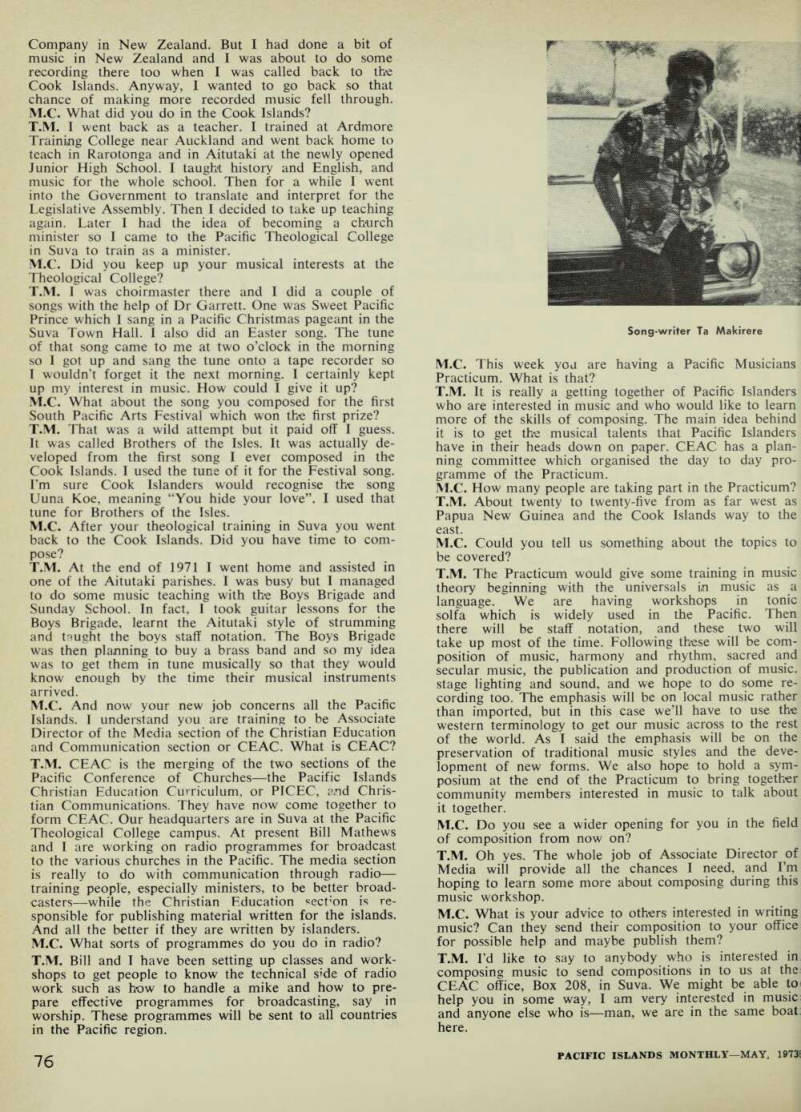
Song-writer Ta Makirere