Living Under The Authority
pp. 76-77 · Read in the full issue
Of A Myth In Ra
By Jo Nacola
Why do the highland tribes of Nakoilava and the neighbouring tribes of Bure on the north-west coast of Viti Levu always taunt and revile each other? It is said that this was the attitude of their ancestral gods, therefore the members of the two tribes must also do likewise lest misfortune should await them.
The myth states that Bure-God asked his friend in the hills, Nakoi lava-God whether the latter could fetch him a fowl in exchange for salt which was a scarce commodity inland. It was agreed that Bure-God and Nakoilava-God would meet half way for the exchange. Instead of pre paring salt from seawater as it was normally done, Bure-God filled an empty basket with sand and covered it well before he proceeded to their rendezvous. Unaware of Bure-God’s trick, Nakoilava-God basketed not a fowl, but wild pigeon before he hurried to meet his friend from the coast.
As might be expected, the meeting was brief and very little was said.
Each of the friends was anxious to leave straight away after the exchange of baskets lest the other unwrapped his gift only to find the true nature of its contents.
“Here is your salt my friend”, assured the God from the coast as
he quickly reached for the other basket.
“Here is your fowl my friend”, whispered his friend from the hills as he likewise grabbed the other basket, anxious to leave as well.
Each had time only to bid the other goodbye over his shoulder, say ing gleefully to himself— “ Ha—i Mr Wild Fowl”
“Ha—i Mr Sandy Salt”
Each then ran away back home happily knowing that he had the better of his friend.
Today the two sets of tribes taunt and revile each other because their ancestral gods tricked each other so their descendants feel they must do likewise. For example, whenever the highlanders go down to the beach for a wedding, their hosts are obliged to make good the mythical trick, so they abstain from eating sea-food, to allow the guests to feast in gaiety. To ensure that this is done they are not to be seen by their hosts eating any sea-food. If this happens, the per-
son concerned has to ask forgiveness through the presentation and the taking of kava communally and during
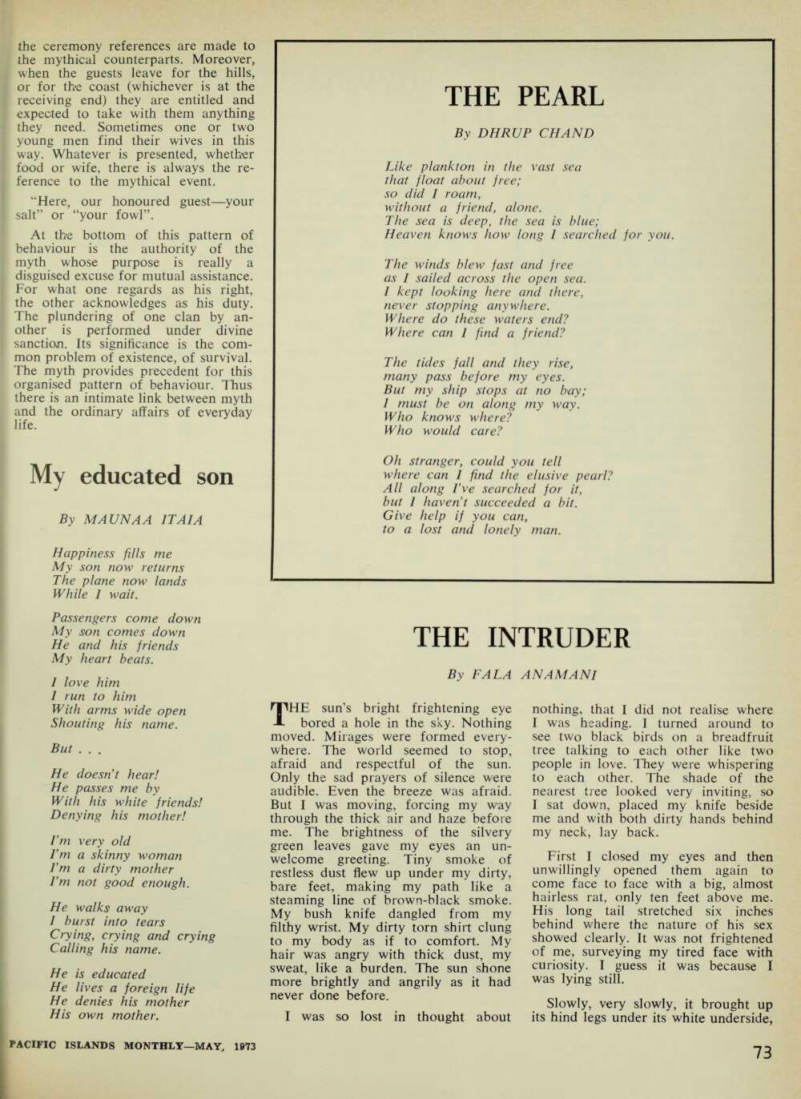
Jo Nacola, president of the SPCAS and author of two articles in this month's
Mana.
the ceremony references are made to the mythical counterparts. Moreover, when the guests leave for the hills, or for the coast (whichever is at the receiving end) they are entitled and expected to take with them anything they need. Sometimes one or two young men find their wives in this way. Whatever is presented, whether food or wife, there is always the re ference to the mythical event.
“Here, our honoured guest—your salt” or “your fowl”.
At the bottom of this pattern of behaviour is the authority of the myth whose purpose is really a disguised excuse for mutual assistance.
For what one regards as his right, the other acknowledges as his duty.
The plundering of one clan by an other is performed under divine sanction. Its significance is the com mon problem of existence, of survival.
The myth provides precedent for this organised pattern of behaviour. Thus there is an intimate link between myth and the ordinary affairs of everyday life.