Footnotes
pp. 40-41 · Read in the full issue
A FUNNY thing happened on the way to the University Book Shop. I was taken for a tourist.
I had gone out to Vaigana* to try to get a book which I had been unable to get in town. When I got there I found that the book shop had moved from its former rather cramped quarters into more spacious ones in a new wing. So I had to ask my way.
The chap I accosted, after looking me up and down in rather a marked manner, very courteously offered to take me there. On the way he asked me, “Are you a tourist?” I explained that actually I had been around for quite a while, in fact almost 50 years. I refrained from asking him whether he was one of the academic tourists of which we have quite a number at UPNG; after all, it had been very decent of him to show me the way, whoever he was.
I found the book I wanted—our University
Book Shop is really something—
and having made my purchase I began to make my way back to my car, puzzling as I went. I was not really upset at having been taken for a tourist; but one of my most cherished beliefs had been shattered. I have always believed that it is impossible to look odd on the campus of our university.
Yet apparently I had achieved this feat.
What was wrong with me? It is
true that my shirt had a collar, unlike the many Afro types around me. But it was a brightly pat terned shirt, and I had not committed the solecism of tucking it into my shorts. Scuffs are not de rigueur at UPNG, and my sandals were near enough to the norm to be inconspicuous.
Due to a series of mishaps with wrist watches I had a lady’s trinket watch hung round my neck on a rolled gold chain, and this perhaps gave me a slightly hippie look; but after all there were a number of males walking around with strings of beads round their necks. And the watch was the only thing I did have slung round my neck—no camera, no light meter, no gadget bag, no binocu lars.
Moving Finger
Writes Pir
Or, Maybe, Rip
What was wrong with me? Suddenly 1 realised that my short-back-and-sides hair cut made me stick out like a sore thumb in that milieu. Well, if that was it, I shall have to go on being taken for a tourist. 1 have a great affection for our university, especially since it has acquired a Chancellor who says Papooa just like I do, and I would be pre pared to lay aside my collared shirts and go Afro to be with it. But in this climate I abso lutely refuse to wear my hair long or grow a beard.
With Percy Chatterton
in Port Moresby
Reaching my car I found that an unknown benefactor had come up with a solution to the problem which had been occupying my thoughts on my way out, namely, what to write about for the May issue of PIM. On the car’s dusty rear window a mischievous finger had traced the letters PIR.
The Pacific Islands Regiment has been in the news lately, due to some outspoken comments by
the Speaker of the House of Assembly Barry Holloway. According to him the PIR is too small to be of any use to repel an external attack but quite big enough to constitute a threat to
Paguinean democracy.
The Chief Minister’s reaction was rather odd.
He is reported as having said that the size of the army was something that would be decided after Papua New Guinea had worked out “why we want an army and what its role should be”.
Well, well, well. The PIR has now been in existence as a peacetime force for a quarter of
* The Papuan name for the area on which the University stands. It is frequently mis-spelt and mis-pronounced, alike by egg-heads and hoi polloi, as Waigani.
a century, during which it has cost the Australian Government some hundreds of millions of dollars.
Is it conceivable that in all that time no one in Canberra’s corridors of power has asked, “What’s it for anyway?” Surely not. It seems more likely that Australia’s original reason for establishing and maintaining this mini-army would no longer sound respectable and must be swept under the carpet. A new rationale for the existence of this force has got to be thought up.
I expressed my thoughts on this subject four years ago, in the March, 1969 issue of PIM, and, although circumstances have changed a great deal since then and problems of internal security have become much more acute, I still hold to what I wrote then. But to the question “What’s it for?” we must now, with self-government and in dependence just round the corner, add the ques tions “Do we need it?” and “Can we afford it?”
I would repeat that to ask these questions is not to criticise the PIR. In 1969 I wrote, “Let us accept that those in charge of the PIR have done the job they were given to do and have done it well. It is no criticism of them or their troops if John Citizen wonders what it is all for and where it will lead.” These words are still valid; indeed they have greater force than ever now that ex tensive localisation of the personnel of the force has taken place.
With 100 million Indonesians to our west and 1,000 million Chinese, Japanese and South-east Asians to our north, it is ridiculous to suppose that our country of under three million people could ever field an army capable of repelling an attack from these quarters. So much for external security. What about internal security?
Australia’s Prime Minister recently reminded us that all over the world ex-colonies which have achieved independence have been happy to accept the former colonial boundaries as their national boundaries and have gone to considerable lengths to maintain them intact. This is quite true, and it is really rather remarkable in view of the fact that in many cases they have rubbished everything else that the colonial powers have given them.
What Mr Whitlam omitted to add was that in many cases these ex-colonial national boundaries have only been maintained by the exercise of very great harshness and cruelty, and at the cost of an enormous volume of human suffering.
Do we want that here? Is it worth it in order to maintain a status quo established by 19th century empire builders?
The Australian Government has indicated that it is prepared to contribute generously to the cost of a continuing PlR—possibly to the tune of about 80 per cent of the total. But can a nation be said to be in any true sense independent if its army is subsidised by another nation?
The questions remain. What will be the role of a Papua New Guinea national army? Does this role call for a full-time standing army, or would a well-trained citizen force (a pepped-up version of the PNGVR) suffice? Does a national army subsidised by another nation make sense?
The answers to these questions must come from the people of Papua New Guinea. One can but hope that they will be arrived at freely and not under pressure, and that they will be real answers, not rationalisations for the perpetuat'on of the status quo.
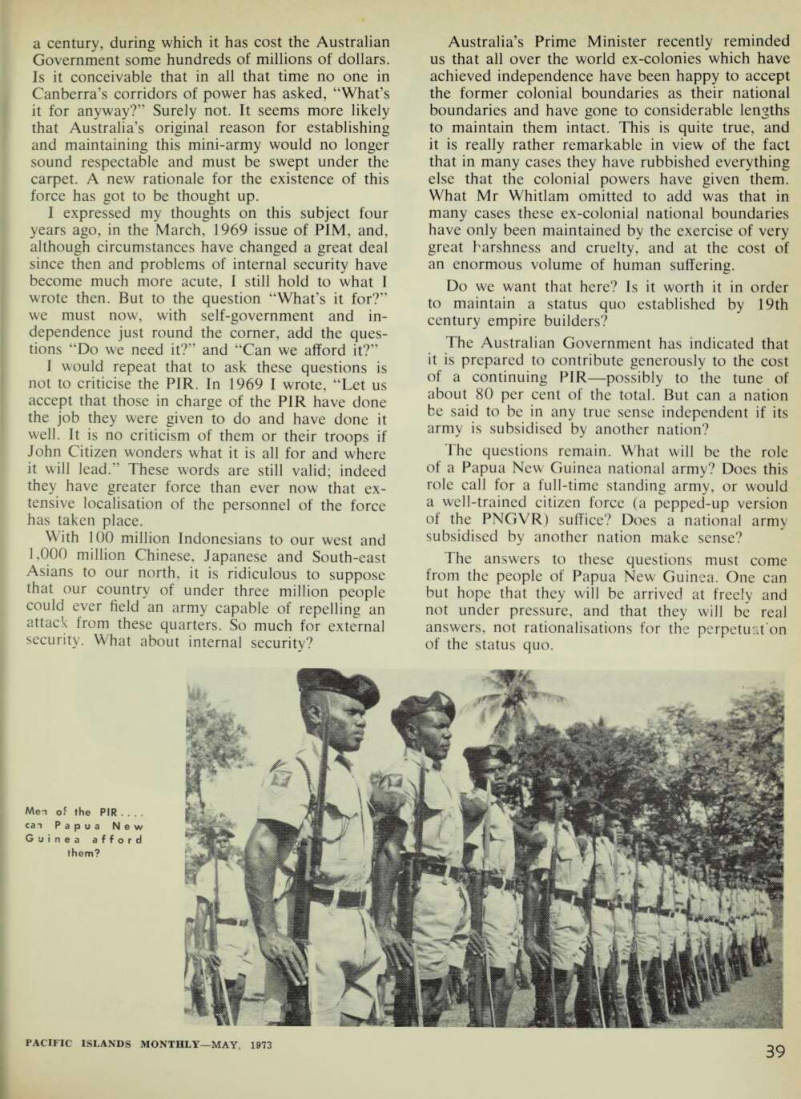
Men of the PIR can Papua New Guinea afford them?