Government Of
p. 25 · Read in the full issue
Giving Them
A Say In The
The Solomons
From a Honiara correspondent The general elections for the British Solomon Islands Protectorate—the first in three years—will be held between May 22 and June 12, begin ning in the Eastern Outer Islands and working inwards. Twenty-four con stituencies have been defined, to re place the former 17, to improve representation. There will be three ex-officio members appointed to the Governing Council also.
During the four year life of this legislature, the Governing Council — if it adopts the recommendations of a special select committee on con stitutional development—will turn the council into a Legislative As sembly, adopt a collectively-respon sible ministerial system of govern ment to replace the present com mittee system which involved all members of Governing Council in Government’s decisions, and choose a Chief Minister to replace the High Commissioner who would then be come Governor, One party has said it will contest the elections, but in April it was still doubtful what effect this untried and still vaguely-formed body would have on these vital elec tions.
Before the nominations had been made, it appeared that there would be a strong contingent of younger men making a bid to unseat the largely older and more colonially moulded Governing Council of today.
Many of these younger men are civil servants with different ideas from the present members on how the Solomons ought to be progressing.
Their precise ideas are being held in store for the final few weeks of campaigning which promise to be fiercely contested in some areas, the capital, Honiara, not the least of these.
The Sixth Development Plan was half over at the end of 1972, with two years to go, and the Seventh plan—being called “the People’s Plan”—will follow. The new form of government, and the 7DP, will be partly a direct result of the new— if new they are to be—forces which make themselves felt in the next Governing Council cum Legislative Assembly. Not all the old brigade are unpopular with the young would-
be’s, but substantially all appear to be, and many of this Govco look ready to fall to potent young con tenders.
It’s a very inexact science picking those who will go, because the will of the people in a developing country such as the Solomons is harder to divine than in an established political system. But if expectations mean anything, there will be many new faces meeting in the High Court chamber for the next Governing Council in August.
Two small groups of people in the Eastern Outer Islands will be voting directly for the first time in these elections—at least, the men will be.
For the running of these tiny islands right out near the border with the New Hebrides is still very much in the hands of the traditional chiefs,
and women don't have a direct say in the island affairs.
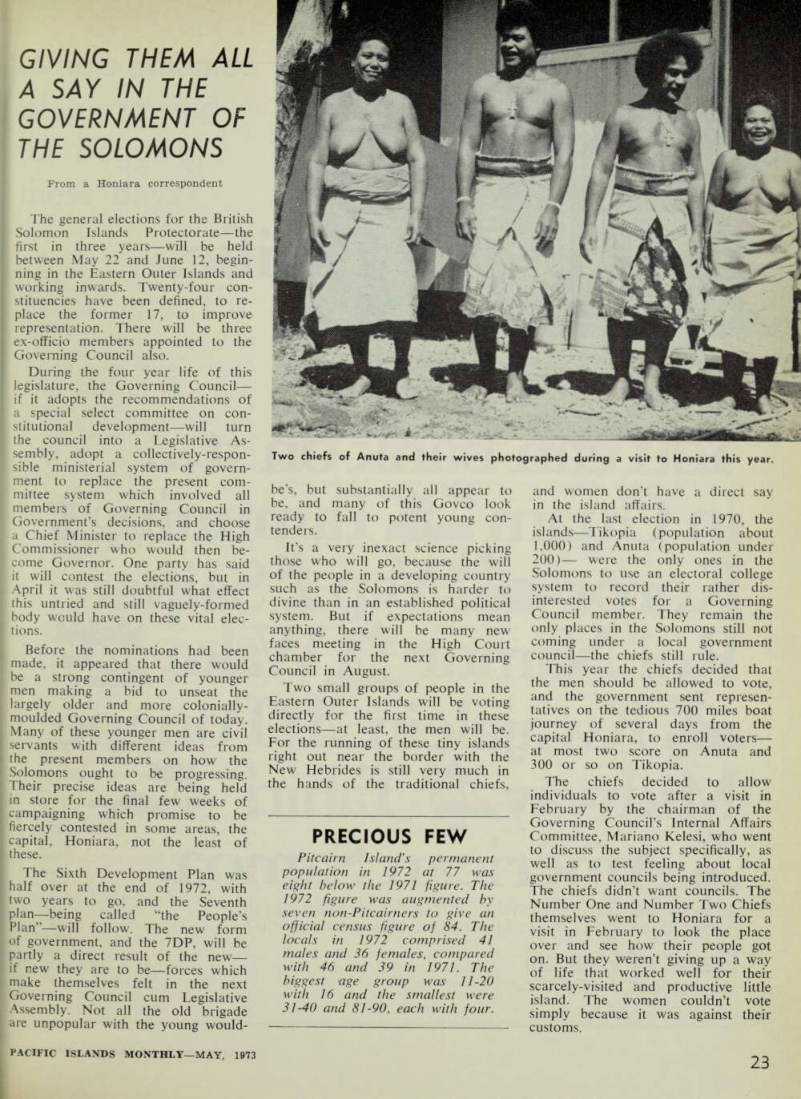
At the last election in 1970, the islands—Tikopia (population about 1,000) and Anuta (population under 200) — were the only ones in the Solomons to use an electoral college system to record their rather dis interested votes for a Governing Council member. They remain the only places in the Solomons still not coming under a local government council—the chiefs still rule.
This year the chiefs decided that the men should be allowed to vote, and the government sent represen tatives on the tedious 700 miles boat journey of several days from the capital Honiara, to enroll voters — at most two score on Anuta and 300 or so on Tikopia.
The chiefs decided to allow individuals to vote after a visit in February by the chairman of the Governing Council's Internal Affairs Committee, Mariano Kelesi, who went to discuss the subject specifically, as well as to test feeling about local government councils being introduced.
The chiefs didn’t want councils. The Number One and Number Two Chiefs themselves went to Honiara for a visit in February to look the place over and see how their people got on. But they weren’t giving up a way of life that worked well for their scarcely-visited and productive little island. The women couldn’t vote simply because it was against their customs.
Two chiefs of Anuta and their wives photographed during a visit to Honiara this year.