Tropicalities
pp. 14-16 · Read in the full issue
Micronesia's
pin-up Sioy
almost
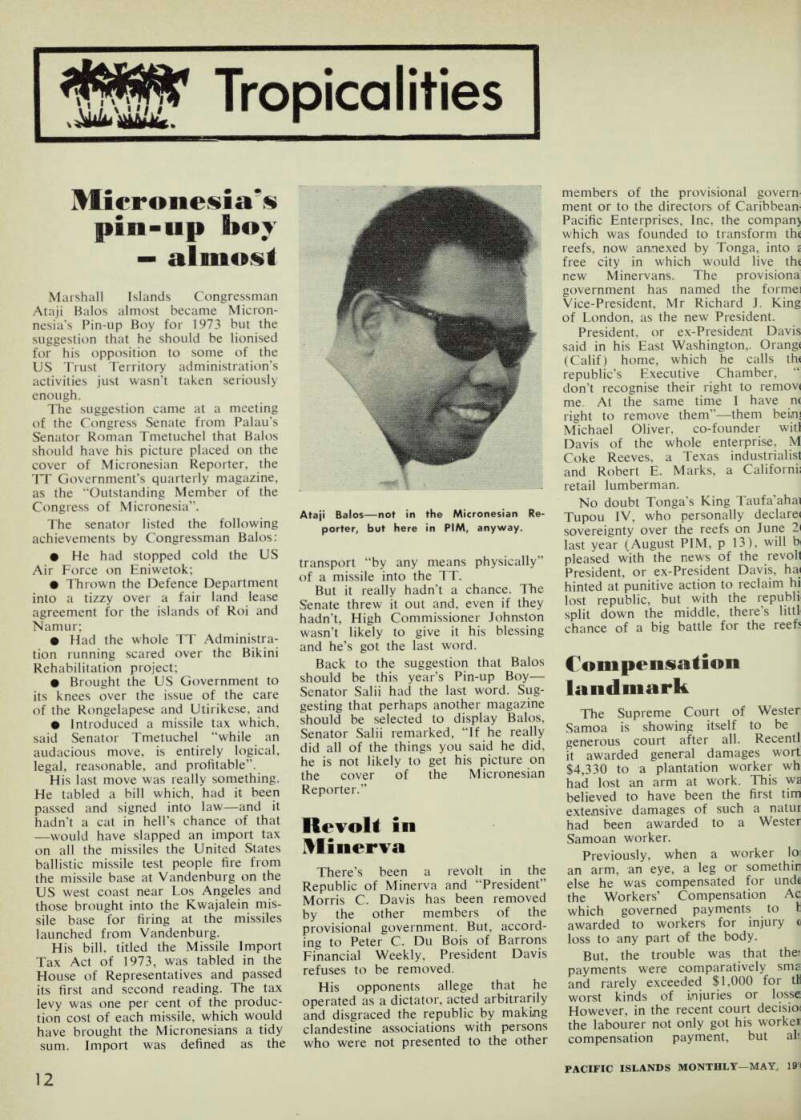
Marshall Islands Congressman Ataji Balos almost became Micron nesia’s Pin-up Boy for 1973 but the suggestion that he should be lionised for his opposition to some of the US Trust Territory administration’s activities just wasn’t taken seriously enough.
The suggestion came at a meeting of the Congress Senate from Palau’s Senator Roman Tmetuchel that Balos should have his picture placed on the cover of Micronesian Reporter, the TT Government’s quarterly magazine, as the “Outstanding Member of the Congress of Micronesia”.
The senator listed the following achievements by Congressman Balos: • He had stopped cold the US Air Force on Eniwetok; • Thrown the Defence Department into a tizzy over a fair land lease agreement for the islands of Roi and Namur; • Had the whole TT Administra tion running scared over the Bikini Rehabilitation project; • Brought the US Government to its knees over the issue of the care of the Rongelapese and Utirikese, and • Introduced a missile tax which, said Senator Tmetuchel “while an audacious move, is entirely logical, legal, reasonable, and profitable”.
His last move was really something.
He tabled a bill which, had it been passed and signed into law—and it hadn’t a cat in hell’s chance of that —would have slapped an import tax on all the missiles the United States ballistic missile test people fire from the missile base at Vandenburg on the US west coast near Los Angeles and those brought into the Kwajalein mis sile base for firing at the missiles launched from Vandenburg.
His bill, titled the Missile Import Tax Act of 1973, was tabled in the House of Representatives and passed its first and second reading. The tax levy was one per cent of the produc tion cost of each missile, which would have brought the Micronesians a tidy sum. Import was defined as the
transport “by any means physically” of a missile into the TT.
But it really hadn’t a chance. The Senate threw it out and, even if they hadn’t, High Commissioner Johnston wasn’t likely to give it his blessing and he’s got the last word.
Back to the suggestion that Bales should be this year’s Pin-up Boy— Senator Salii had the last word. Sug gesting that perhaps another magazine should be selected to display Balos, Senator Salii remarked, “If he really did all of the things you said he did, he is not likely to get his picture on the cover of the Micronesian Reporter.”
He volt in
Minerva
There’s been a revolt in the Republic of Minerva and “President”
Morris C. Davis has been removed by the other members of the provisional government. But, accord ing to Peter C. Du Bois of Barrens Financial Weekly, President Davis refuses to be removed.
His opponents allege that he operated as a dictator, acted arbitrarily and disgraced the republic by making clandestine associations with persons who were not presented to the other
members of the provisional govern ment or to the directors of Caribbean- Pacific Enterprises, Inc, the company which was founded to transform the reefs, now annexed by Tonga, into £ free city in which would live the new Minervans. The provisional government has named the formei Vice-President, Mr Richard J. King of London, as the new President.
President, or ex-President Davis said in his East Washington,, Orange (Calif) home, which he calls the republic’s Executive Chamber, “! don’t recognise their right to remove me. At the same time I have nc right to remove them” —them beiji!
Michael Oliver, co-founder wit!
Davis of the whole enterprise, M Coke Reeves, a Texas industrialist and Robert E. Marks, a Californii retail lumberman.
No doubt Tonga’s King Taufa’ahai Tupou IV, who personally declare< sovereignty over the reefs on June 2( last year (August PIM, p 13), will b pleased with the news of the revolt President, or ex-President Davis, ha< hinted at punitive action to reclaim hi lost republic, but with the republi split down the middle, there’s littl chance of a big battle for the reefs
Compensation
landmark
The Supreme Court of Wester Samoa is showing itself to be generous court after all. Recent! it awarded general damages wort $4,330 to a plantation worker wh had lost an arm at work. This wa believed to have been the first tim extensive damages of such a natur had been awarded to a Wester Samoan worker.
Previously, when a worker lot an arm, an eye, a leg or somethin else he was compensated for unde the Workers’ Compensation Ac which governed payments to t awarded to workers for injury o loss to any part of the body.
But, the trouble was that the; payments were comparatively sms and rarely exceeded SI,OOO for tH worst kinds of injuries or losse However, in the recent court decisioi the labourer not only got his worker compensation payment, but al;
Ataji Balos —not in the Micronesian Re porter, but here in PIM, anyway.
general damages amounting to $4,330.
This does not mean that the law enabling this award to be made was not always there. It has always been there but Samoans had not taken advantage of it. That is, until Fani Afemata, a labourer from Safata, decided to bring a general damages claim to court. He was represented by Mr G. Loe.
The plaintiff alleged that, as a result of the negligence of the em ployer, Mr Douglas Atoa of Saleimoa, and his employees, he received a serious injury when a tree fell on top of him. His arm had to be amputated. The Chief Justice, His Honour G. Donne, ruled that there had been negligence on the part of the employer and his employees.
Working conditions were far from safe and no proper warning was given to the plaintiff concerning the danger he was in the judge decided.
He made the award as follows: economic loss $580; pain and suffer ing $750; loss of enjoyment of life $3,000.
The decision is a landmark because it will encourage more workers to claim for general damages for injuries received during employment.
Employers, on the other hand, will have to be more careful.
Justice at
village level
Papua New Guinea’s villagers are on the way to getting a small measure of law reform. The Cabinet has pro visionally approved a system of vil lage courts, and a definite decision will be made soon. The system is aimed at providing the sort of courts people want to have. Instead of the usual aloofness associated with formal courts of law, the village courts will be closely tied to local government and to community life.
A number of details have already been worked out. No qualification will be necessary for appointment as a village magistrate. The number of magistrates for each area will be no less than three, and no more than 10.
Magistrates will not sit alone. A court will consist of at least three magistrates sitting together, and there must be an odd number so that it may give a decision by a simple majority.
A prime function will be to mediate and to attempt to settle disputes by agreement. There will be wide powers in both criminal and civil jurisdic tions. As civil courts, they may make orders for compensation up to SIOO, or goods to that value, but where destruction of livestock is involved, the limit may be removed. They may
also order work for the benefit of a party, for eight hours a day, six days a week, for up to four weeks.
In the criminal jurisdiction the courts will deal with such offences as minor assault, minor damages to property, drunkenness and sorcery.
All fines will be payable to the local government council in the area. A convicted person may also be ordered to do community work.
There will be no formal rules of procedure, and the courts will not be required to apply the general law of PNG, even for criminal cases. In short, it will be able to apply com monsense and consider all relevant native customs in deciding cases.
Bllood, sex
and all that
Looks like the Censorship Com mittee in Western Samoa is beginning to show a more tolerant attitude towards films of so called “sex” and “violence”. Or is it? “Sex” films in this context must be defined as those films in which there is excessive nudity or explicit lovemaking of more than just the kissing kind. “Violent” films are those in which there is excessive violence or unusual scenes of violence.
The committee seems ready to accept many of these sex and violence films provided the theatre owners cut out certain objectionable scenes.
However recently, the Grand Theatre management went ahead and adver tised the screening of a couple of films of this sort, Blood Mania and Mantis in Lace, that had been banned by the censors, saying they had been okayed later. A spokesman for the committee denied that the ban had been lifted and said the Grand Theatre management had been pro mised a review of the two films. This was not the same thing as lifting the ban.
Infuriated, the committee indicated it would not review the two films— and proceeded to ban yet another, Sex and the Lonely Woman.
So relations between the theatre owners and the Censorship Committee have again deteriorated—and it may take time before the breach is healed.
PIM In a
sea saga
In its 43 years, PIM has been many things to the people of the South Pacific but never, until now, has it acted as part of a search and rescue organisation. In April we got an air-
mail letter from a Taiwan fishing company, asking us to report to the GEIC the rescue in the South Pacific of two Gilbertese fishermen.
We were told that the men, said to have been drifting for nearly four months, had been picked up by the No 1 Yu Chang, a catcher belonging to the Yu Chang Fishery Corpora tion, of Taiwan, and would be landed at Pago Pago some time in May when the ship returned to its base.
The men, whose names were not given, were “well”.
News of the rescue had been radioed to Taiwan from the ship.
The Yu Chang Company’s director, Mr W. S. Hsu, told PIM in the letter that he knew of no other way of letting the men’s families know than writing to PIM.
PIM promptly telephoned the GEIC Government Secretary, Mr John Hunter, who revealed a real tangle.
Four men, in two pairs, were missing at sea, one pair, Nakau and Anterea, having disappeared on January 12; the other pair, Rui Tiare
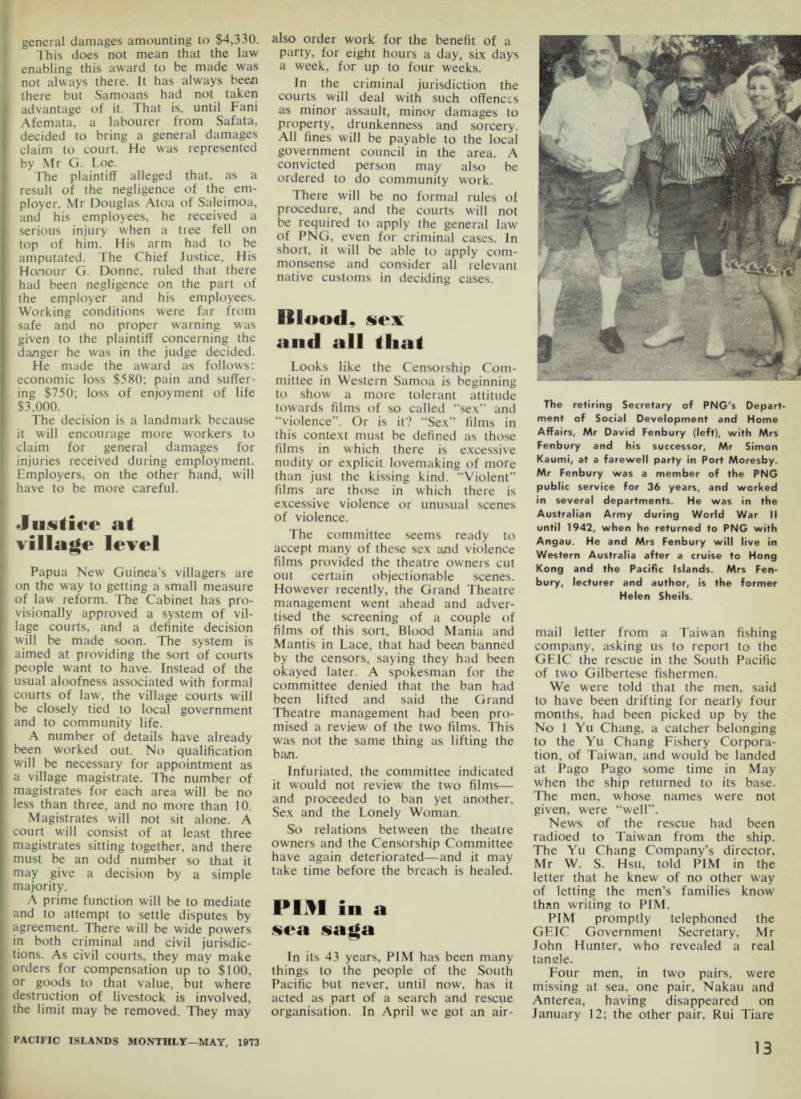
The retiring Secretary of PNG's Depart ment of Social Development and Home Affairs, Mr David Fenbury (left), with Mrs Fenbury and his successor, Mr Simon Kaumi, at a farewell party in Port Moresby.
Mr Fenbury was a member of the PNG public service for 36 years, and worked in several departments. He was in the Australian Army during World War II until 1942, when he returned to PNG with Angau. He and Mrs Fenbury will live in Western Australia after a cruise to Hong Kong and the Pacific Islands. Mrs Fen bury, lecturer and author, is the former Helen Sheils.
and Babeia Kamainga, being lost on January 17. Who then were the rescued men?
That wasn’t all. Two men were also reported to have come ashore on New Hanover Island in northern New Guinea. Their names were given in news agency reports as Foua Leuelu and Fati Taiti, but PIM was told by Mr Hunter that no men with those names had been reported missing!
The last word to PIM from Mr Hunter came more than two weeks later, by cable: “Now confirmed that men are Nakau and Anterea.
Expected to land Samoa sometime in May.”
Earlier from GEIC came a story of the ordeal of two Gilbertese, Nabuti Tabutoa and Taraia Tekataba, both of Teaoraereke, who were picked up by a Taiwan fishing boat near Western Samoa after they had drifted for 44 days. Their outboard engine had broken down while on a fishing trip and a storm, which lasted for three days, drove them far out to sea. For a week they were without food. Then a young shark, four feet long, swam to their boat.
They seized it with their bare hands, dragged it into the boat, tore it to pieces and lived on its raw flesh until they managed to catch other fish and turtle with a large hook which they straightened and used as a spear.
PNG Anglicans
cutting adrift
Moves to make the Papua New Guinea Anglican church completely independent are progressing slowly but steadily.
The PNG church is already an autonomous diocese within the world wide Anglican Communion, but it still belongs to the Province of Queensland and is heavily dependent on funds from Australia.
However, the Garamut Appeal for $1 million, which aims to make the PNG church financially independent, has now reached the $300,000 mark; and the Diocesan Council last month decided to seek approval from the Australian General Synod for plans to form a Province of Papua New Guinea.
The Province of Queensland has already agreed that the PNG church may leave when it wishes, but before this can happen approval must also be given by General Synod, which is the chief governing body of the Australian church.
The Diocesan Council’s request will go to the forthcoming meeting of General Synod this May. Since the synod meets only at three-yearly intervals, it is hoped that this year’s meeting will agree to delegate to its standing committee the power to
allow the PNG church to break away if it wants to before the next General Synod in 1976.
Also in May, the diocese will pre sent a supplementary budget request to the Australian Board of Missions, which last year warned that it would have to cut its 1973 grant to the diocese by 20 per cent. This meant that the diocese had to budget for a 54,000 deficit, as well as cutting out several important aspects of its life and work. But present indications are that giving to the board this year may be better than forecast.
It is precisely this sort of situation which the Garamut Appeal seeks to eliminate. If successful, income from the invested funds should go a long way towards ensuring that the PNG church is no longer at the mercy of fluctuations in Australian church giving.
Compensation but
no jubilation
There was jubiliation in Micronesia recently with the news that at long last something really solid, in the way of cash, was being done to recom pense people who had suffered through World War II in Micronesia.
The Micronesian Claims Commis sion, established to examine claims for death, physical injury and loss of property, announced its first award $U54,400 to Minniah and Harvey Melong, of Majuro, and Don Melong, of Namorik Atoll in the Marshalls for losses through the death of a relative Melong Lautak.
As it was the first death claim to be decided. Claims Commission officials planned to throw a ceremony in the Maiuro legislative chambers and laid on a photographer. The three beneficiaries turned up but there was no ceremony. Until they arrived at the legislative chambers, the three hadn’t heard how much they were getting. As soon as they heard, the> refused to join in any celebration The award wasn’t enough, they said They wanted $ll,OOO and would ap peal, which, of course, they’re entitlec to do.
It looks as if there’ll be plenty o: claims once the claims machinery starts churning out the awards There’s a sliding scale for deatF claims which runs from $5OO fo; persons 12 years of age and undej at the time of death to a maximum of $5,000 for age 21, with a declining scale of $lOO a year for those ove; 21 to a minimum of $l,OOO at ago 61.
The fund out of which war clairm will be paid amounts to $lO million