Legislators get
pp. 10-11 · Read in the full issue
some harmless practice
American Samoa Governor Johr M. Haydon used his veto powen like Mr Vishinsky in the early days of United Nations, when he recently turned down nine bills passed by the 13th Legislature of American Samoa Then he went off to Honolulu tc attend a series of conferences or federal spending. Back in Pago Page a few days later, he signed an ap propriation bill for $2.4 million foi unbudgeted local revenue in the cur rent financial year.
Bills which got the Haydon ax( (reasons in brackets) were to — • Set up a community servic( agency to provide records and reports (Existing agencies in the governmen already took care of them); • Shorten setback requirements ii the Building Code from 35 to 2: feet from the centreline of the road (Setbacks should be governed b: zoning regulations, and such a restric tion could mean loss of federal ait in road-building); • Allow career service employee; to be paid for unused leave. (Tin present regulation allowing them t< accumulate 30 days of leave wa; equitable, and departments should nc allow workers to accumulate mor than that); • Change regulations covermi holiday work. (The current executive regulations provided for extra pay
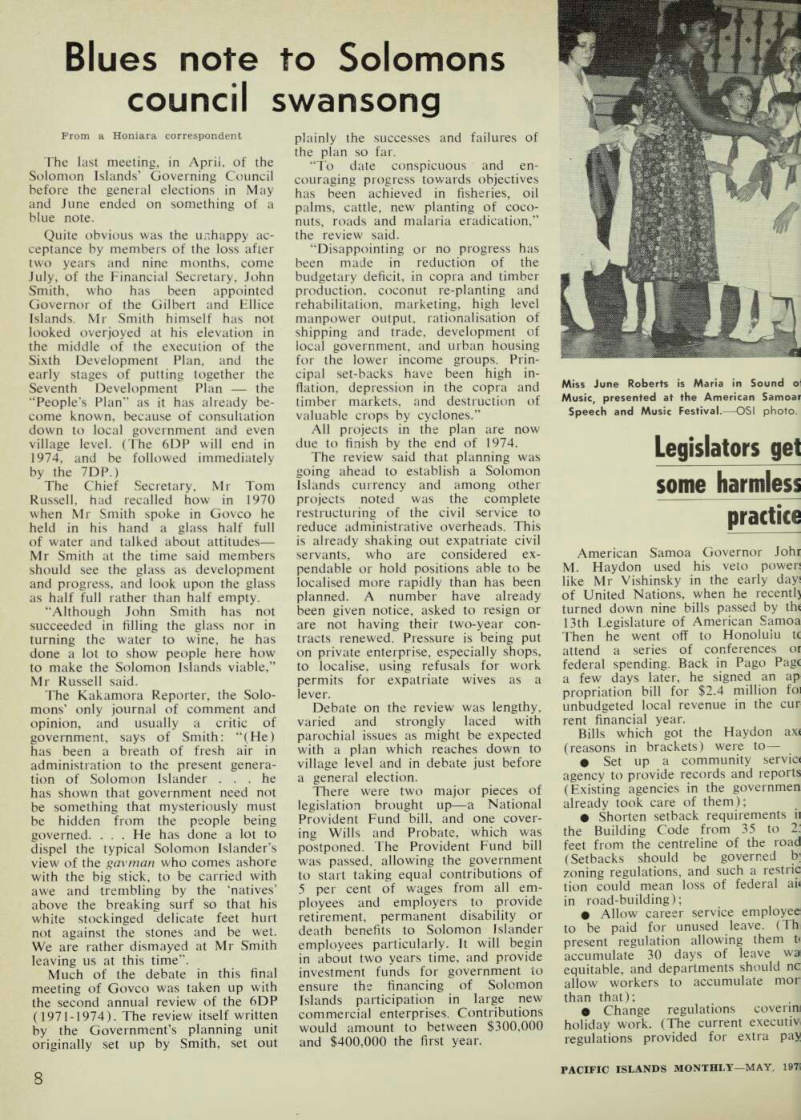
Miss June Roberts is Maria in Sound o[?] Music, presented at the American Smoar[?] Speech and Music Festival.—OSI photo.
ment to workers who worked on ; holidays); • Require people recruited from ■ any ship in harbour to be on local ll hire in the career service. (The l| problem of casual hiring would be I eliminated by the new position [ allocation system; they should be under contract and not in the career I service, where it would be difficult I to replace them by Samoans); • Allow for a separate police I department administered by a police I commission. (The department still I needed to be directed by a well trained public safety commissioner); • Require three doctors to be I stationed in Manua on a fulltime I basis. (It would have placed too I great a load on the medical staff, and records did not indicate a need for three doctors there); • Reduce the age for retirement I from government service. (No I actuarial study had been made to determine what effect the law would [have on the government's retirement I system); • Provide a $l5O bonus for em ployees after 30 years of government I service. (Employees retiring under I the new retirement system were draw ling more than they ever contributed Ito the retirement fund, and received ■adequate benefits for their service).
I The appropriation of $2.4 million ■ included $1.13 million to implement ■ the uniform wage scale for Samoan ■employees in the career service. Other ■ major items were $160,000 for a new [government warehouse at Tafuna, $lOO,OOO for paving the Ili’ili-Vaitogi Road, $75,000 for the first phase of a vocational education skill centre, $123,000 for the Education Depart ment and $131,000 for the Medical Services Department.
I The uniform wage scale, which be came effective from April 22, reduced [the number of wage scales in the [career service from 15 to two. One fccale covers teachers and the other fell other career service staff. Under [the new scheme no one received less [pay. Some remained on the same [scale, but 80 per cent of the em ployees received an increase. All [career service employees now receive i minimum of $1 an hour; previously ■hat minimum only applied to the Education and Medical Services I Governor Haydon praised the legislature for adopting the uniform scale.
I “For years we have had unfair inequities in the numerous pay scales and most of them hurt the workers in the lower grades,” he said. “We have learned that other approaches such as across-the-board raises only made the inequities worse.”