Book Reviews
pp. 80-81 · Read in the full issue
Of Pioneers, Fat Cats And Cab
Although Flightpath South Pacific is what the title indicates, its scope goes beyond the southern hemisphere and ends by being pretty much an every man’s - guide - to - commercial aviation. Its author, lan H. Driscoll, has done a monumental job of re search and got off to a flying start by being avidly interested in aviation from age 12 and being actively in volved in it from early adulthood.
He was born in England, started off his working life in a bank but soon decided that this was not for him. He joined the purser’s staff of the old Orient Co, switched to Imperial Airways, when the British airline decided that pursers were an essential ingredient of flight crew, went back to sea for Union Castle just before World War 11, after which he migrated to New Zealand, became New Zealand National Airways Cor poration’s first public relations officer when it was formed in 1947 and is currently regional manager of the air line in Auckland.
His book is slightly New Zealand orientated for this reason but not aggressively so. In any event, all commercial aviation, no matter where it is taking place, tends to be in fluenced by international events and certainly the development of inter national routes in the South Pacific always was, and still is, influenced by the Fat Cats of power in far away Europe or the USA.
Aviation has traditionally been controlled in a way that shipping never has. Technically, there may be freedom of the skies as well as of the high seas but airspace over countries is sacrosanct and landing rights are bartered about as, in a different age, royalty married off its sons and daughters in reciprocal deals calcu lated to do Dad Rex or Mum Regina, and, therefore, their country, most good.
The greatest wheeler-dealer cum international steamroller in the inter national airways sense is the US Civil Aeronautics Board (CAB), at least according to the author and a lot of other people who are at the wrong end of the stick.
Stimulated by a presidential dictum that “attempts to restrict US opera tions abroad should be vigorously opposed”, CAB has gone in boots and all and in the process has hurt not only foreign operators but its own airline companies as well. By encouraging charter carriers to operate on world routes at the same time that the wide-bodied jumbo-jets with a surplus of unfilled seats hit the aviation scene, it has turned many scheduled airline companies from prosperity to the brink of financial disaster.
Not even the International Air Transport Association (lATA), the scheduled airlines’ own instrumen tality, has been able to stand up to CAB and is, in fact, suspect by the government agency as probably con travening the US anti-trust laws. The 1970 s swept in like a chill wind for air transport, says Mr Driscoll, and ends his argument as follows: “The CAB is as secure as the USA.
It is without experience of compe tition but believes this to be good for the other fellow. As a government agency, it has gambled dangerously without putting up any stake of its own. Its losses have accrued to the stockholders of its own national air lines, all of which are public com panies, with a resultant loss of investor confidence in the industry, or to foreign governments with sub
stantial holdings in their international flag carriers. It has yet to be demon strated that scheduled airlines can achieve the revenue to eventually survive the drastic tariff reductions of the 19705.”
But that comes at the end of his story. Commercial aviation made its first faltering beginning after World War I. The first scheduled services between Hounslow, near London, to Le Bourget, outside Paris, by aircraft Transport and Travel in 1919; the inauguration of New Zealand’s first airmail service, Auckland-Whangarei, in 1921; the formation of Qantas the same year; the founding of Imperial Airways Ltd in 1922, which was to do for British aviation in the 20th century what the East India Company had done in the 19th; the birth of Pan American World Airways ir 1927, as a direct descendant of Juan Trippe’s Long Island Airways formed in 1922. This and very much more make up the minutiae of informatior in this book. Certainly nothing thai has happened in aviation, no airmar of any note in Australia, New Zealanc or the Pacific Islands in the last 6C years escapes the fine-mesh Driscoll drag-net.
By the late 1920 s established comi mercial airlines had broken out ano extended beyond internal services KLM was running an airmail servict from Amsterdam all the way tt
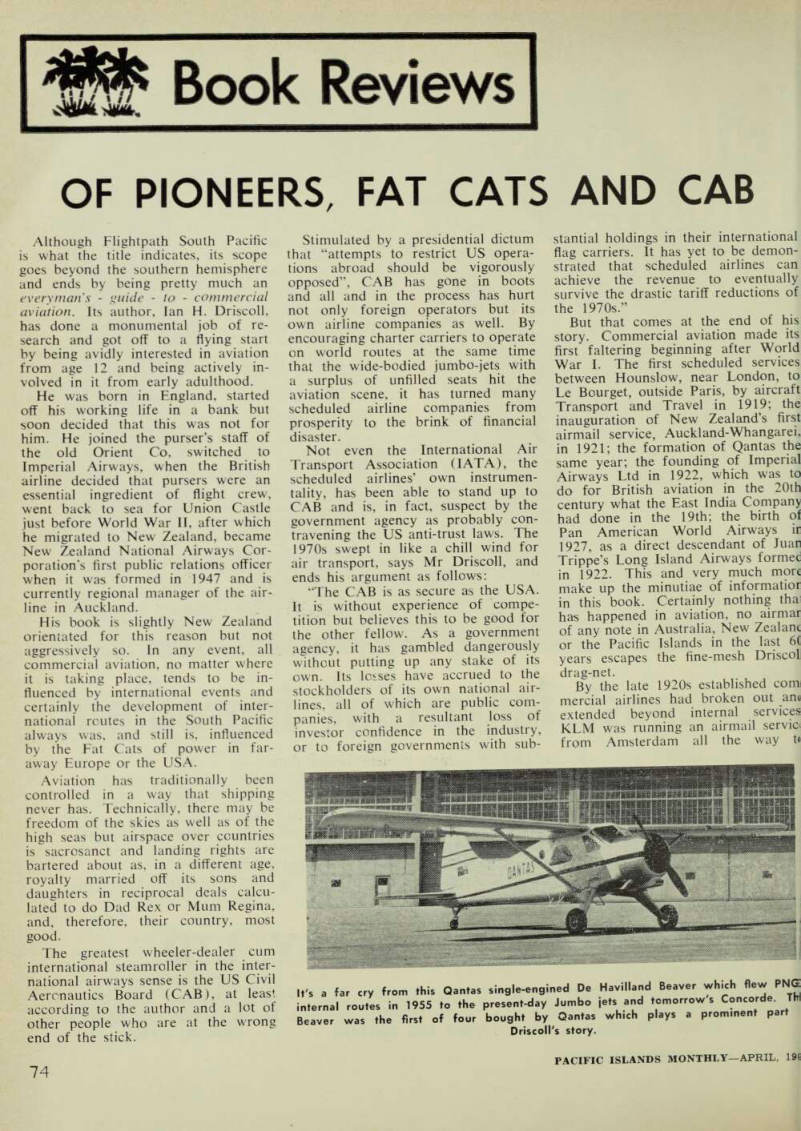
It's a far cry from this Qantas single-engined De Havilland Beaver which flew PNG internal routes in 1955 to the present-day Jumbo jets and tomorrows Concorde. T[?] Beaver was the first of four bought by Qantas which plays a prominent part Driscoll's story.
Batavia (now Djakarta); Imperial Airways had services from London all over Europe and had extended to India; Pan-American had services from North America to the West Indies and through a part-owned sub sidiary, Panagra, to the South American continent.
However, the last links in world airways were not forged until a decade later. In 1937 a Pan-American flying-boat (Samoan Clipper) began a service between San Francisco and Auckland via Kingman Reef and Pago Pago, but this was suspended a few months later when this aircraft
was lost with all on board off Pago Pago. The service was not resumed until 1940 when, almost simul taneously, Tasman Empire Airways (now Air New Zealand) completed the London-Auckland route by in augurating the trans-Tasman service, Sydney-Auckland.
But World War II was already in being, soon passed out of the phoney stage of uneasy quiet and put most air transport out of reach of all but priority class civilians for the next six years. Out of necessity, aviation made great technical strides during the war period, particularly in long distance flights, including the Perth- Ceylon service inaugurated under war time conditions by Qantas in 1943.
At the time it was the longest non stop flight in the world, of over 3,000
miles. Catalinas were used and the longest elapsed time on the crossing was a gigantic 31 hours, 45 minutes.
Between the 1920s and the 1970s, commercial aviation has come a long way. From the open cockpit, string and-paper aircraft, where passengers as well as pilot had to be pioneers; to the big bellied monsters and economy class or excursion mass air travel, which is also 100 per cent discomfort in a different way.
In between was the halcyon period of the 1950s, with the last generation piston-engined planes, when travel was first-class and passengers were, indeed, treated like rajahs. Round the comer, perhaps, supersonic flight with break fast in Sydney, dinner in London and disorientation and turmoil within.
In aviation, as well as in many other modern marvels, we have be come too darned smart for our own comfort, and generally for our own good.
For the real aviation buff, Mr Driscoll’s book has some excellent appendices covering technical data of airlines and aircraft, in easy-to-get-at form. There is also a good chronology
and an index.-
Judy Tudor.
(Plightpath South Pacific, By
Ian Driscoll. Whitcombe & Tombs. $6.95.)
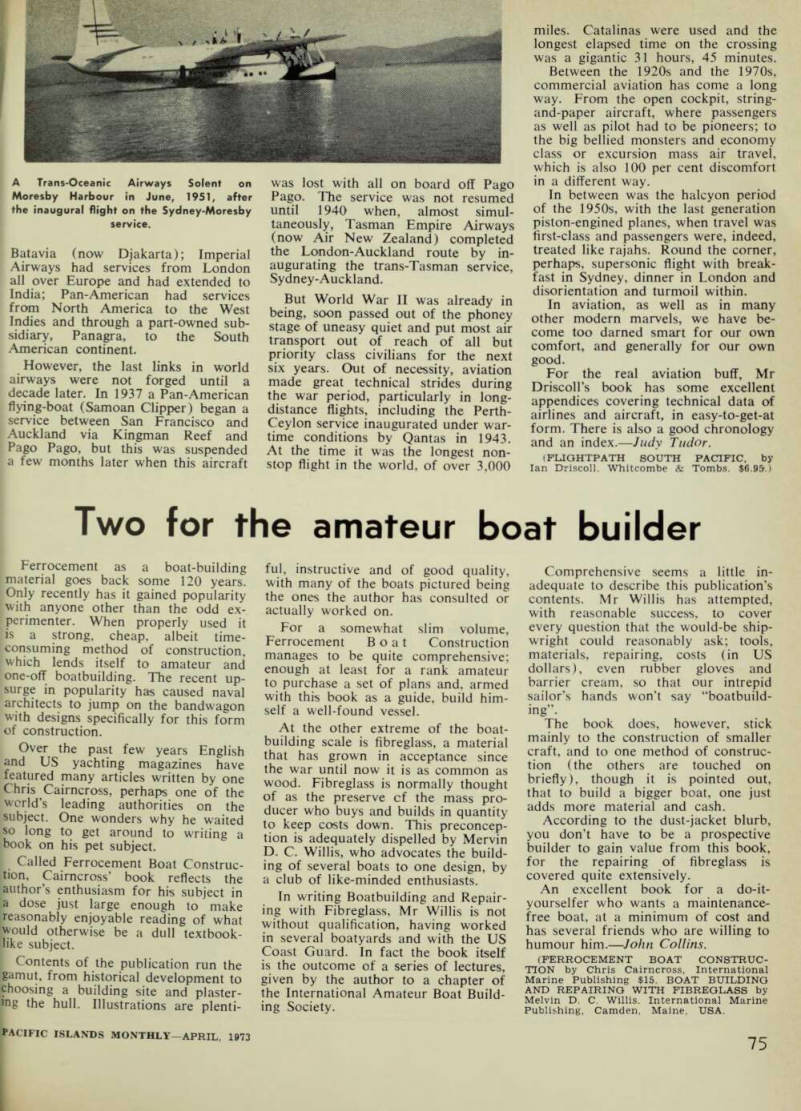
A Trans-Oceanic Airways Solent on Moresby Harbour in June, 1951, after the inaugural flight on the Sydney-Moresby service.