Pacific art
pp. 77-78 · Read in the full issue
Pacific personality
Aloi Pilioko and Pacific art
By N. MICHOUTOUCHKINE, interviewed by Marjorie Crocombe
• Last month Marjorie Crocombe interviewed Nicolai Michoutouchkine, a painter in the New Hebrides, about the work of Aloi Pilioko, a young artist from Uvea, or Wallis Island. Here she continues her interview with Michoutouchkine about his own work and about Pacific art generally.
M. How did you come to be in the Pacific?
N. I came just by accident. You see, when I graduated from a high commercial school I had artistic inclinations. I had had the chance to work with various well-known painters in Europe particularly in France where I was born, but my parents wanted me to gradu ate in something serious. So I decided to go on an artist’s pilgrimage to India.
M. “Why India?”
N. Probably because I was searching for some thing mystical. On the way to India I saw all the mar vellous collections of centuries-old traditional art of Greece, Italy and other middle-eastern countries. After several years in India, living with the people and observ ing their traditions, I was called back to France to do my military service in 1956. The French military forces gave me the choice between Madagascar or New Caledonia. I chose New Caledonia, and that’s how I came to the South Pacific.
I felt immediately drawn to Melanesian art and culture. After opening the first art gallery in the South Pacific and visiting Melanesian schools I was immedi ately fascinated by the fact that the best drawings were made by people closely related to the really traditional Melanesian artist. In 1959 I was asked by the New Caledonian Tourist Board to help the revival of Mela nesian traditions. I toured the interior and contac ed possible traditional artists, but unfortunately the board had no money and they were not able to buy anything so 1 bought some of the art pieces to encourage the artists. When I displayed my first collection everybody wanted to buy pieces from my collection but I said, J m sorry this is not for sale” and that was it. That’s how my collection started. I have been travelling and painting things across the South Pacific for about 16
[years now.
L M , C ” You are now living in the New Hebrides.
Why the New Hebrides?
N.M.: Well, the New Hebrides has always attracted me so after my New Caledonian experience I had the chance to go and live on Futuna. At the time it was a |ver> remote utt.e is and. I remember in 1960 only three iships came during the whole year. But on Futuna I was able to do some ethnographical work without knowing it.
As an artist I got interested in their culture and tradi tions and because it was a remote island the culture was lather well preserved and I assembled a very important prst collection of Polynesian art in the little micro-
universe of Futuna. I wanted to create a museum there but everything was too complicated.
Anyhow, since our first visit to the New Hebrides in 1960 we kept on returning there regularly. Exhibiting my paintings was an open door to me because financially I was able to sell some of my paintings, to do research work, to visit tribal people in the interior of the New Hebrides and acquire new pieces. Then with all that we shifted to New Caledonia to have another exhibition.
And so we’ve gone on like that across the South Pacific.
Now, 16 years later, I have more than 4,000 pieces of Pacific Islands art that I’m not selling but I have shown them at exhibitions. We came to the New Hebrides because the New Hebrides is an exciting place; a meeting place of Melanesian and Polynesian cultures.
In that melting pot that is the South Pacific all these people have been making contact with one another for thousands of years.
The New Hebrides is also very interesting because of the Anglo-French duality and that makes it very attractive to us. In the New Hebrides, I hope to create a museum and that proposal is being carefully studied now by the French Government, We would also like to create a little centre next to it where people who paint or carve or design from all the islands would come and stay and work. An artist from Fiji, or from Tonga, or Rarotonga could easily make himself unders ood in the New Hebrides. Similarly, a French-speaking artist from Tahiti or New Caledonia who doesn’t know a single word of English would also feel exactly at home in such a centre.
For example, I noticed during the South Pacific Festival of Arts a fellow named Aleki, from Tonga, who is a remarkable carver and artist. But he is unfor tunately working with an absolutely dreadful wood— there is no good wood in Tonga but we have most wonderful species in the New Hebrides so that an artist who came to a place where he could have plenty of good wood at his disposal, could, I am sure, get new inspira tion into his art. He rerews himself then by seeing and living in that museum that we want to create. 1 want a living museum—not something that is behind glass or something that you can’t touch. I want something that has that contact with the traditional art and here 1 come back to Pilioko in that university studio that he was working in. You saw the way he arranged and displayed all the New Guinea carvings that were there. Why? Because there is a power, there is a mana in ail those things. You also saw how he felt when they took those carvings away. He said: “Oh, I feel as if I've been stripped of something. All those things have
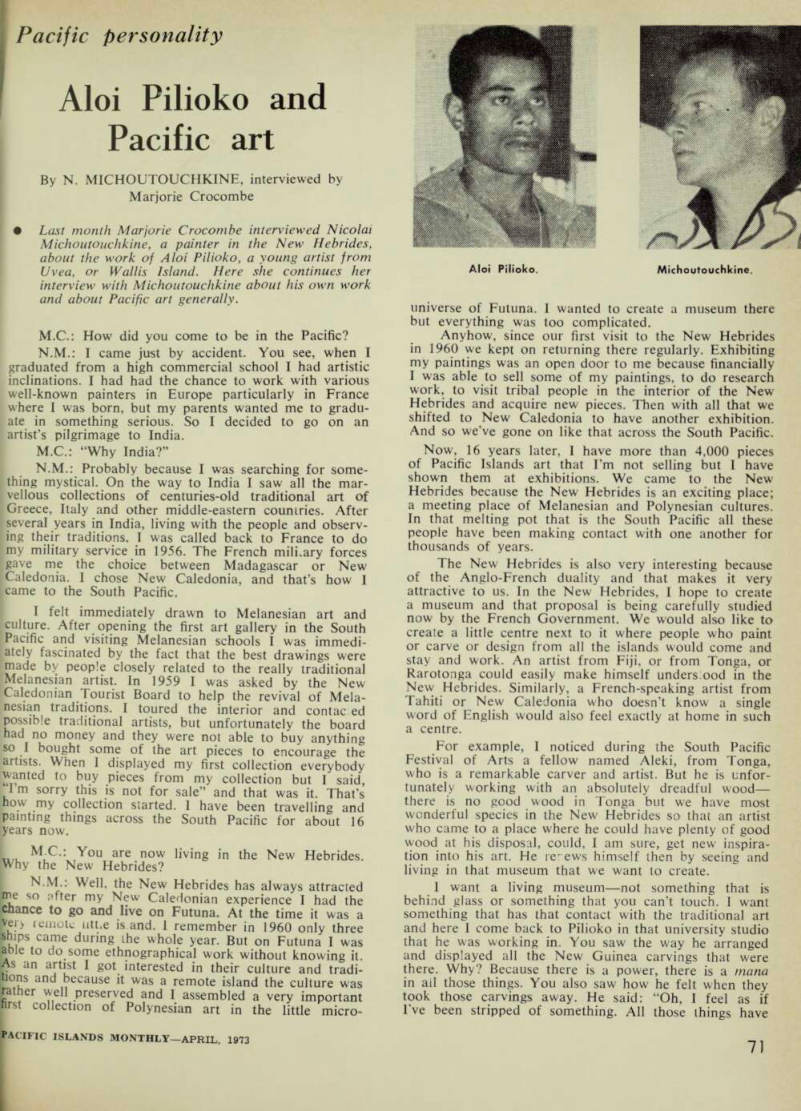
Aloi Pilioko.
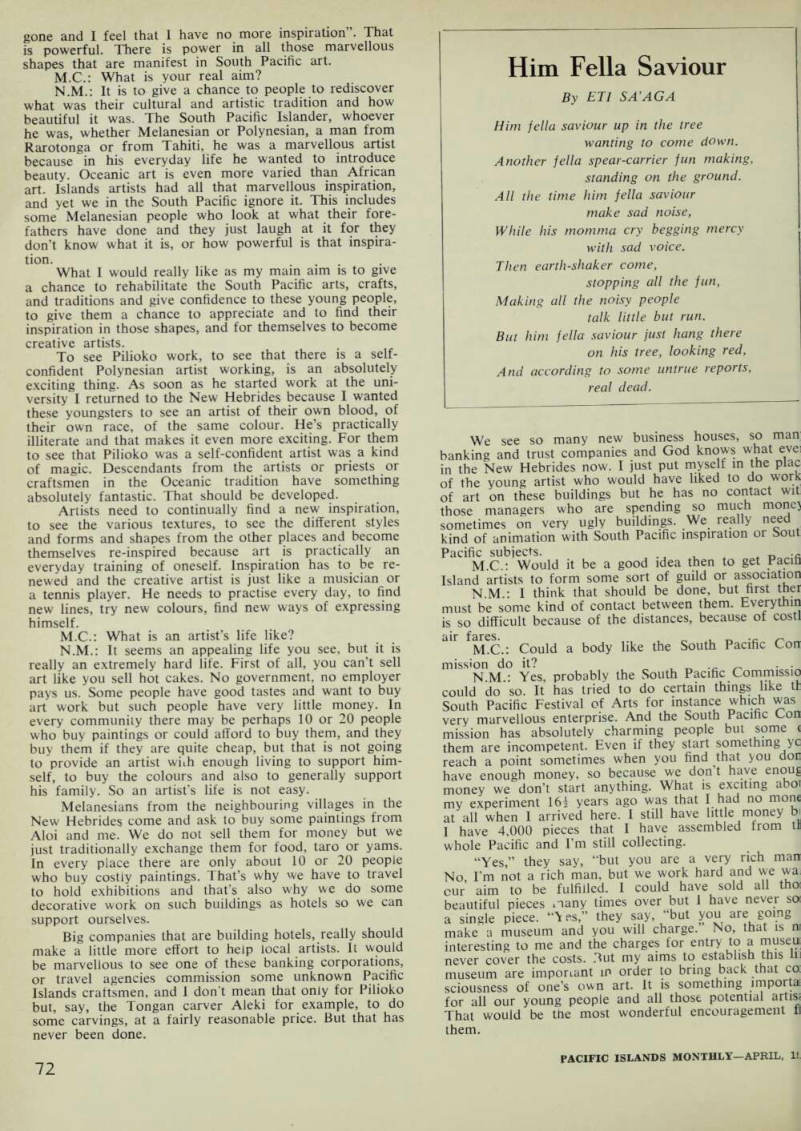
Michoutouchkine.
gone and I feel that I have no more inspiration”. That is powerful. There is power in all those marvellous shapes that are manifest in South Pacific art.
M. What is your real aim?
N. It is to give a chance to people to rediscover what was their cultural and artistic tradition and how beautiful it was. The South Pacific Islander, whoever he was, whether Melanesian or Polynesian, a man from Rarotonga or from Tahiti, he was a marvellous artist because in his everyday life he wanted to introduce beauty. Oceanic art is even more varied than African art. Islands artists had all that marvellous inspiration, and yet we in the South Pacific ignore it. This includes some Melanesian people who look at what their fore fathers have done and they just laugh at it for they don’t know what it is, or how powerful is that inspira tion.
What I would really like as my main aim is to give a chance to rehabilitate the South Pacific arts, crafts, and traditions and give confidence to these young people, to give them a chance to appreciate and to find their inspiration in those shapes, and for themselves to become creative artists.
To see Pilioko work, to see that there is a self confident Polynesian artist working, is an absolutely exciting thing. As soon as he started work at the uni versity 1 returned to the New Hebrides because I wanted these youngsters to see an artist of their own blood, of their own race, of the same colour. He’s practically illiterate and that makes it even more exciting. For them to see that Pilioko was a self-confident artist was a kind of magic. Descendants from the artists or priests or craftsmen in the Oceanic tradition have something absolutely fantastic. That should be developed.
Artists need to continually find a new inspiration, to see the various textures, to see the different styles and forms and shapes from the other places and become themselves re-inspired because art is practically an everyday training of oneself. Inspiration has to be re newed and the creative artist is just like a musician or a tennis player. He needs to practise every day, to find new lines, try new colours, find new ways of expressing himself.
M. What is an artist’s life like?
N. It seems an appealing life you see, but it is really an extremely hard life. First of all, you can’t sell art like you sell hot cakes. No government, no employer pays us. Some people have good tastes and want to buy art work but such people have very little money. In every community there may be perhaps 10 or 20 people who buy paintings or could afford to buy them, and they buy them if they are quite cheap, but that is not going to provide an artist with enough living to support him self, to buy the colours and also to generally support his family. So an artist’s life is not easy.
Melanesians from the neighbouring villages in the New Hebrides come and ask to buy some paintings from Aloi and me. We do not sell them for money but we just traditionally exchange them for food, taro or yams.
In every place there are only about 10 or 20 people who buy costly paintings. That’s why we have to travel to hold exhibitions and that’s also why we do some decorative work on such buildings as hotels so we can support ourselves.
Big companies that are building hotels, really should make a little more effort to help local artists. It would be marvellous to see one of these banking corporations, or travel agencies commission some unknown Pacific Islands craftsmen, and 1 don’t mean that only for Pilioko but, say, the Tongan carver Aleki for example, to do some carvings, at a fairly reasonable price. But that has never been done.
We see so many new business houses, so man; banking and trust companies and God knows what evei in the New Hebrides now. I just put myself m the plac of the young artist who would have liked to do work of art on these buildings but he has no contact wit those managers who are spending so much mone} sometimes on very ugly buildings. We really need kind of animation with South Pacific inspiration or Sout Pacific subjects. . n M.C.; Would it be a good idea then to get Pacih Island artists to form some sort of guild or association NM.: I think that should be done, but first ther must be some kind of contact between them. Everythin is so difficult because of the distances, because of costl ciii* fcircs M.C.: Could a body like the South Pacific Con mission do it? , „ ._ . .
NM.: Yes, probably the South Pacific Commissio could do so. It has tried to do certain things like tfc South Pacific Festival of Arts for instance which was very marvellous enterprise. And the South Pacific Con mission has absolutely charming people but some c them are incompetent. Even if they start something yc reach a point sometimes when you find that you don have enough money, so because we don’t have enoug money we don’t start anything. What is exciting aboi my experiment 16i years ago was that I had no mone at all when I arrived here. 1 still have little money b_ 1 have 4,000 pieces that I have assembled from tU whole Pacific and I’m still collecting.
“Yes,” they say, “but you are a very rich man No, I'm not a rich man, but we work hard and we wa. cur aim to be fulfilled. 1 could have sold all thot beautiful pieces many times over but 1 have never sot a single piece. “Yes,” they say, “but you are going make a museum and you will charge. No, that is nt interesting to me and the charges for entry to a museut never cover the costs. Tut my aims to establish this lu museum are imporiant in order to bring back that ca sciousness of one’s own art. it is something imperial for all our young people and all those potential artis< That would be the most wonderful encouragement fl them.