Queensland
pp. 55-57 · Read in the full issue

To be or not to be forever Queensland
By Geoffrey Peregrine
If a few more people take the trouble to travel down the Papuan coast and across to the three islands of the Torres Strait, which look like being forever Queensland, the border dispute that is blowing up may pro duce some facts instead of rhetoric.
It’s not an easy journey. First you have to square yourself away with the Queensland authorities. The islands of Boigu, Dauan and Saibai, which lie just off the southern Papuan coast, are a preserve of the state’s Aboriginal and Island Affairs Depart ment which is a power in the area from the tip of Cape York to within a mile or so of the Papuan mudflats.
Then there’s the usual permit to enter Papua New Guinea and the problem with Australian customs —to do it all properly that means checking in at Thursday Island, which is more than 100 miles to tne south.
Apart from that, there’s the sheer difficulty of access. In the north westerly season, it doesn’t inake much sense trying to reach there from Thursday Island unless you travel in one of the departmental supply boats.
And permission for this isn’t readily forthcoming.
The best thing to do is to go to Daru, the administrative centre of the western district of Papua New Guinea, hire yourself an outboard canoe and driver and set off. It’s some 55 miles down the coast to the village of Sigabada, which is directly oppo site the Queensland island of Saibai.
The channel between is four or five miles wide and up to 120 ft deep— not the easy walk at low tide that some of the publicists would have you believe.
Saibai is a long, low island, about 90 per cent swamp apparently just like the Papuan land opposite. How ever, the low ridge at the western end where the village is and where
some 200 people live is a low pebbled laterite ridge, possibly six or so feet above the sea, and flecked with grey sand.
The distinction doesn’t seem much.
But it does lead to a markedly dif ferent landscape from Sigabada, which is mud and little else besides.
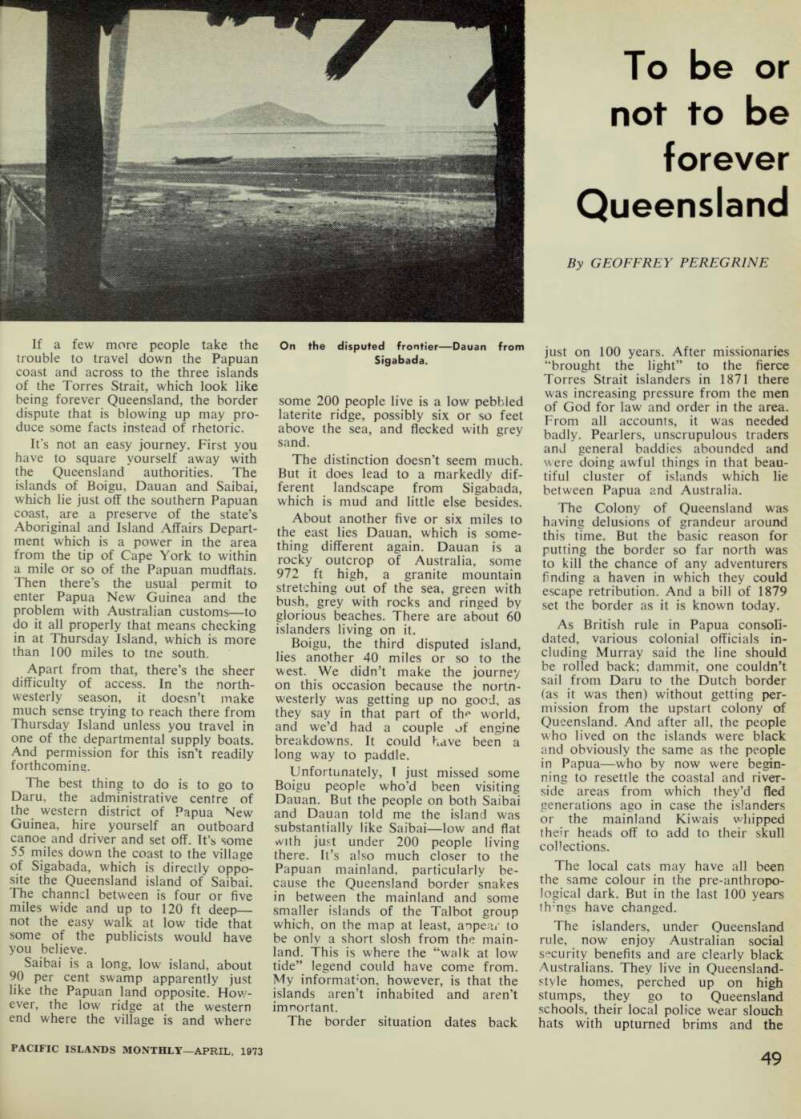
About another five or six miles to the east lies Dauan, which is some thing different again. Dauan is a rocky outcrop of Australia, some 972 ft high, a granite mountain stretching out of the sea, green with bush, grey with rocks and ringed by glorious beaches. There are about 60 islanders living on it.
Boigu, the third disputed island, lies another 40 miles or so to the west. We didn’t make the journey on this occasion because the nortn westerly was getting up no good, as they say in that part of world, and we’d had a couple of engine breakdowns. It could have been a long way to paddle.
Unfortunately, I just missed some Boigu people who’d been visiting Dauan. But the people on both Saibai and Dauan told me the island was substantially like Saibai—low and flat vvith just under 200 people living there. It’s also much closer to the Papuan mainland, particularly be cause the Queensland border snakes in between the mainland and some smaller islands of the Talbot group which, on the map at least, anpear to be only a short slosh from the main land. This is where the “walk at low tide” legend could have come from.
My information, however, is that the islands aren’t inhabited and aren’t important.
The border situation dates back
just on 100 years. After missionaries “brought the light” to the fierce Torres Strait islanders in 1871 there was increasing pressure from the men of God for law and order in the area.
From all accounts, it was needed badly. Pearlers, unscrupulous traders and general baddies abounded and were doing awful things in that beau tiful cluster of islands which lie between Papua and Australia.
The Colony of Queensland was having delusions of grandeur around this time. But the basic reason for putting the border so far north was to kill the chance of any adventurers finding a haven in which they could escape retribution. And a bill of 1879 set the border as it is known today.
As British rule in Papua consoli dated, various colonial officials in cluding Murray said the line should be rolled back; dammit, one couldn’t sail from Dam to the Dutch border (as it was then) without getting per mission from the upstart colony of Queensland. And after all, the people who lived on the islands were black and obviously the same as the people in Papua—who by now were begin ning to resettle the coastal and river side areas from which they’d fled generations ago in case the islanders or the mainland Kiwais whipped the'r heads off to add to their skull collections.
The local cats may have all been the same colour in the pre-anlhropo logical dark. But in the last 100 years th : ngs have changed.
The islanders, under Queensland rule, now enjoy Australian social security benefits and are clearly black Australians. They live in Queensland style homes, perched up on high stumps, they go to Queensland schools, their local police wear slouch hats with upturned brims and the
On the disputed frontier —Dauan from Sigabada.
Australian flag flies over their vil lages. Alone.
The houses, the benefits and the pensions have tended to fascinate the lesser-favoured mainland people over the years and there’s been a bit of muttering about it. If Papua New Guinea took over the islands, the thought has been put, then the pen sions and the houses and the oppor tunity to earn real money in Thurs day Island, would belong to the favoured Papua New Guineans in the area. The ideas simmered and bubbled out at local council meetings.
When PNG politics sprang into being, the issue was a natural. For western district MHA and now Min ister for Education, Ebia Olewale, it was something he could hammer at village level and also use at national level. Consequently it surfaced as a major PNG item of concern.
The description of how it de veloped sounds cynical. But the issue, nevertheless, has a number of points of genuine concern. There is the ac cess question, which seems to apply mainly to the area between Boigu and the mainland, and the feeling many Papuans have that the paternal approach of Queensland to the islan ders is undignified when only a few miles away PNG people are finding nationhood.
These are probably the two areas which need speedy resolution. Imme diate adjustments in the Boigu area to the border could take a lot of the
heat off and, in any case, the old fashioned Queensland approach to the islands is repugnant to many Aus tralians nowadays, as well.
I suggest these as short-term measures because the eventual solu tion will probably take much longer to work out. It just isn’t as simple as the politicians in Port Moresby and Canberra seem to think.
The people on Saibai and Dauan, at least, are clearly very different from the Papuans of the adjacent mainland, even to untutored eyes. The islanders say they speak a different language—the same as the other islands of the western group of the straits—and the Papuans agree. They share a few words, but these are mainly the phrases trade and harsher exchanges of the past would have given rise to.
Undoubtedly, the islanders I spoke to don’t want to become PNG citi zens. They look south through the straits to Thursday Island and Queensland. In the case of Saibai, many local families left the island in 1948 to settle at Cape York at what is now Bamaga (named for the Saibai leader of the migration). And Bamaga is emerging as the centre for island peoples in the straits, particularly with the opening there in February of a big new high school.
The major issue in the future seems to me to be the question of natural resources. Mr Ole wale told me he wants seabed rights to half the straits,
down to 10 degrees south. This is a somewhat vain hope—even PNG’s strongest supporters in Canberra aren’t willing to give away this much of Australia.
But few Australians would want to block the Papuans from their natural fishing grounds in the reefs, which lie well to the south of the disputed islands. And few would begrudge them the possible wealth that lies in the seabed, be it gas, oil or minerals.
The solution I canvassed is one where a sea border is set but the island enclaves remain part of Aus tralia. There would be access for all to and fro. But I believe we have to go much further than this and look to continuing co-operation between Australia and an independent Papua New Guinea in the straits area. Both countries have too much at stake not to get together.
Australia’s rockbottom position is the control of the two major shipping routes. One goes just north of Ham mond Island (which in turn is jus( north of Thursday Island) and through this all the east-west traffid passes. This is well below the tentty parallel. However, the Great North-j east Channel, which emerges at Bramble Cay is another matter alto gether. It cuts across all the border solutions proposed up to now. Aus tralia’s defence chiefs want to keep it in Australian hands for obvious strategic reasons.
Unfortunately, the Warrior Reefs, which are a major fishing ground, skirt the channel. And Papuans fish these reefs. Consequently, there is no easy way of untangling individual in terests and dividing them with a stroke of the cartographic pen.
If there is this mutual use of re sources, the interdependence already exists. There must be consultation in the future on fisheries control, on seabed exploitation—particularly if oil or gas is discovered—on navi gation and tourist development.
Why not, then, work towards a Torres Strait Commission represent ing Australia, the islanders, the local Papuan groups and Papua New Guinea for joint administration of these problem areas?
If Australia and Papua New Guinea work together, it will defuse the potential problems which re defining the border or leaving it as it is will create. With it can go an equitable seabed border and the op portunity, in the future, of self determination for the Queensland islanders caught on the PNG side.
Such a border, expressed idealis tically, would be a line which not so much divides Australia and an inde pendent PNG, but joins them.
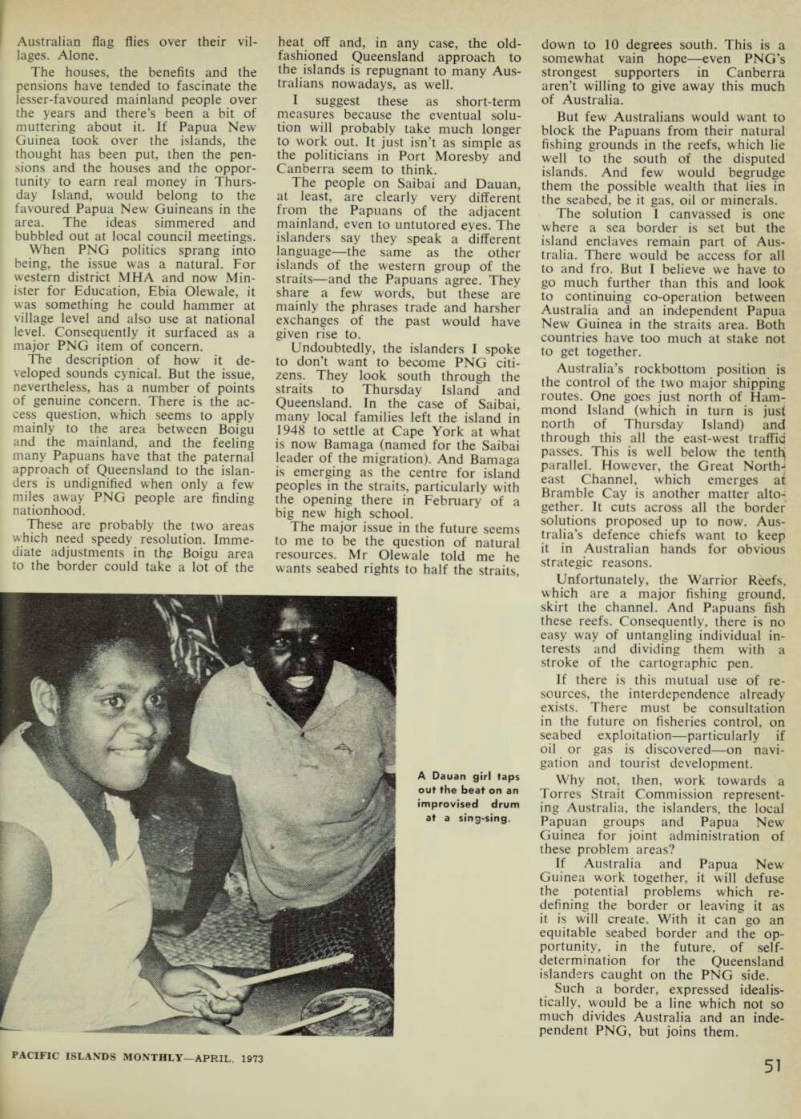
A Dauan girl taps out the beat on an improvised drum at a sing-sing.