Marianas status wrangle
p. 31 · Read in the full issue
UN mission sits in on a Marianas status wrangle
From MIKE MALONE in Saipan
The 1973 United Nations Visiting Mission to the American Trust Ter- I ritory of the Pacific Islands visited the Congress of Micronesia towards February’s end and sat in on a senate debate concerning two related and sensitive issues: Micronesia’s fragile unity and future political status.
Senator Andon Amaraich of Truk, in presenting a committee report on a resolution related to political status, urged the senate to take a strong stand on Micronesian unity. “No other entity besides the Congress’ joint Committee on Future Status has the authority to conduct negotiations with the United States, at least in the absence of a specific authorisation from the Congress of Micronesia,” he said.
Obviously referring to the Mariana Islands District which began separate negotiations with the United States two months ago, Amaraich declared, “The United States has recently abandoned its previous position that it would negotiate only with the Trust Territory as a whole, through the Congress of Micronesia, and has embarked upon a course of action . . . that leads to the inescapable con clusion that it is encouraging, if not fomenting, the political division of the single political unit which is the Trust Territory.”
Marianas Senator Edward Pange linan, who also serves as the chair man of the Marianas Status Commis sion, protested at the presentation of the report in the presence of the UN visiting mission. Challenging certain statements in the report, he called the report misleading and said, “Let me make the record clear. The United States has never encouraged the Marianas to begin separate negotia tions. Despite many resolutions and expressions of sentiment by the people of the Marianas, the US did not
address itself to this problem during the past 10 years.”
Pangelinan added that only after the Congress of Micronesia continued to negotiate for a status “not wanted by the people of the Marianas” did they ask for separate talks.
“I hope the United Nations will respect the aspirations of the Marianas as a minority group in Micronesia,” he said. Labelling the report “One sided” he said he could not support the bill.
However, the measure passed the senate by a voice vote.
Senate vice-president Lazarus Salii of Palau spoke briefly concerning the Constitutional Convention bill and declared: “There are forces within and without Micronesia today which are at work to divide our people. But for me, I believe that the forces of unity are also at work and have been working in Micronesia for the past 20 years. ... I believe we have in our own people a strong sense of dedication toward a national con stitution.
“Micronesians should be the master of their own destiny and be first-class citizens under their own constitution.”
During the mission’s brief stay on Saipan many congressmen privately expressed indignation over what they regarded as a “takeover of the social gatherings by the American staff,” as one Truk congressman explained it.
Senator Bailey Offer of Ponape, chairman of the powerful senate Ways and Means Committee, was blunt in his criticism.—“l was personally shuffled away from the mission members in a luncheon hosted by the congress while some Ameri cans were seated next to the members.
The mission, I thought, came here to talk to the congress, not members of the US State Department staff.”
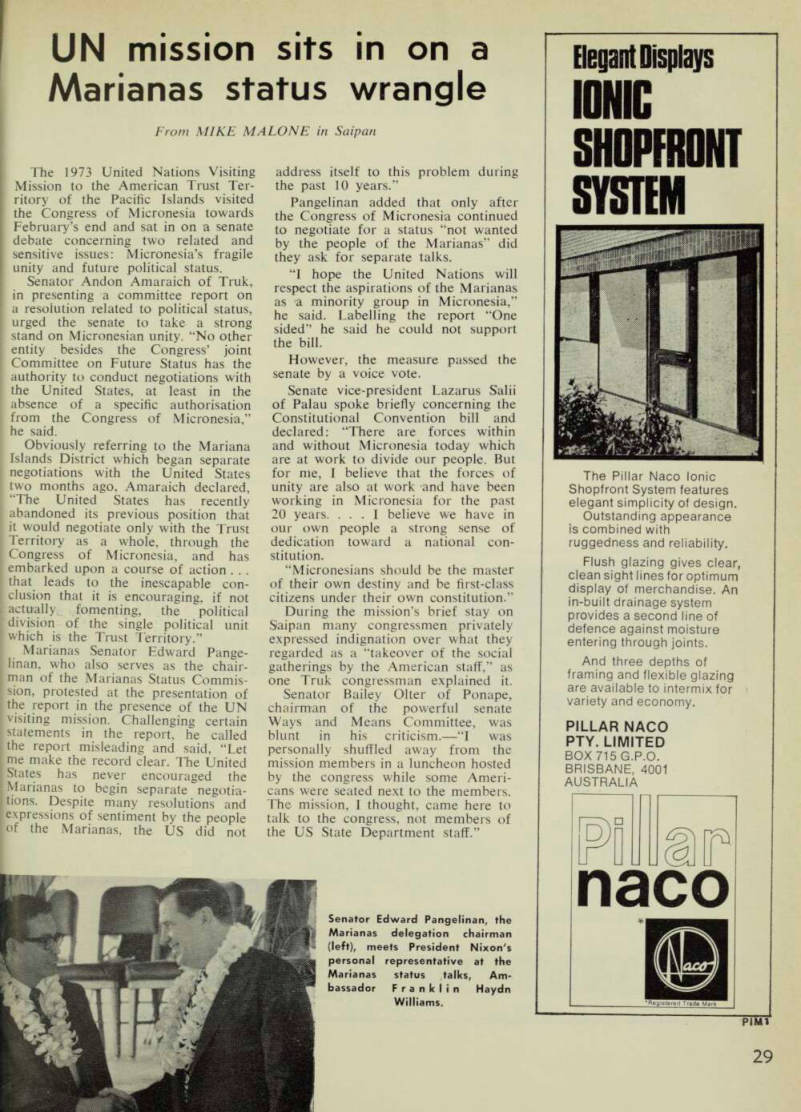
Senator Edward Pangelinan, the Marianas delegation chairman (left), meets President Nixon's personal representative at the Marianas status talks, Am bassador Franklin Haydn Williams.