Footnotes
pp. 28-29 · Read in the full issue
“SPHERE is nothing new under the sun,” wrote an ancient Hebrew philosopher. Listening to and reading about the latest trends in Papua New Guinea education, I feel that he was right.
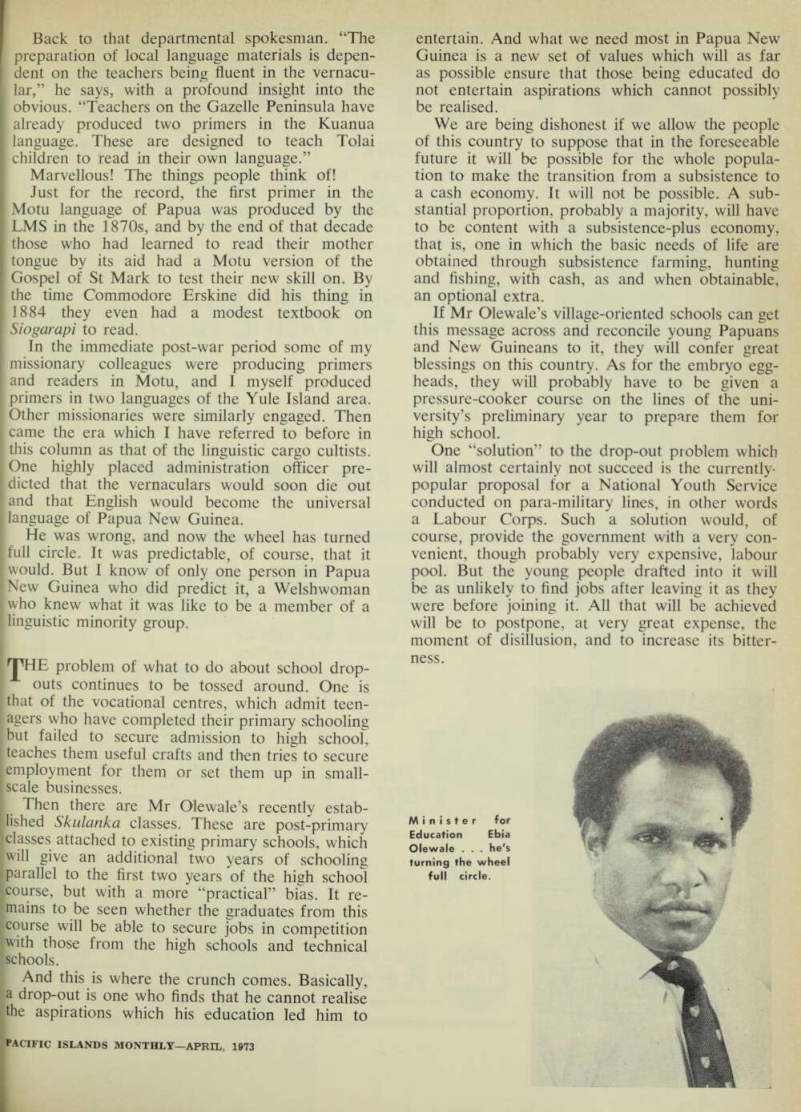
A spokesman for the Minister for Education, Mr Ebia Olewale, is reported as saying that his department is developing a policy under which “children would spend half the day studying for mal subjects and half with adult villagers being schooled in fishing, native arts and culture”.
It embarrasses me to keep on harking back to what the mission I once worked for, and other missions, used to do; but the fact is that this “new” policy is precisely the policy under which the LMS and other missions working in pre-war Papua, used to operate. Mr Olewale, who was born in 1940, may be unaware of this, but it is a fact. School was held in the early morning and late afternoon hours on three, or sometimes on four, days a week, leaving the pupils plenty of
time to imbibe from their parents or other adults the traditional crafts of the village.
This policy, which I am sure was the right one for those days, led to our achieving only a modest standard in classroom learning, a fact of which we are frequently reminded —by Mr Olewale him self among others. But what was right in 1937 is not necessarily right in 1973, and one wonders what high school principals will
make of the products of the new-style primary schools.
Actually, we are here up against the perennial and perhaps insoluble problem of how to provide a primary schooling which is “right” both for those who are going no further and for those who are going on to secondary and tertiary education.
In another departmental “release” we are told about the primary schools’ cultural activities pro gramme introduced last year and to be continued and expanded. “A direct result of this cultural programme,” we are told, “has been the introduc tion in some areas of local languages in the class room. These are being used in the early stages of
So Education
Moves Forward
Into The Past
education where it is difficult to get children tc understand ideas presented in English.”
Fine, fine! This is exactly why, in pre-wai Papua, mission schools used local languages a; the medium of instruction and, where they were able to, taught English as a subject.
About 1960, give or take a year or two, th« LMS found that the job of providing schooling fo: the children of the fast-swelling population oi Hanuabada was getting beyond its resources, anc so it decided to invite the Department of Educa tion to establish a school in the area. This wa.
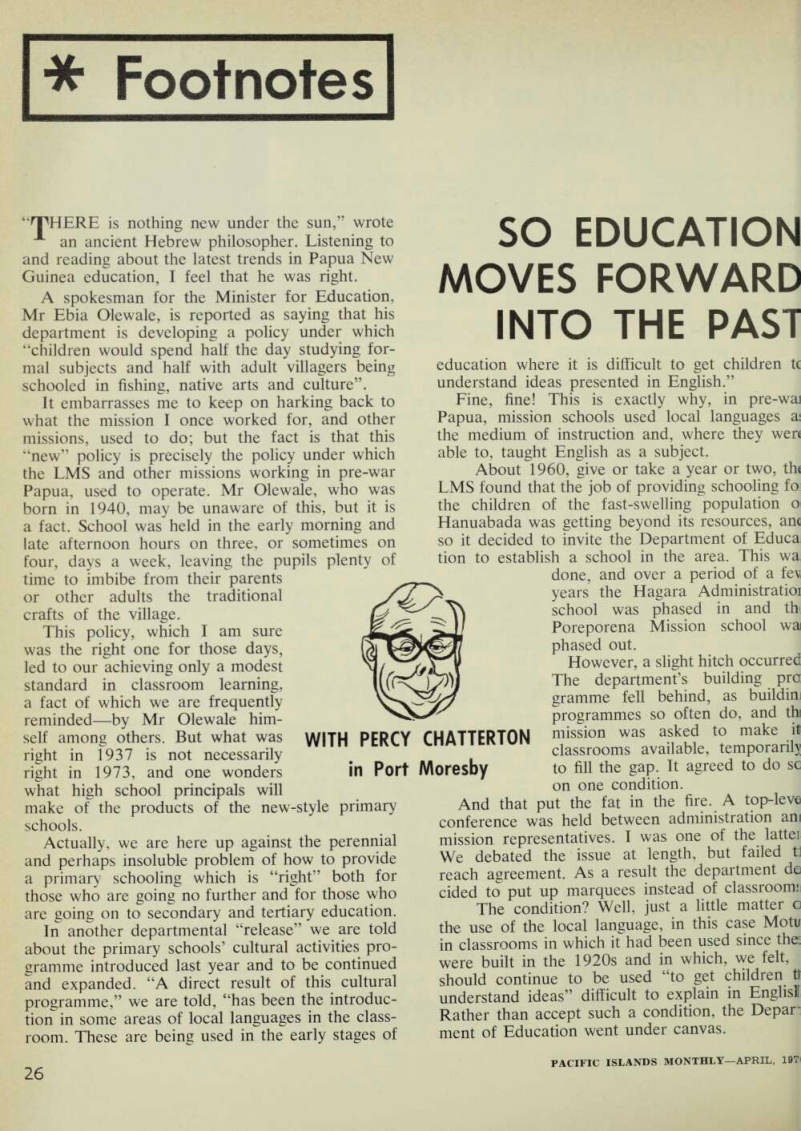
With Percy Chatterton
in Port Moresby
done, and over a period of a fev, years the Hagara Administratioi school was phased in and th Poreporena Mission school wai phased out.
However, a slight hitch occurred The department’s building pro gramme fell behind, as buildim programmes so often do, and thi mission was asked to make it classrooms available, temporarily to fill the gap. It agreed to do sc on one condition.
And that put the fat in the fire. A top-lev© conference was held between administration am mission representatives. I was one of the latter We debated the issue at length, but failed tj reach agreement. As a result the department de cided to put up marquees instead of classroom?!
The condition? Well, just a little matter o the use of the local language, in this case Motu in classrooms in which it had been used since thes were built in the 1920 s and in which, we felt, should continue to be used “to get children tt understand ideas” difficult to explain in Enghsl Rather than accept such a condition, the Depan ment of Education went under canvas.
Back to that departmental spokesman. “The preparation of local language materials is depen dent on the teachers being fluent in the vernacu lar,” he says, with a profound insight into the obvious. “Teachers on the Gazelle Peninsula have already produced two primers in the Kuanua language. These are designed to teach Tolai children to read in their own language.”
Marvellous! The things people think of!
Just for the record, the first primer in the Motu language of Papua was produced by the LMS in the 1870 s, and by the end of that decade those who had learned to read their mother i tongue by its aid had a Motu version of the I Gospel of St Mark to test their new skill on. By the time Commodore Erskine did his thing in 1884 they even had a modest textbook on Siogarapi to read.
In the immediate post-war period some of my missionary colleagues were producing primers and readers in Motu, and I myself produced primers in two languages of the Yule Island area.
Other missionaries were similarly engaged. Then came the era which I have referred to before in this column as that of the linguistic cargo cultists.
One highly placed administration officer pre dicted that the vernaculars would soon die out and that English would become the universal language of Papua New Guinea.
He was wrong, and now the wheel has turned 'full circle. It was predictable, of course, that it would. But I know of only one person in Papua New Guinea who did predict it, a Welshwoman who knew what it was like to be a member of a linguistic minority group. problem of what to do about school drop outs continues to be tossed around. One is that of the vocational centres, which admit teen agers who have completed their primary schooling but failed to secure admission to high school, teaches them useful crafts and then tries to secure employment for them or set them up in small scale businesses.
Then there are Mr Olewale’s recently estab lished Skulanka classes. These are post-primary classes attached to existing primary schools, which will give an additional two years of schooling parallel to the first two years of the high school course, but with a more “practical” bias. It re mains to be seen whether the graduates from this course will be able to secure jobs in competition with those from the high schools and technical schools.
And this is where the crunch comes. Basically, a drop-out is one who finds that he cannot realise the aspirations which his education led him to
entertain. And what we need most in Papua New Guinea is a new set of values which will as far as possible ensure that those being educated do not entertain aspirations which cannot possibly be realised.
We are being dishonest if we allow the people of this country to suppose that in the foreseeable future it will be possible for the whole popula tion to make the transition from a subsistence to a cash economy. It will not be possible. A sub stantial proportion, probably a majority, will have to be content with a subsistence-plus economy, that is, one in which the basic needs of life are obtained through subsistence farming, hunting and fishing, with cash, as and when obtainable, an optional extra.
If Mr Olewale’s village-oriented schools can get this message across and reconcile young Papuans and New Guineans to it, they will confer great blessings on this country. As for the embryo egg heads, they will probably have to be given a pressure-cooker course on the lines of the uni versity’s preliminary year to prepare them for high school.
One “solution” to the drop-out problem which will almost certainly not succeed is the currently popular proposal for a National Youth Service conducted on para-military lines, in other words a Labour Corps. Such a solution would, of course, provide the government with a very con venient, though probably very expensive, labour pool. But the young people drafted into it will be as unlikely to find jobs after leaving it as they were before joining it. All that will be achieved will be to postpone, at very great expense, the moment of disillusion, and to increase its bitter ness.
Minister for Education Ebia Olewale . . . he's turning the wheel full circle.