Albert's
p. 13 · Read in the full issue
1973 may be Albert's
From Kathleen Hancock
I Cook Islands Premier Albert Henry was invited to Wellington last I month to pay his respects to New Zealand’s new Labor government ; and he was able to greet a lot of old friends dating back to his active days in the New Zealand Labor Party in Auckland.
Though this wasn’t a funds-seeking I visit, Mr Henry’s thoughts, as ever, turned to the financial situation in the Cocks and he repeated his view that if the Cook Islands were to move towards eventual self-sufficiency, co lordinated aid was needed to support all avenues of endeavour in his
! country.
“It’s not much good,” said Mr Henry, “to give aid to the banana project and forget shipping. That can be a waste of money.” He said the Cook Islands very much appreciated I New Zealand help and assistance, but they needed the right tools at the right time. “We in the Cook Islands have built up internal revenue 136 per cent,” he said. “I reckon that’s good by any international standard.”
Albert Henry’s argument is that he has been working with an administra tive structure not much changed since colonial days, and that this has re tarded development. He feels that his high administrative costs have Partly, at least, stemmed from having to work with the old cumbersome system. But he sees a glimmer of light.
“We are gradually altering the ad ministrative picture,” he said in Wellington. “This year will be spent completely reorganising the structure of government.”
Zoning has now come to the Cooks with the Land Use Act, which clearly differentiates between land to be used for residential or industrial use, for tourist hotels or for recreational pur poses. The Premier said this bill should put a stop to people buying seemingly worthless land for a song and then reaping big profits from tourist hotels built on it. Another bill that has changed the life pattern in the Cooks is the Short Term Crop Leases Act, which deals with absentee ownership. This is a major problem in a county where many acres of good land lie idle while their owners live and work in New Zealand. By the terms of this bill an absentee family can grant a five-year lease terminable at 12 months’ notice.
The procedure for Cook Islanders who want to do this is simple.
“There’s no need for expensive legal proceedings for the landlord or the lessee,” says Mr Henry. “A plain piece of paper is lodged with the Land Development Department and that’s that.”
This bill appeals to the Premier for other reasons, too. He feels it introduces his people to one more way of European thinking. It also helps willing workers to get a good return for their labour on a decent sized plot of ground. “Any way in which neglected land can be brought back into production is another step forward,” he said.
Mr Henry feels he has been mis represented in some quarters as a
dictator. He reckons the only dictatorial action he’s taken lately is the enforcement of an old statute forbidding dancing or working on Sundays. “Now this dates back to missionary days,” he said. “I feel that the missionaries wrongly made us feel dancing was an ugly thing, but I found out that 90 per cent of my people want the law kept. It was never changed under the New Zealand administration and it is still a law. I enforce it, and if this is dictatorial, then maybe I am a dictator!”
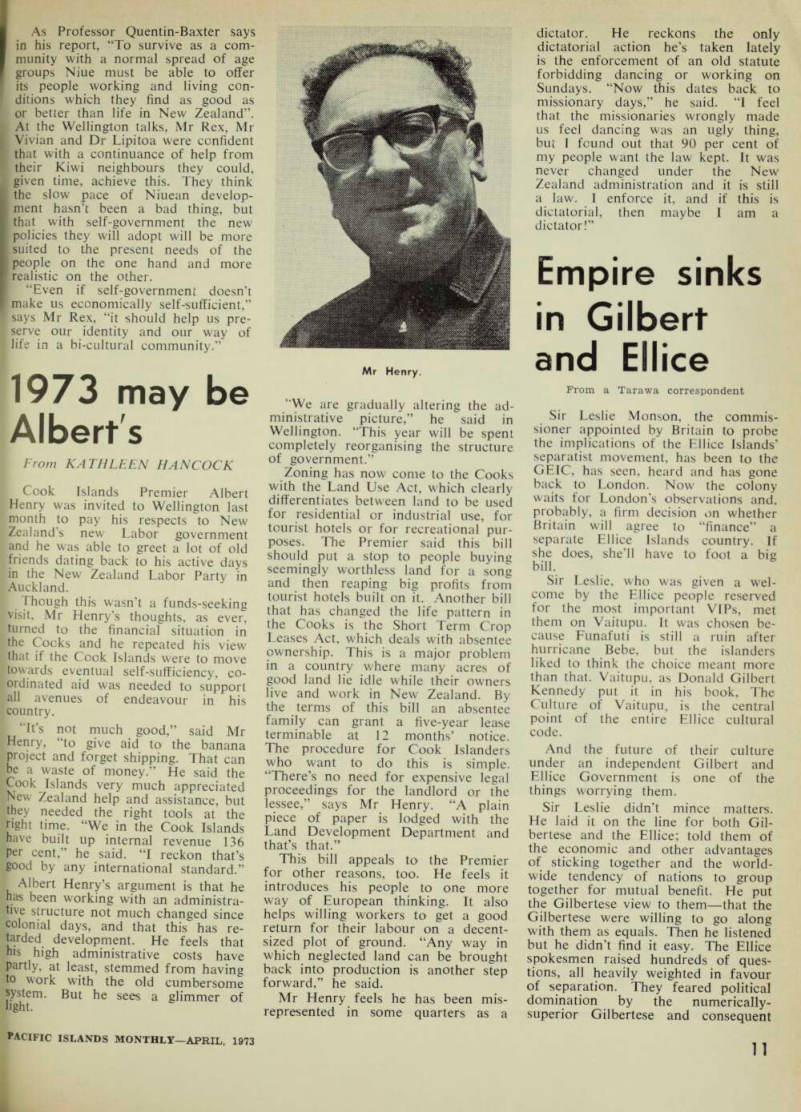
Mr Henry.