1974 Is Niue's Year
pp. 12-13 · Read in the full issue
From KATHLEEN HANCOCK in Wellington
Talks in Wellington in March between the Niue Government and the New Zealand Government resulted in agreement on a definite date for Niuean self-government. Late 1974 is the time set for the 4,600 citizens of what delegation leader Robert Rex calls “the Gibraltar of the Pacific” to start paddling their own canoe. And in accordance with Niuean wishes, New Zealand will remain responsible for defence and foreign affairs, as she is in the Cook Islands.
Leader of Government Business Robert Rex, Young Vivian and Dr Enetama Lipitoa were the team that negotiated the Wellington agreement.
The constitution they will prepare in consultation with the New Zealand Government won’t be finally drawn up until 1974, but the general trend of the new relationship is foreshadowed by the report on the Constitutional Development of Niue, drawn up by Professor R. Quentin- Baxter of Victoria University of Wellington.
The Niueans don’t want to see their long and close association with New Zealand broken. They want a permanent New Zealand resident on the island. And unlike some territories receiving substantial aid. Niue has no objection to the New Zealand Government taking an interest in both the area to which aid is applied and the methods used in its application. Though the Niuean is one of
the most individualistic islanders h the Pacific, he’s well aware that as developing island nation Niue sti]
needs guidance in spending pubh
money.
Niue will still be looking to Net Zealand for preferential access t Kiwi markets. Robert Rex has alway been a champion of diversificatio and he has done his best to er courage his people away from simpl subsistence cropping and copra t other avenues of production. Canne lime juice and passionfruit will t on Niue’s list of exports by the en of the year and honey production another departure from tradition: island husbandry, Mr Rex is hopeful that with sel government more Niueans will stc home and help build their own stat Today a whopping 50 per cent * Niue’s people have left their horn land to live in New Zealand. B’ lately the exodus of the able and tt educated is not quite so noticeabl says Young Vivian. To encoura;. the territory’s young people to acce: and appreciate their environmen Mr Rex hopes to change the dire tion of education and economic d velopment. He wants to see mo; emphasis on the region they live i and an escape from the old traditu of subsistence cropping which i quires both old and young Niuea to garden after work, after sc and on Saturdays.
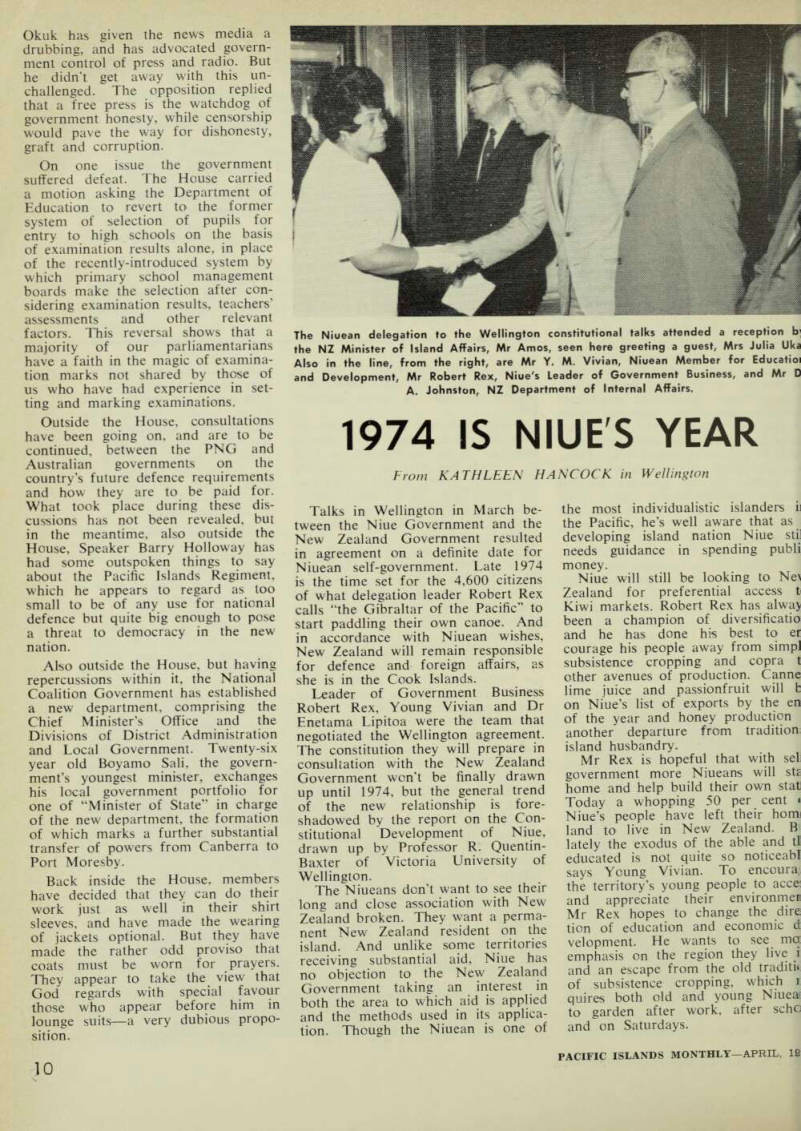
The Niuean delegation to the Wellington constitutional talks attended a reception by the NZ Minister of Island Affairs, Mr Amos, seen here greeting a guest, Mrs Julia Uka[?] Also in the line, from the right, are Mr Y. M. Vivian, Niuean Member for Education and Development, Mr Robert Rex, Niue's Leader of Government Business, and Mr D.
A. Johnston, NZ Department of Internal Affairs.
As Professor Quentin-Baxter says in his report, “To survive as a com munity with a normal spread of age groups Niue must be able to offer its people working and living con ditions which they find as good as or better than life in New Zealand”.
At the Wellington talks, Mr Rex, Mr Vivian and Dr Lipitoa were confident that with a continuance of help from their Kiwi neighbours they could, given time, achieve this. They think the slow pace of Niuean develop ment hasn’t been a bad thing, but that with self-government the new ; policies they will adopt will be more 1 suited to the present needs of the people on the one hand and more realistic on the other.
“Even if self-government doesn’t make us economically self-sufficient,” says Mr Rex, “it should help us pre serve our identity and our way of life in a bi-cultural community.”