ideas and a big breakfast
pp. 111-113 · Read in the full issue
Pacific Aviation Round-Up
A small airline with big ideas and a big breakfast
From Christopher Beck
in Melbourne
Air Nauru, the international flag carrier of the tiny phosphate republic of Nauru nestling just south of the equator, is the sort of airline on which Itrailblazing tourists like to travel— to get right off the beaten track, and the mini-airline helps them do just that.
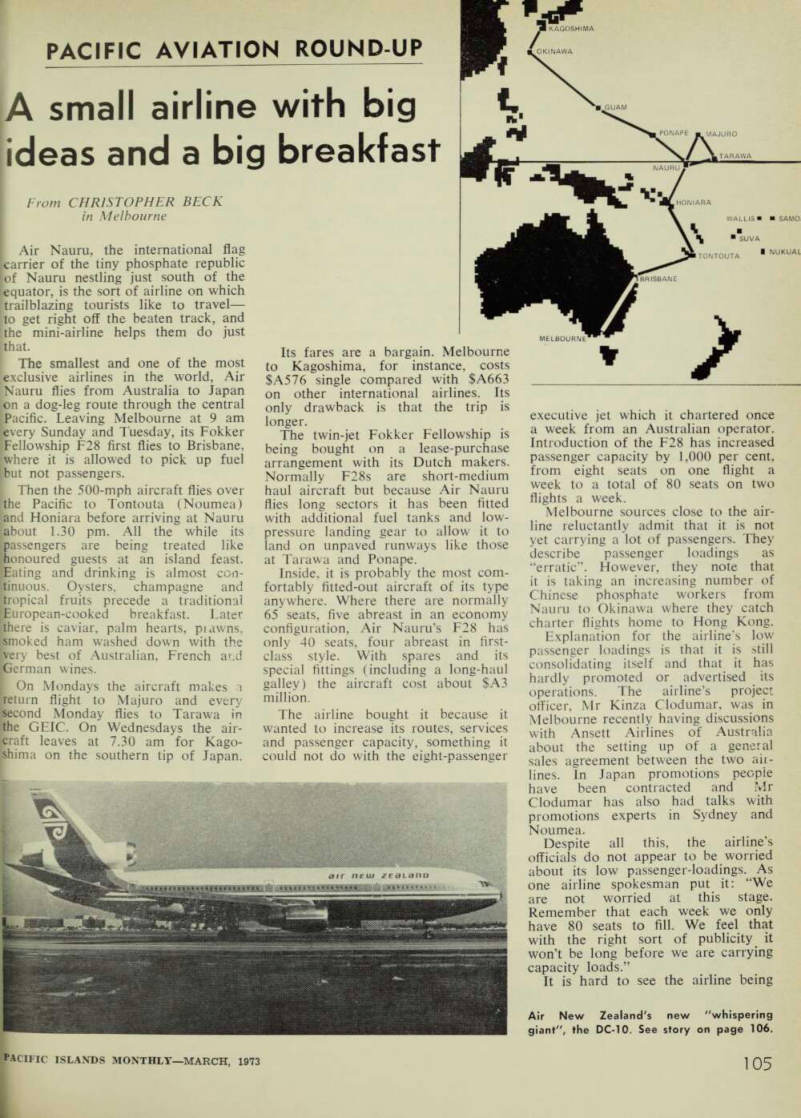
The smallest and one of the most exclusive airlines in the world. Air Nauru flies from Australia to Japan on a dog-leg route through the central Pacific. Leaving Melbourne at 9 am every Sunday and Tuesday, its Fokker Fellowship F2B first flies to Brisbane, ■where it is allowed to pick up fuel but not passengers.
I Then the 500-mph aircraft flies over the Pacific to Tontouta (Noumea) and Honiara before arriving at Nauru [about 1.30 pm. All the while its massengers are being treated like honoured guests at an island feast. [Eating and drinking is almost con tinuous. Oysters, champagne and tropical fruits precede a traditional |European-cooked breakfast. Later jthere is caviar, palm hearts, ptawns, smoked ham washed down with the [very best of Australian, French and German wines.
I On Mondays the aircraft makes a peturn flight to Majuro and every second Monday flies to Tarawa in the GEIC. On Wednesdays the air craft leaves at 7.30 am for Kago shima on the southern tip of Japan.
Its fares are a bargain. Melbourne to Kagoshima, for instance, costs $A576 single compared with 5A663 on other international airlines. Its only drawback is that the trip is longer.
The twin-jet Fokker Fellowship is being bought on a lease-purchase arrangement with its Dutch makers.
Normally F2Bs are short-medium haul aircraft but because Air Nauru flies long sectors it has been fitted with additional fuel tanks and low pressure landing gear to allow it to land on unpaved runways like those at Tarawa and Ponape.
Inside, it is probably the most com fortably fitted-out aircraft of its type anywhere. Where there are normally 65 seats, five abreast in an economy configuration, Air Nauru’s F2B has only 40 seats, four abreast in first class style. With spares and its special fittings (including a long-haul galley) the aircraft cost about SA3 million.
The airline bought it because it wanted to increase its routes, services and passenger capacity, something it could not do with the eight-passenger
executive jet which it chartered once a week from an Australian operator.
Introduction of the F2B has increased passenger capacity by 1,000 per cent, from eight seats on one flight a week to a total of 80 seats on two flights a week.
Melbourne sources close to the air line reluctantly admit that it is not yet carrying a lot of passengers. They describe passenger loadings as “erratic”. However, they note that it is taking an increasing number of Chinese phosphate workers from Nauru to Okinawa where they catch charter flights home to Hong Kong.
Explanation for the airline’s low passenger loadings is that it is still consolidating itself and that it has hardly promoted or advertised its operations. The airline’s project officer, Mr Kinza Clodumar, was in Melbourne recently having discussions with Ansett Airlines of Australia about the setting up of a general sales agreement between the two air lines. In Japan promotions people have been contracted and Mr Clodumar has also had talks with promotions experts in Sydney and Noumea.
Despite all this, the airline’s officials do not appear to be worried about its low passenger-loadings. As one airline spokesman put it; “We are not worried at this stage.
Remember that each week we only have 80 seats to fill. We feel that with the right sort of publicity it won’t be long before we are carrying capacity loads.”
It is hard to see the airline being
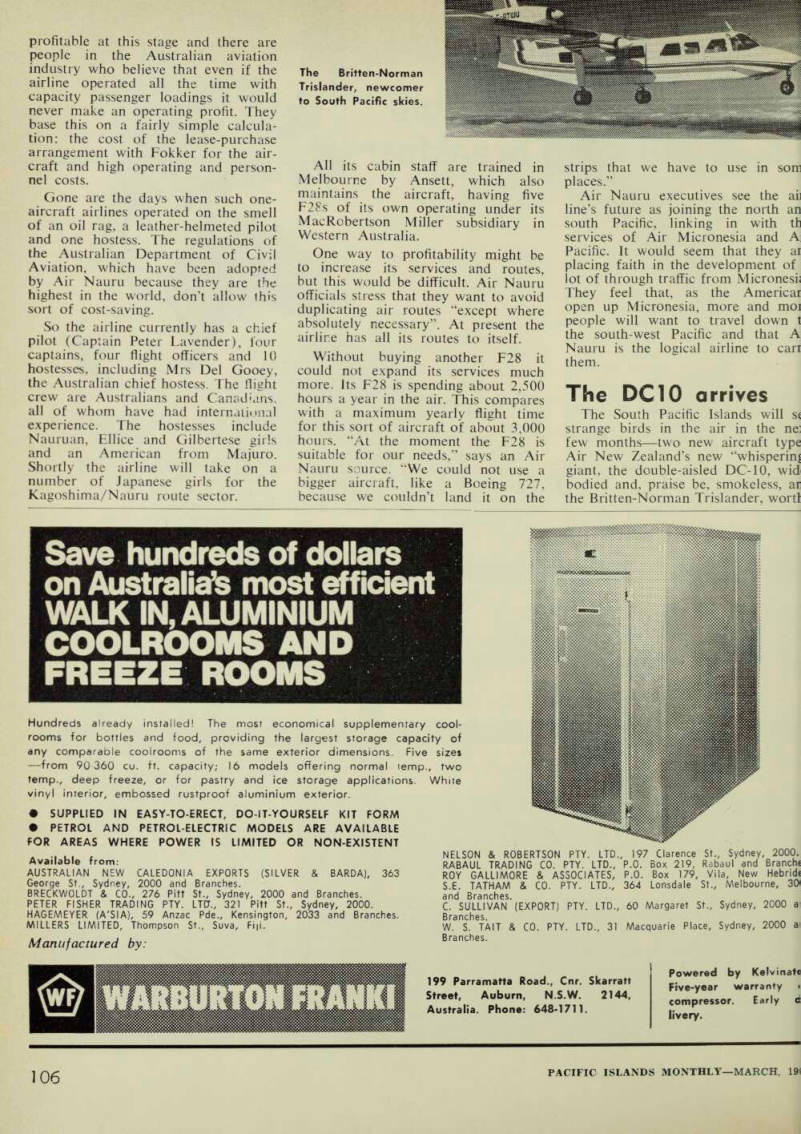
Air New Zealand's new "whispering giant", the DC-10. See story on page 106.
profitable at this stage and there are people in the Australian aviation industry who believe that even if the airline operated all the time with capacity passenger loadings it would never make an operating profit. They base this on a fairly simple calcula tion: the cost of the lease-purchase arrangement with Fokker for the air craft and high operating and person nel costs.
Gone are the days when such one aircraft airlines operated on the smell of an oil rag, a leather-helmeted pilot and one hostess. The regulations of the Australian Department of Civil Aviation, which have been adopted by Air Nauru because they are the highest in the world, don’t allow this sort of cost-saving.
So the airline currently has a chief pilot (Captain Peter Lavender), four captains, four flight officers and 10 hostesses, including Mrs Del Gooey, the Australian chief hostess. The flight crew are Australians and Canadians, all of whom have had international experience. The hostesses include Nauruan, Ellice and Gilbertese girls and an American from Majuro.
Shortly the airline will take on a number of Japanese girls for the Kagoshima/Nauru route sector.
All its cabin staff are trained in Melbourne by Ansett, which also maintains the aircraft, having five F2Bs of its own operating under its Macßcbertson Miller subsidiary in Western Australia.
One way to profitability might be to increase its services and routes, but this would be difficult. Air Nauru officials stress that they want to avoid duplicating air routes “except where absolutely necessary”. At present the airline has all its routes to itself.
Without buying another F2B it could not expand its services much more. Its F2B is spending about 2,500 hours a year in the air. This compares with a maximum yearly flight time for this sort of aircraft of about 3,000 hours. “At the moment the F2B is suitable for our needs,” says an Air Nauru source. "We could not use a bigger aircraft, like a Boeing 727, because we couldn’t land it on the
strips that we have to use in som places.”
Air Nauru executives see the ail line’s future as joining the north an south Pacific, linking in with th services of Air Micronesia and Ai Pacific. It would seem that they ar placing faith in the development of lot of through traffic from Micronesh They feel that, as the Americar open up Micronesia, more and moi people will want to travel down t the south-west Pacific and that A Nauru is the logical airline to can them.
The DC 10 arrives
The South Pacific Islands will sc strange birds in the air in the ne: few months—two new aircraft type Air New Zealand’s new “whispering giant, the double-aisled DC-10, widi bodied and, praise be, smokeless, ac the Britten-Norman Trislander, wort!
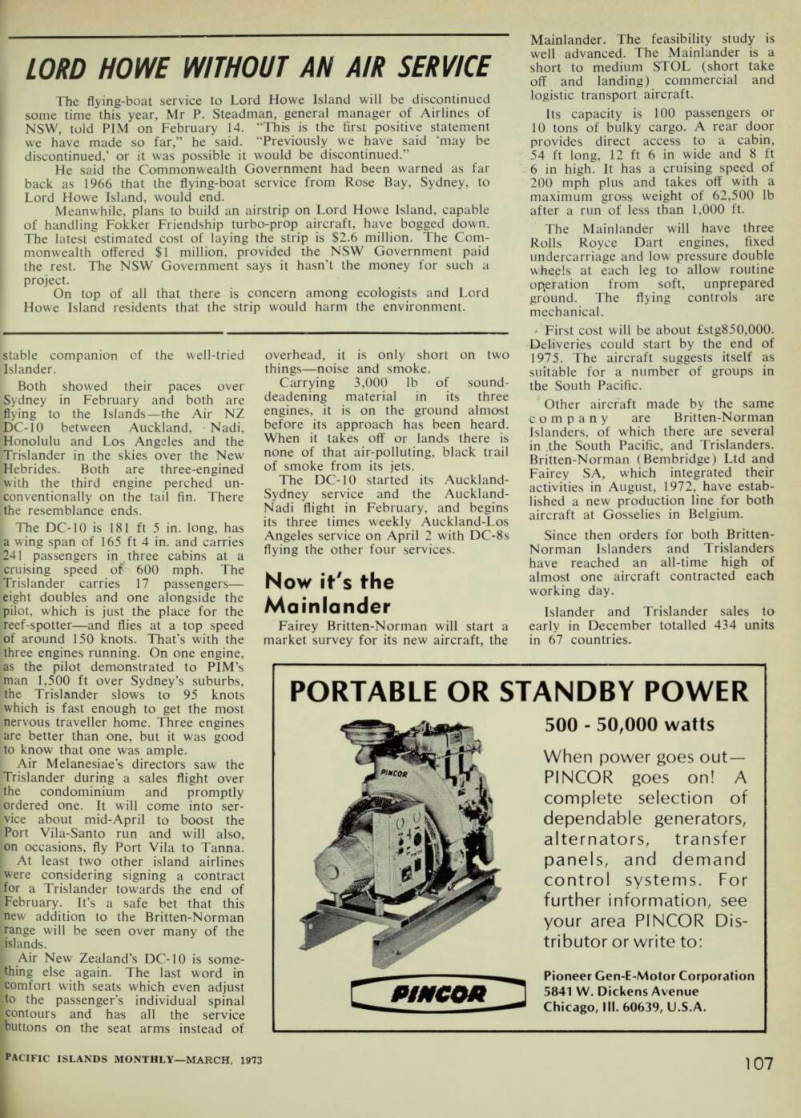
The Britten-Norman Trislander, newcomer to South Pacific skies.
stable companion of the well-tried Islander.
Both showed their paces over Sydney in February and both are flying to the Islands—the Air NZ DC-10 between Auckland, Nadi, Honolulu and Los Angeles and the Trislander in the skies over the New Hebrides. Both are three-engined [with the third engine perched un iconventionally on the tail fin. There [the resemblance ends.
I The DC-10 is 181 ft 5 in. long, has a wing span of 165 ft 4 in. and carries |241 passengers in three cabins at a cruising speed of 600 mph. The Trislander carries 17 passengers— eight doubles and one alongside the pilot, which is just the place for the reef-spotter—and flies at a top speed of around 150 knots. That’s with the three engines running. On one engine, as the pilot demonstrated to PlM’s man 1,500 ft over Sydney’s suburbs, the Trislander slows to 95 knots which is fast enough to get the most nervous traveller home. Three engines are better than one, but it was good to know that one was ample.
Air Melanesiae’s directors saw the Trislander during a sales flight over the condominium and promptly [ordered one. It will come into ser vice about mid-April to boost the [Port Vila-Santo run and will also, on occasions, fly Port Vila to Tanna.
I At least two other island airlines were considering signing a contract for a Trislander towards the end of I February. It’s a safe bet that this new addition to the Britten-Norman range will be seen over many of the islands. [ Air New Zealand’s DC-10 is some thing else again. The last word in comfort with seats which even adjust to the passenger’s individual spinal contours and has all the service buttons on the seat arms instead of
overhead, it is only short on two things—noise and smoke.
Carrying 3,000 lb of sound deadening material in its three engines, it is on the ground almost before its approach has been heard.
When it takes off or lands there is none of that air-polluting, black trail of smoke from its jets.
The DC-10 started its Auckland- Sydney service and the Auckland- Nadi flight in February, and begins its three times weekly Auckland-Los Angeles service on April 2 with DC-8s flying the other four services.
Now it's the
Moinlonder
Fairey Britten-Norman will start a market survey for its new aircraft, the
Mainlander. The feasibility study is well advanced. The Mainlander is a short to medium STOL (short take off and landing) commercial and logistic transport aircraft.
Its capacity is 100 passengers or 10 tons of bulky cargo. A rear door provides direct access to a cabin, 54 ft long, 12 ft 6 in wide and 8 ft 6 in high. It has a cruising speed of 200 mph plus and takes off with a maximum gross weight of 62,500 lb after a run of less than 1,000 ft.
The Mainlander will have three Rolls Royce Dart engines, fixed undercarriage and low pressure double wheels at each leg to allow routine operation from soft, unprepared ground. The flying controls are mechanical.
First cost will be about £stgBso,ooo.
Deliveries could start by the end of 1975. The aircraft suggests itself as suitable for a number of groups in the South Pacific.
Other aircraft made by the same company are Britten-Norman Islanders, of which there are several in the South Pacific, and Trislanders.
Britten-Norman (Bembridge) Ltd and Fairey SA, which integrated their activities in August, 1972, have estab lished a new production line for both aircraft at Gosselies in Belgium.
Since then orders for both Britten- Norman Islanders and Trislanders have reached an all-time high of almost one aircraft contracted each working day.
Islander and Trislander sales to early in December totalled 434 units in 67 countries.