Globetrotting Golf
pp. 104-105 · Read in the full issue
A World Survey by Peter Ryde
Golf is the businessman’s sport, but for some it is also the businessman’s business. In the United States, accord ing to the latest figures, more money is spent on the game than on any other sport. Jack Nicklaus, for ex ample—probably the quickest million aire the game has produced—is now diverting some of his great energies to the business opportunities that his own skill has opened up. He says he has found a whole new challenge— at a time when golf has hardly any challenges left for him—in organising his own business affairs and marketing his own skills.
One of the directions in which he has turned is course architecture. In Japan, where he is partly engaged, 15 vast complexes are under way, each worth about £lm, according to the British golf architect, John D. Harris.
Other golfers who have turned to course construction after finding themselves less tied to the circuit than in their formative days, are Arnold Palmer and Bruce Devlin in the United States, Peter Thomson in Aus tralia, and the combinations from Britain of Peter Allis with David Thomas, and of Brian Huggett and Neil Coles. There seems to be room for all, so great is the rate of expan sion. The professional firms of course architects are not complaining. The hardest man to find at home these days is the course architect.
Most national championships are financed by their organisers but tournaments are dependent on spon sorship. It is reckoned generally that running a tournament costs about twice the total prize-money—but the greater the prize-money, of course, the higher the calibre of contestants and the greater the prestige for the sponsors.
The sponsors, naturally, are reticent about the actual cost. But take, for example, the annual Piccadilly World Matchplay tournament at Wentworth, near London, which involves only eight players. The prize-money was raised to £25,000 in 1971. To this must be added the cost of first-class air fares for the competitors, most of whom travel from the United States, Australia and New Zealand, hire-cars on their arrival, a stay in a first-class hotel—perhaps with their wives—or in a specially rented country house,
which some now prefer. So to double the amount of the prize-money seems a realistic figure.
What do the sponsors get in return?
At the top of the list comes tele vision. The lack of it has sometimes dissuaded potential promoters from taking the field. But W. D. and H. O.
Wills, for example, secured 17 hours of viewing time for their event at Dalmahoy, Scotland.
Also important is press coverage.
The name of a product repeated daily in dozens of newspapers keeps it in the public consciousness. Schweppes paid one of the first cheques for $l,OOO for a golfer holing out in one and press cuttings bearing the com pany’s name came in from all over the world.
Some sponsors would no doubt put ahead of this kind of publicity the benefit of being able to entertain a large number of important clients.
This has long been the practice of Dunlop at its model Masters tourna
ment, and the new Viyella tournament is put to the same use.
More than half of the $450,000 in prize-money put up by sponsors on the British circuit last year came from tobacco manufacturers.
Carreras, for example, have been in the field for ten years. The com pany says: “An important part of our marketing strategy has for years been to give some support to sport. There are, after all, reckoned to be more than a million golfers in Britain and about half of them will be smokers”.
The firm has found a useful addi tion to its publicity in the full-length film it makes of the Piccadilly tourna ment. This was shown 10,000 times last year at golf club and society meetings throughout the UK and else where.
But back to the individual golfer who travels the world—in most cases a businessman. Along BOAC’s world routes, the traveller can now count on finding first-rate golf facilities. I have always found a marked understanding of the problems of the travelling golfer—in whatever guise he may appear—on the part of airline crews, possibly because so many take ad-
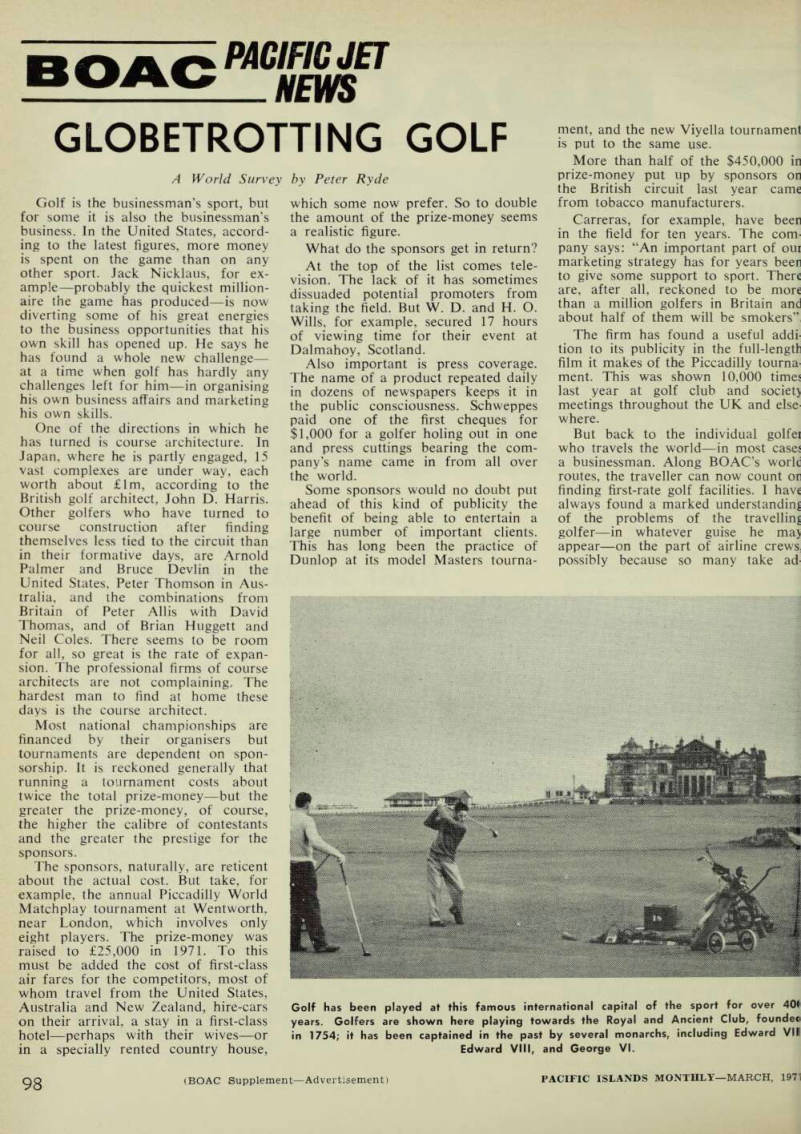
Golf has been played at this famous international capital of the sport for over 40 years. Golfers are shown here playing towards the Royal and Ancient Club, founded in 1754; it has been captained in the past by several monarchs, including Edward VII Edward VIII, and George VI.
I vantage of stopovers to widen their [experience of the game.
The connoisseur traveller will leave that great heavy scratchman’s bag i behind and content himself with a j drainpipe version containing half a dozen of his favourite clubs. One friend calculates the size of the suit leases he needs for air travel by the length of his putter. It is the most personal of all clubs; the rest he is content to leave to chance. It is be coming increasingly easy to hire or borrow clubs at courses abroad and, in my own experience, they are often much better than those left behind. In that spirit one can enjoy a whole new set of experiences.
One may find oneself playing on courses in parts of Africa where the ( greens are browns. One may be dazzled by the beauty of such courses as the Nuwara Eliya club in Sri Lanka (formerly Ceylon), some 100 miles from Colombo, where the course is thickly planted with crimson rhododendrons and golden wattle and where the rough is dotted with pink orchids and sky-blue gentian.
Approaching the sixth green at Delhi, the golfer may surprise mon keys sunning themselves on ancient Mogul tombstones. In Eastern Trans vaal they have carved a course out of the Kruger National Park at Phala borwa. It took some time to pen the wildlife behind fences, and the golfer may still be surprised by the sight of an elephant or buffalo that has broken through the barricade or by a giraffe that has stepped over it.
Most of the opportunities the traveller gets for golf will be less re mote and exotic than these few ex amples. On the well-beaten tracks that most of us follow, the greens may be better manicured and the bars better stocked. But what matter? The sense of novelty and of exploration is there to be tasted on any strange course.
A golfer need never be alone any where, for wherever in the past Britons have travelled—as soldiers, priests or engineers—they always seem to have stuck their flagsticks.
Scottish emigrants planted the game in the United States before the turn of the century and provided the first dozen or so winners of the American championship. The first evidence of golf in South Africa was a six-hole affair laid out close to the Royal Scot’s camp at Wynberg in the Cape. » The first golf course on the Con
tinent was started by convalescent officers from the Highland Brigade of Wellington’s army who stayed on in Pau, in France, and sowed the seeds of the game there beside the quiet waters of the Gave.
I was talking some time ago to the Austrian explorer, Heinrich Harrer, author of Seven Years in Tibet and a member of the Austrian golf team.
Recently, in exploring Sudan, he came across an old map dated just after World War I. In one corner of the country, far from any big town, there was marked a little flagstick which turned out to be the remains of a nine-hole course, left there no doubt by some addict in the Sudan Civil Service.
In many countries golf is one of the important supports of the tourist industry. Those tight little islands of Bermuda and the Bahamas, for ex ample, do not have much land to spare, yet their courses are spacious and sequestered—often linked in the latter area to a development scheme, but providing genuine and first-rate golf. Such are the Lucayan club on Grand Bahama, and Nassau to which a new lease of life was recently given by a slsm development including a new hotel and clubhouse, and a com plete watering system for both courses.
My own favourite in that area is at Great Harbour Key. a jewel of a little island, more like a floating golf
course with just enough room round it for an airstrip, a clubhouse, and a scattering of villas bordering the emerald seas.
And in the West Indies, the busi nessman or the golfer—l would not wish to distinguish between the two —can find himself, for example, sit ting on a verandah on a headland of the island of Tobago, the Caribbean spread out before him and, just be side him, a first-class, full-length course awaiting his attention.
These enterprises circle the globe now, most of them made possible by the complicated economy of land de velopment—selling plots round the course while retaining the freehold of the playing area—or by big hotel complexes.
The gloomy ones shake their heads and say golf has become big business.
All right, so it has. It has moved a whole world away from the days when the addict shouldered his bag and cycled, ever faithful, to his own club—kept alive somehow on creak ing finances. In the process of change, the game may at times have been ex ploited. But golf is strong enough to rise above such setbacks. The lines along which it is developing ensure that it is entering international life more fully at every level.
Peter Ryde has been golf corres pondent of The Times, London, for 20 years and admits modestly to hav ing covered most of the world’s major championships.