Pacific Shipping
pp. 89-97 · Read in the full issue

Government And Companies Are
All Mates In Fiji's Shipyards
From SUE WENDT in Suva
I Luxury cruise vessels, service ships, landing craft, barges, research vessels, bugs. fishing and pleasure boats—Fiji’s fastgrowing shipbuilding industry is turning them out, if not quite at the rate of knots, certainly at an en couraging pace. [ If the industry expands as fast as the demand, it could become very big business indeed for Fiji, as the ministry with the tediously long title of Communications, Works and Tourism is discovering. Its Walu Bay shipyard is already fully committed Until at least the middle of 1974.
K The government shipyard is Fiji’s biggest, with 228 employees and jeveral million dollars worth of con struction either completed during the bast two years or due for completion by early 1974. Originally intended to build government vessels only, the pipyard launched into the com mercial sphere in 1970, with a con tract to build a 121 ft luxury cruise ressel for Blue Lagoon Cruises, of lautoka.
I The contract price for the cruiser, lamed Lycianda, was $156,750 but »sts rose to $171,305. There was ome confusion over whether or not he shipyard made or lost money on i-ycianda (the ministry says it made rprofit, though not as much as an- Kipated) but an important side effect it the time was to maintain full mployment in the shipyard and ivoid redundancies. The exercise was ptisfactory enough for it to take on I second Blue Lagoon order—the |24 ft Talei-Anda, with a contract •rice of $237,000. Talei-Anda, lunched last August, took 12 months o build. A third Lycianda-type vessel be built for the Blue Lagoon
puises.
[Next big challenge for the govern ment shipyard will be to build a [placement for the Tui Lau the 700on cargo-passenger ship which was wrecked on a reef in 1968, soon after he began operating regular services
between Suva and the remote Lau Group.
An overseas design for the Tui Lau replacement was considered but build ing to the design would have been too expensive. A more realistically priced design was produced locally, calling for a 146 ft vessel with a 135ton cargo capacity, 52 airliner-type seats for saloon passengers and two berth cabins for another 14 passengers, making her the biggest ship yet tackled in Fiji. The contract price is less than half the rumoured price of $700,000, according to a spokesman for the department.
Since it has the shipyard with the greatest construction capacity, it was logical for the Marine Department to enter into commercial shipbuilding, says the secretary for Transport, Mr Tom Vakatora. But he stresses that it was the government’s intention to stimulate the industry, not take away
business from local shipbuilding com panies.
“Under no circumstances will we enter into competition with other commercial shipbuilding operations in Fiji,” he said. “There is more than enough business for everyone at present. Government’s policy is to encourage the industry as a whole, not take business from others. It wouldn’t be good for the companies and it wouldn’t be good for Fiji.”
As an example of the co-operation existing between the government and commercial concerns, Mr Vakatora explained that the W. R. Carpenter Group recently called for tenders to build a tug and three barges. “Govern ment is quoting for them in com petition with overseas yards,” he said.
But by having the closest discussions with Millers Ltd, we will endeavour to ensure that these orders remain in Fiji. Government relations with
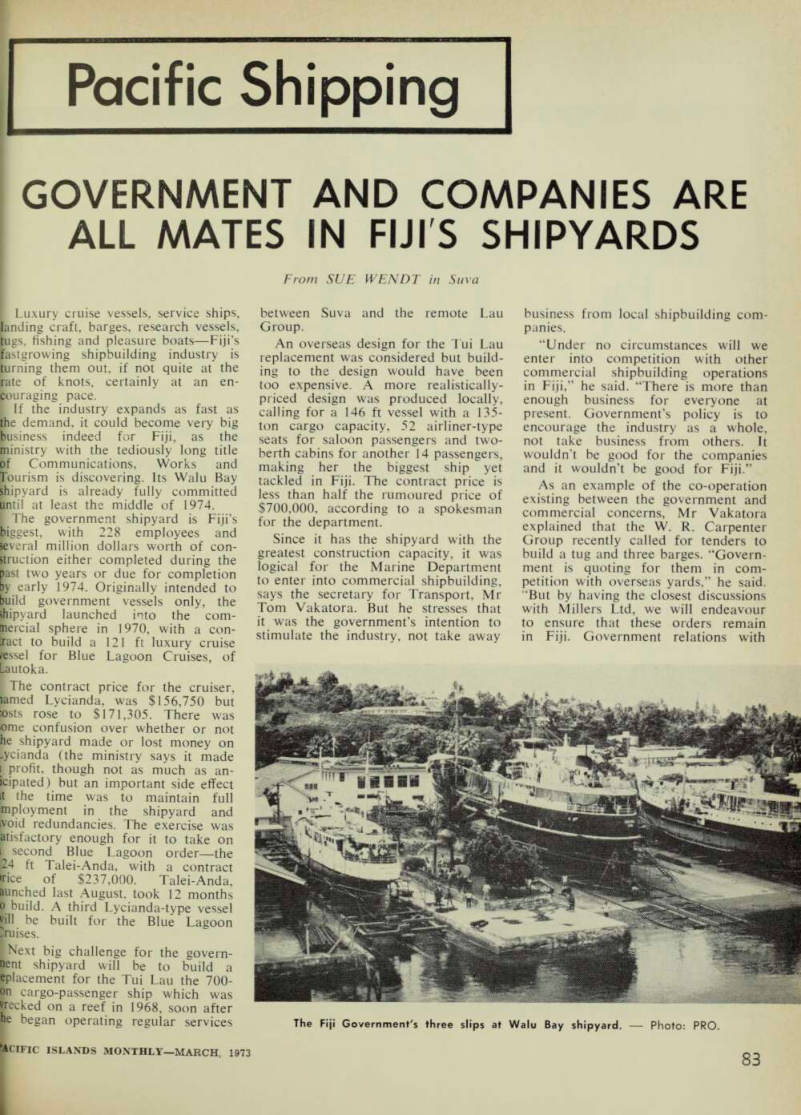
The Fiji Government's three slips at Walu Bay shipyard. Photo: PRO.
the commercial shipbuilding industry !are very good indeed.”
I The government shipyard hasn’t [taken on any overseas orders yet, but it did receive inquiries from a US [company recently about the possibility [of building up to five Lyciandas! “We fcaven’t heard anything from the com pany since, but it’s an indication of She kind of interest being generated fey our shipbuilding efforts. If the lommercial side of our operations Continue, the government yard could probably be geared to turning out a lessel like the Lycianda every nine months,” Mr Vakatora said. [Obviously, that would involve con siderable advance planning, because Steel and ships’ engines take up to six months to arrive in Fiji.”
I Although the potential profitability of commercial shipbuilding must prove attractive to the ministry, first priority is still the building of government vessels, for which >798,000 is allocated in Development plan VI, taking Fiji up to 1975.
I The government has earmarked >200,000 for the expansion of the palu Bay shipyard to enable con buction of ships up to 250 ft in fength and 1,500 tons dwt. The bogramme, due for completion this [ear. includes erection of a 35-ton bntry crane, extension of building rays, the provision of profile-cutting wuipment and the introduction of a pefabrication process which will bead construction. [Although it’s difficult to relate [xpenditure to profitability when so duch of the yard’s building opera ions are concerned with service fessels, the Marine Department earns evenue from other rewarding sources, uch as fees and dues from ports and lipways. Suva’s three public slip rays—2oo-ton, 500-ton and 1,000- P n —slipped about 240 vessels in £72 and are running to capacity.
Much of the demand for slipway pace comes from fishing vessels pitted by companies like Millers and lish Ltd, and as Transport Secretary [akatora puts it: “Ship repair is ne aspect of the industry which will lake a lot of money for Fiji if we an hold on to the business. Fijians lake good steel workers and repair k)rk done in Fiji is of a high
pndard.”
Millers Limited, with the lion’s lare of repair work in Fiji, was due [ complete its first repair slipway in inuary. This will allow the company I cater for vessels up to 140 ft in sngth or 250 tons dwt and serve the ual purpose of consolidating Millers’
Psition as the dominion’s major ship [Pair agency and easing the burden
d Suva’s public slipways.
|“We are also planning a $250,000
expansion programme which will double Millers’ capacity to build new large vessels and triple our slipping capacity,” Millers general manager, Mr Ken Clemens told PIM.
“A Syncrolift drydock is to be installed by the end of 1973 and when fully developed, it will provide our Walu Bay shipyard with two ad ditional repair berths and another new building berth, each catering for ships of up to 225 tons.”
Millers Ltd, which became part of the W. R. Carpenter Group of Companies in 1956, has been build ing wooden boats in Fiji since 1931.
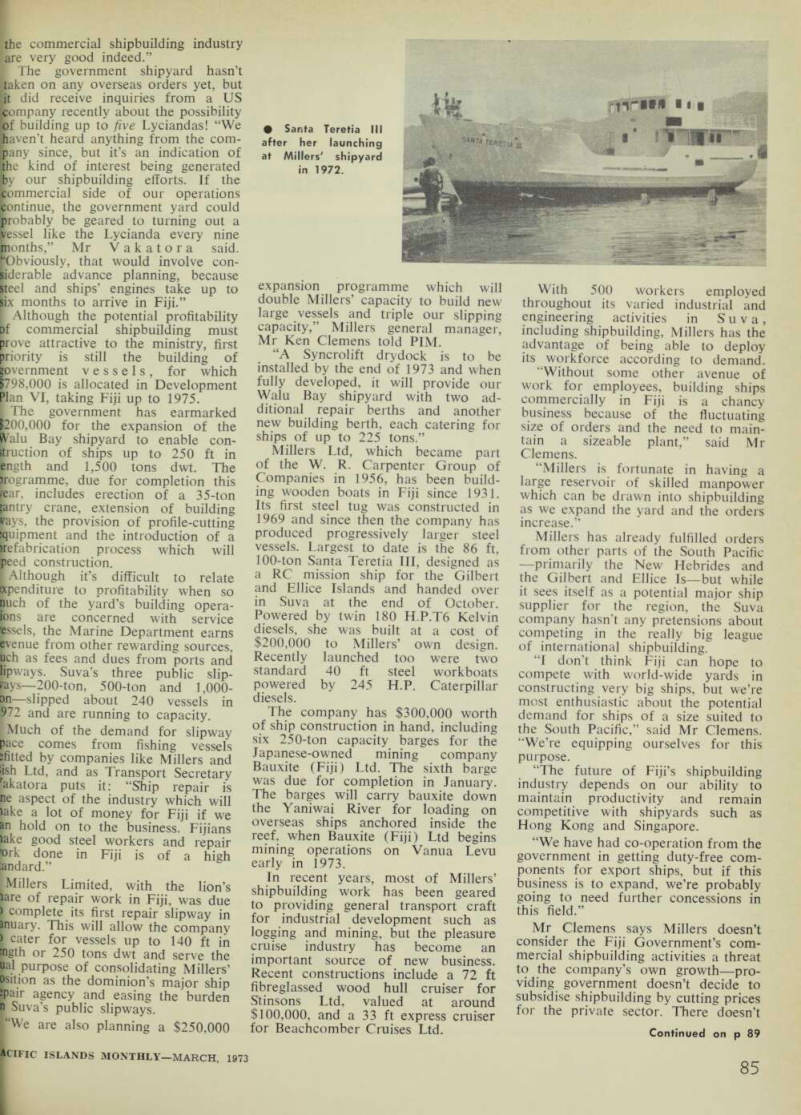
Its first steel tug was constructed in 1969 and since then the company has produced progressively larger steel vessels. Largest to date is the 86 ft, 100-ton Santa Teretia 111, designed as a RC mission ship for the Gilbert and Ellice Islands and handed over in Suva at the end of October.
Powered by twin 180 H.P.T6 Kelvin diesels, she was built at a cost of $200,000 to Millers’ own design.
Recently launched too were two standard 40 ft steel workboats powered by 245 H.P. Caterpillar diesels.
The company has $300,000 worth of ship construction in hand, including six 250-ton capacity barges for the Japanese-owned mining company Bauxite (Fiji) Ltd. The sixth barge was due for completion in January.
The barges will carry bauxite down the Yaniwai River for loading on overseas ships anchored inside the reef, when Bauxite (Fiji) Ltd begins mining operations on Vanua Levu early in 1973.
In recent years, most of Millers’ shipbuilding work has been geared to providing general transport craft for industrial development such as logging and mining, but the pleasure cruise industry has become an important source of new business.
Recent constructions include a 72 ft fibreglassed wood hull cruiser for Stinsons Ltd, valued at around $lOO,OOO, and a 33 ft express cruiser for Beachcomber Cruises Ltd.
With 500 workers employed throughout its varied industrial and engineering activities in Suva, including shipbuilding, Millers has the advantage of being able to deploy its workforce according to demand.
“Without some other avenue of work for employees, building ships commercially in Fiji is a chancy business because of the fluctuating size of orders and the need to main tain a sizeable plant,” said Mr Clemens.
“Millers is fortunate in having a large reservoir of skilled manpower which can be drawn into shipbuilding as we expand the yard and the orders increase.”
Millers has already fulfilled orders from other parts of the South Pacific —primarily the New Hebrides and the Gilbert and Ellice Is—but while it sees itself as a potential major ship supplier for the region, the Suva company hasn't any pretensions about competing in the really big league of international shipbuilding.
“I don’t think Fiji can hope to compete with world-wide yards in constructing very big ships, but we’re most enthusiastic about the potential demand for ships of a size suited to the South Pacific,” said Mr Clemens.
“We’re equipping ourselves for this purpose.
“The future of Fiji’s shipbuilding industry depends on our ability to maintain productivity and remain competitive with shipyards such as Hong Kong and Singapore.
“We have had co-operation from the government in getting duty-free com ponents for export ships, but if this business is to expand, we’re probably going to need further concessions in this field.”
Mr Clemens says Millers doesn’t consider the Fiji Government’s com mercial shipbuilding activities a threat to the company’s own growth—pro viding government doesn’t decide to subsidise shipbuilding by cutting prices for the private sector. There doesn’t
Continued on p 89
• Santa Teretia III after her launching at Millers' shipyard in 1972.
seem any likelihood of this happening, he adds, “We appreciate that the government ■ must accept some commercial work K to keep its labour force employed I and that it can’t afford to have an I idle yard,” Mr Clemens said.
“Co-operation between the govern- I ment and our company is excellent. Work is automatically referred from [one to the other, so we’re both work ling to keep each other’s yards full.”
Fibreglass and ferro-cement boats I are coming into their own too in I Fiji. George and Ashton (Pacific [islands) Ltd (owned jointly by Millers and Alex Harvey Industries [Ltd of New Zealand) is the major manufacturer at present in this field, with its 29 ft fibreglass “Karitane” type vessel the most successful to I date. Seven have been exported to the New Hebrides, Tonga, Christmas Island and the GEIC as tugs, fishing boats and for missionary purposes.
Union's Threat
Pays Off
I Fijian seamen in the inter-island frader, Komaiwai, will get overtime, while Banabans working beside them Nvon’t. The Komaiwai is owned by the Banabans of Rabi Island, and is operated by Rabi Holdings Ltd.
I When the Banabans bought the Komaiwai they decided Banaban em ployees would get normal pay instead of time-and-a-half for working over time. to keep costs to a minimum.
The Komaiwai then carried 27 sea men and officers. This was reduced to 21 as an economy measure. The briginal plan was to retain seven Fijian seamen, but after talks with the union the number was lifted to The managing director of Rabi Holdings, Mr Tetoki Rotan, said there was no intention of squeezing he Fijians out. Earlier the union fccretary, Mr Taniela Veitata, had laid his members would “squeeze the Komaiwai off the map” if the Janaban owners tried to replace the Fijian crew. And judging by Mr feitata’s determined attitude during he crippling dockworkers’ strike in 971 he obviously meant what he aid.
.Evuka's Shipping Exodus
)Nly Temporary
L A decline of about 30 in the number I fishing ships servicing the Pacific fishing Co at Levuka will be tem prary. The company’s fleet will rise I 38 in about six months. Some of ie ships will be bigger and more Tif rn t^lan t * lose * n present fleet.
I There was concern at Levuka when r Korean fishing ships, crewed by pout 300 men, switched to Pago
Pago to supply American canneries there. The Americans offered the Koreans better financial rewards.
The managing director of the Pacific Co, Mr Yuichi Yamamoto, went to Fiji from Tokyo to make a first hand inspection of the likely effects of the departure of the Koreans. He assured the Mayor of Levuka, Major T. Casling-Cottle, council officials and businessmen, they need have no worries about the economic effects.
The Korean boats withdrawn belonged to a semi-government cor poration. Six privately-owned Korean ships remained as part of the com
pany’s fleet, which would be added to over the next six months.
Mr Yamamoto said the value of fish exported from Levuka in 1972 was about $lO million.
A Delayed Finish
For Old Tofua
The Union Steam Ship Co of NZ Ltd is considering ways and means of replacing the Tofua but there is no intention of taking her off the
Auckland-Fiji-Tonga-Niue-Samoa run
till there is a replacement. She will, however, go out of service in April for her annual routine survey.
Mr Ross Cribb, of Sydney, a
director of the USS Co, said the Tofua provided a “very popular” service, but was a heavy loser. She I was getting very old. “If we can find I a decent 3,000-tonner which carries I freight and passengers we will buy I it,” Mr Cribb said.
The company was trying to bring I in Tarros vessels, but they had prob lems because of the tide surge. At I Apia, the surge could be 13 to 15 I feet. Recently a ship was unable to I get alongside there for 36 hours I because of the swell. It was not I difficult to imagine the problem of [trying to handle a roll on-roll off I ship in such a swell.
“We are working on all these prob- I lems and hope to come up with a [ solution before the year-end,” Mr I Cribb said. “At the moment we have 1 a team of 10 working on the type of [vessel needed and other problems.”
I Not the least of the USS Co’s prob lems in the Islands trade is the “one way” traffic. The average tonnage shipped from NZ each month is about 9,000. Against that the return cargo averages about 500, mostly bananas.
The revaluation of the Australian dollar could lead to a bigger demand for NZ goods, with a consequent demand for more outward cargo
[space.
Gange To Become
Razor Blades?
I The Messageries Maritimes cargo ship, Gange, 8,000 tons, is for sale for scrap. Her owners brought her on to the Australia - Fiji - New Hebrides - New Caledonia run, early in 1972. She will be temporarily re placed by the Lara Viking, which will include Suva and Lautoka on the Melbourne-Sydney- Auckland - Papeete service. The Lara Viking will leave Australia every five weeks. When a replacement arrives for the Gange the Lara Viking will revert to the monthly sailing from Australia for Papeete via Auckland.
Fiji's Mystery Ban
On Mr Bull
A conference of South Pacific waterfront unions went ahead in Suva
as scheduled in February following
removal of a ban on Mr Tasnor Bull entering Fiji. Early in December Mr Bull, organiser of the Australian Waterside Workers’ Federation, was subject to strict limitation of move ment while he was on his way to the GEIC. Restrictions were also applied
on the return journey.
The president of the Australian council of Trade Unions, Mr R. I.
Hawke, while on a Pacific cruise, protested to the Fiji Labour Minister, Mr lonati Mavoa, against the ban
on Mr Bull. Had the ban remained the conference may not have been held—in Fiji anyway.
As it turned out Mr Bull did not go to Suva for the conference. The Waterside Workers’ Federation was represented by Federal president, Mr A. A. Fulton, and the industrial officer, Mr N. Docker. Other countries and territories represented were Tahiti, New Caledonia, New Zealand, Papua New Guinea and Fiji. The GEIC sent an observer.
One of the main objects of the con ference was to discuss setting up a consultative committee to deal with questions of mutual interest.
Mr Bull earlier told PIM that the
immigration officials imposed con ditions before they would allow him to stay at Nadi until his plane left for Tarawa. He had to promise to hold no public meetings; to stay at the hotel named; to report at intervals to the officer in charge of immigration and was allowed to visit Nadi town and Lautoka once only during his stay. He had also to make a firm booking out of Fiji on his return from Tarawa.
The reason for placing him on the “prohibited” list was a mystery to him. He and his wife spent four days in Fiji last year without any trouble.
“I’m not a communist,” he said in reply to PlM’s query.