The Kakala
pp. 74-75 · Read in the full issue
By Futa Helu
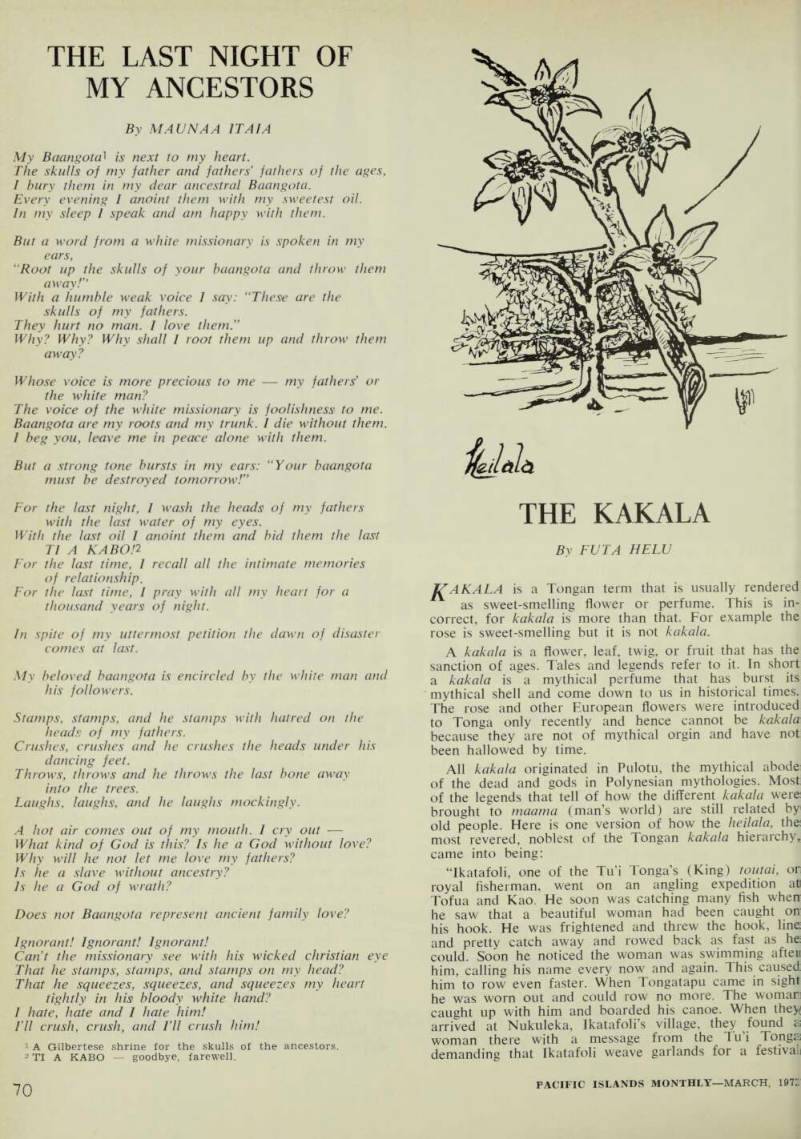
JSAKALA is a Tongan term that is usually rendered as sweet-smelling flower or perfume. This is in correct, for kakala is more than that. For example the rose is sweet-smelling but it is not kakala.
A kakala is a flower, leaf, twig, or fruit that has the sanction of ages. Tales and legends refer to it. In short a kakala is a mythical perfume that has burst its mythical shell and come down to us in historical times.
The rose and other European flowers were introduced to Tonga only recently and hence cannot be kakalai because they are not of mythical orgin and have not: been hallowed by time.
All kakala originated in Pulotu, the mythical abode: of the dead and gods in Polynesian mythologies. Most of the legends that tell of how the different kakala were; brought to maama (man’s world) are still related by' old people. Here is one version of how the heilala, the; most revered, noblest of the Tongan kakala hierarchy, came into being: “Ikatafoli, one of the Tu’i Tonga’s (King) toutai, on royal fisherman, went on an angling expedition att Tofua and Kao. He soon was catching many fish when he saw that a beautiful woman had been caught on his hook. He was frightened and threw the hook, line and pretty catch away and rowed back as fast as he could. Soon he noticed the woman was swimming aften him, calling his name every now and again. This caused him to row even faster. When Tongatapu came in sight he was worn out and could row no more. The woman caught up with him and boarded his canoe. When arrived at Nukuleka, Ikatafoli’s village, they found a woman there with a message from the Tui Tongs demanding that Ikatafoli weave garlands for a festival]
to be held the next day. On hearing the message the sea-goddess—for that’s what the woman was—told Ikatafoli she must leave and would return the next morning.
This she did, and early next morning before dawn Ikatafoli saw someone swimming down through the bay waving above her head a heilala branch in full bloom. It was his friend returning from Pulotu and that was the introduction of the heilala to maama. They then set out together to Lapaha where the King was living but as they went the woman strung together a beautiful garland from the heilala flowers. The King was enthralled by the appearance and fragrance of the garland and to this day, that garland, in disc-shape, is called the tui-tu'u (to string while walking).
So kakala does not mean merely sweet-smelling flower or fruit but one that has behind it the sanction of mythical existence and Pulotu, the Polynesian Olympus.