canoe' paddling
pp. 25-29 · Read in the full issue

Where 'state canoe' paddling is an art to be learned
From a special correspondent in Tarawa
The Gilbert & Ellice Islands Legi slative Council was two years old at the close of 1972. Several of its members served in the former House of Representatives. One or two con tinued from the Resident Commis sioner’s appointed Advisory Council.
Some of those with portfolios in the existing Executive Council also served in the former policy-making Governing Council. The Chief Elected Member under the old set-up, Reuben Uatioa, is also holding the current top political post of Leader of Gov ernment Business.
Apart from appointed officials and a few elected participants, members are still muddled about their role as legislators and policy-makers; they are still moaning about the content of fat documents such as the Budget or the Development Plan; they are still raising matters of little or no significance despite hints from vari ous sources regarding the controversial issue to concentrate on; they are still uttering conflicting views on issues.
Some did make an attempt to learn, for good or for bad; others thought they were worth SIOO a month to shut up.
The language barrier is undoubtedly the main obstacle to understanding, and if one adds the imposition of new ideas such as the art of demo cratic government, the art and power of legislating and formulating policies under an approved constitution, the techniques of commerce, trade and industry, one would really hate to blame the members for being so confused. None of them grew up in a country where those complex arts are practised as aspects of everyday life.
A few more informed citizens have reason to be disturbed about this lack of awareness. 111-equipped legi slators and policy-makers often con
fuse national objectives and threaten the advance of orderly, constitutional government. GEIC is in the process of advancing constitutionally with in ternal self-government or complete in dependence as the goal. The motion at the last meeting by the Leader of Government Business that a Select Committee be appointed to see if any changes should be made to the exis ting set-up was passed unanimously.
It’s almost common knowledge that a “ministerial” system will be the next step. With more and more power going to the politicians, there is a slight feeling of uncertainty that the few reliable ones will in time, be outvoted on really crucial issues by the democratic majority rule—to the country’s detriment.
But constitutional change must come. The Gilbertese and Ellice peo ple themselves are the best qualified to determine and guide their own destiny. That does not mean that the GEIC has all the technical, profes sional and managerial expertise it requires. For a long time it will need foreign experts in those fields, but those experts should confine them selves to work specifically assigned to them and advise the administration on matters that come within their line of work. Whitehall (or is it Miss Emery’s department in the FGO?) should interfere as little as possible.
The “colonial boys” at Tarawa should take a back seat and make room for Islanders to paddle their own canoe.
But paddling will not be easy. The territory, having been brought this far by a series of past colonial governments who, in many cases, knew very little about the Islanders and their way of life, has a host of unique problems.
Very rapidly this territory—with very limited resources —is increasing its dependence on foreign money,
foreign skills, foreign ideas and foreign goods, all produced and priced according to factors outside its con trol. One wonders if many people realise the extent to which it has gone, and will continue to go, in this direction. It goes further than acquiring a taste for corned beef.
It is all the more terrifying to see that practically no effort is being made on the part of those in authority (in cluding locals) to curb this demand.
The territory does not really need half of what it gets from overseas.
It is dependent on overseas em ployment for a very large part of the cash income. About 45,000 peo ple, three quarters of the population, have a standard of living which could not be maintained if it could not place its men at Ocean Island, Nauru and in the merchant marine of other countries. The decisions which affect their employment—even whether they should continue to be employed—are not made by their own government. (Ocean Island poses a most peculiar case since it is part of the territory and yet the whole phosphate show is run completely by foreigners). The decisions are made by employers who have many other things on their minds besides GEIC’s rural economy and by employees’ organisations who may actually not want Gilbertese and Ellice people doing those jobs at all.
The civil service is steadily in creasing its proportion of foreign workers. Over the last 10 years the number of foreigners, all in key posi tions, has risen twice as fast as the total size of the civil service. The indications are that this trend will continue, since the demands (ap parently) being made by the people (apparently) require more foreign ex pertise, more expensive houses, offices, clerical staff etc, etc, with enormously distorting effects on the people’s own
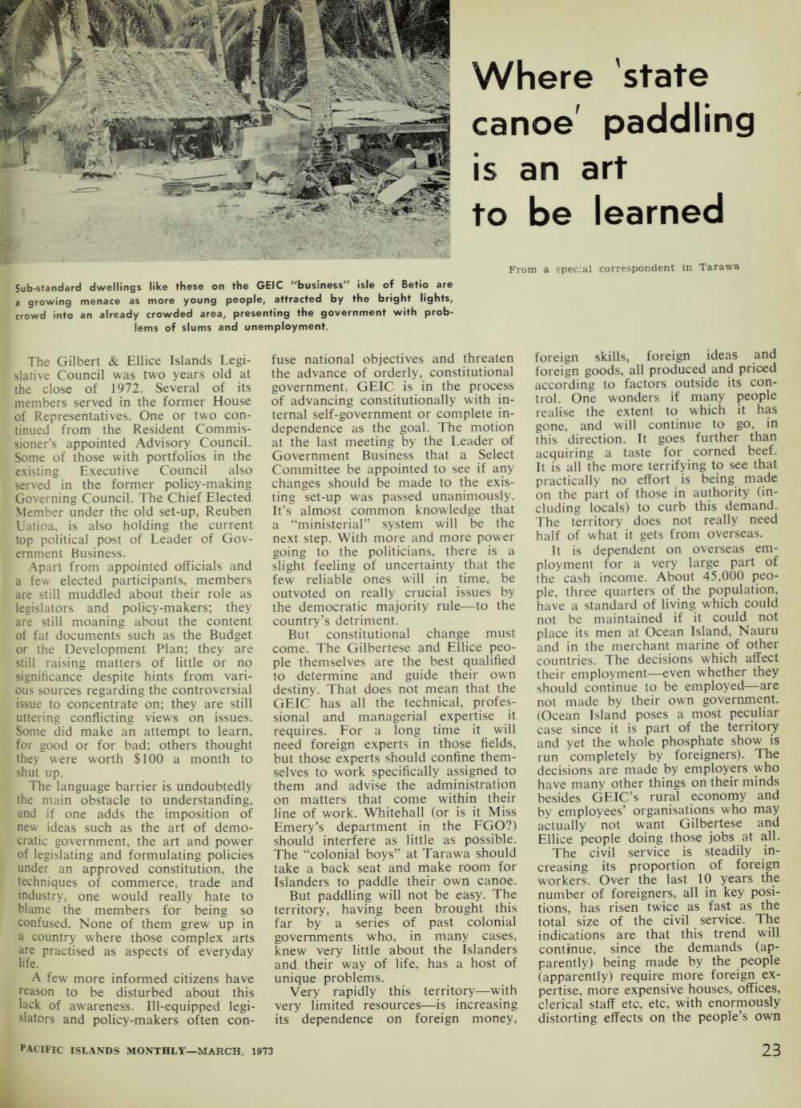
Sub-standard dwellings like these on the GEIC "business" isle of Betio are a growing menace as more young people, attracted by the bright lights, crowd into an already crowded area, presenting the government with prob lems of slums and unemployment.
ideas of what is a “good” or “happy kind of life to aim for.
As well as foreign employees and foreign expertise, the territory is be coming permanently dependent on foreign money being injected into the economy. The way the economy is moving, in about 10 years the territory will be depending on large amounts of British (or someone else’s) aid just to keep it going. The levels of services and standard of living ap parently demanded by the people, are such that the large budget surplus we presently get from phosphate and put in the bank is already in danger, and probably cannot be saved over the next five years until phosphate is finished. Even the potential earnings from economic activities in fisheries and others are already endangered.
Just to pay wages and try to keep things running is already costing well over $5 million a year.
The population, standards and costs are rising at the same time as the country’s prospective income is shrinking. The level at which things are now running is such that it is very unlikely that the territory can avoid a heavy dependence on foreign aid for the recurrent budget by about 1980. With that kind of foreign aid goes a particularly high degree of foreign influence and participation by foreigners in decision-making. People want to be free of interference in their domestic affairs, and this applies to nations as much as to families.
Experience shown in all other deve loping countries is clear: the aid-giver always tries to make sure that the aid receiver spends the aid in the way the giver thinks it should be spent, so that the giver’s objectives are reached faster than those of the re ceiver.
Yet, to many politicians aid is looked upon as a haven, and it is feared that there are fatal misconceptions arising from the availability of aid, the two main ones being: • That capital aid is a one-off expenditure and when you’ve spent it, that’s it; • That foreign aid is free, or perhaps more clearly, that it does not cost anything.
Infrastructure alone takes up 57.8 per cent of the capital allocation for 1973 and indications are that it will continue at that level throughout the plan period. The heavy investment in infrastructure is almost all in South Tarawa. Very little income is expected to be gener ated from these projects, but the annual recurrent costs resulting from the existence of infrastructure alone would certainly outweigh any expected income from productive projects. This is simple economic reasoning. Re-
current costs of capital projects don’t qualify for aid funds. They will have to come out of the Gilbert and Ellice taxpayer’s pocket. That money will be channelled to Britain every year to pay for materials, spare parts, machinery, etc to maintain roads,
public utilities, transport, airfields, houses, offices, stores, etc, so that, in the long run, it will be British in dustry which stands to gain. (The aid rule is buy British).
So far in this country, despite official warning about the con sequences of capital aid and grant-in aid, the rest of the people, including many politicians, have not faced up to the problem. A picture is seen at present of steadily increasing de pendence on overseas goods and ser vices; a steady upward trend in the use of highly-paid foreign personnel for key technical, executive or un comfortable jobs; and an unquest ioning acceptance that foreign aid is a marvellous thing.
There is surely a case for a reap praisal, since the net effect is that the territory is losing control of its own destiny; just at the time when it is supposed to be having control handed over to it. It will mean that the Gilbertese and Ellice Islanders will in the end place their hands on the levers and knobs in the control room of the great Ship of State, but the actual steering of it will have to be done by aid-donors from many miles away.
About some 100 years ago in
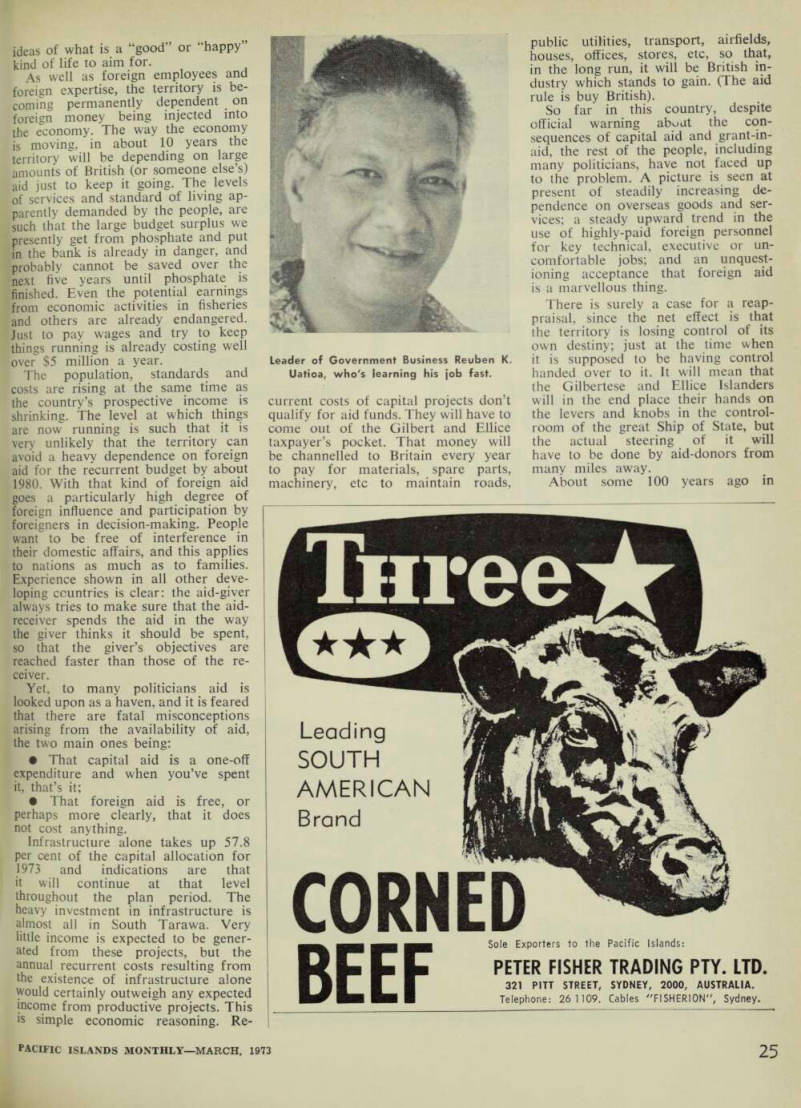
Leader of Government Business Reuben K.
Uatioa, who's learning his job fast.
Abemama, Tem Baiteke woke up to the fact that this was happening to his kingdom, which had been invaded by beachcombers (an early form of technical assistance personnel!!); he suddenly realised that control of key sectors of the economy was slipping from his grasp. He had the lot exe cuted on Abemama, Kuria and Ara nuka, and got things back under con trol. Oddly enough, nothing nasty happened to him as a result of this.
Foreign aid was not cut off and diplomatic pressure was not exerted.
Tem Baiteke’s solution is not ad vocated, but one sympathises with his reaction to foreign takeover of the key functions in the society.
The budget clearly showed how wealth is being distributed in this small territory. It is being sliced up vertically into a geographical distribu tion between South Tarawa, Ocean Island, and the rest; and horizontally between foreigners, local people in town, and the rest. In the vertical slicing, the 12,000 or so people who live in South Tarawa collect some thing like three-quarters of the $4.5 million paid out in cash incomes.
The government and the Develop ment Authority between them pay out $3 million a year in South Tarawa in wages and salaries, 15 times as much as they pay in rural areas. Eighty per cent of all govern ment staff and 93 per cent of all senior staff, work in South Tarawa; GEIDA has 1,500 employees in Tar awa and 50 outside it.
The three big co-operatives in South Tarawa account for half the country’s $2.5 million co-operative trading turn over each year. And of that, $600,000 goes through Nano Lelei of Betio alone.
The influx of people from rural islands to South Tarawa is getting worse and worse, but who can blame them for that? Tarawa has a better cash income, better educational op portunity and facilities, brighter lights, etc. The existence of 600 unemployed already in Tarawa does not deter more people from coming. The un employed will in turn become para sites and all sorts of violence will result.
If we leave out the Ocean Island workers, whose jobs will be ending in the next five years (and who live in another world as far as social or ganisation goes) and leave out our workers overseas whose remittances are actually keeping the rural com munities going, we are left with the civil service and GEIDA employees dominating everyone else.
In the civil service, about 470 peo ple, or 60 per cent of the total, are on salary scales with a mid-point of less that $750 a year. Thus the bottom
section of the service receives 33 per cent of the total salaries. At the other end of the scale, the top 20 per cent of the civil service, receive nearly half of the total salary payments. The 60 people on the ‘A’ scale (mainly expatriates) divide $152,000 between them (15 per cent of the total), and the 24 people on superscales share $122,00 or 12i per cent of the total.
None of this is extreme by world standards, but it does not reflect any basically Gilbertese or Ellice view (of society and how wealth should be distributed. The point to be made, though, is that the key decisions, including decisions on how much civil servants are to be paid,
are made in effect by a small group of already wealthy civil servants, listening to other civil servants and naturally having a very highly-deve loped understanding of the financial and other needs of civil servants, The civil service is due for salary review early in 1973, and accordingly provision was made in the estimates, This will result in a further widening of the rural/urban cash imbalance.
Yet no member from the rural areas raised a finger in protest, At the earlier meeting of the Legi slature, a supplementary provision for more than $300,000 went through with virtually no comment. The ad ditional amount was required to pay shipping subsidies to GEIDA, some